Legislator, animal advocate, son of Holocaust survivors Hy Kloc dies at 75
His mother survived World War II by working in mines in Siberia. His father was in the Polish underground.
Born in a displaced persons camp in Germany in 1947, Hy Kloc emigrated to Brooklyn with his parents, Polish Jews who survived the Holocaust, in 1950. In 2000, Kloc moved to Boise, where he worked at Boise State Public Radio and later served in the Idaho Legislature.
He died on Tuesday of a heart attack at St. Alphonsus Medical Center, according to the Idaho Democratic Legislative Campaign Committee. He was 75.
“He will leave a long, lasting legacy in this community of a lot of things that he did,” John Hess, the former general manager of Boise State Public Radio, told the Idaho Statesman. “He certainly dedicated a good portion of his life to Boise and helping this become a better place.”
After taking a job at Boise State Public Radio, Kloc eventually became the station’s development director. In 2010, he chaired the Boise Census Committee, which assisted the federal government in conducting the census.
A Democrat, he was elected to the Idaho House of Representatives in 2012 to represent West Boise and Garden City, according to a news release from the state Democratic campaign committee. He retired from the Legislature in 2018, having been diagnosed with cancer.
When he died, Kloc was a director on the Greater Boise Auditorium District board, having been elected in 2011 and again in 2017.
“Hy was a steadfast champion of early childhood education, introducing bipartisan legislation seeking to end Idaho’s status as one of the few states lacking public pre-k,” the Democratic release said. “As the son of Holocaust survivors, he was an unfailing advocate for refugees and the most vulnerable members of society, sponsoring Add the Words legislation every year and vigorously opposing all legislation he saw as discriminatory.”
Add the Words is an Idaho organization that pushes every year to add discrimination protections for gay and transgender people to Idaho’s Human Rights Act.
Known for his love of dogs, Kloc spearheaded the effort to create Idaho’s ‘Pet Friendly’ license plate, which includes a drawing of a dog and a cat and has raised over $100,000 for the Idaho Humane Society, according to the Democratic release. The funds help provide “veterinary services for low-income Idaho residents and spay and neuter services,” the release said.
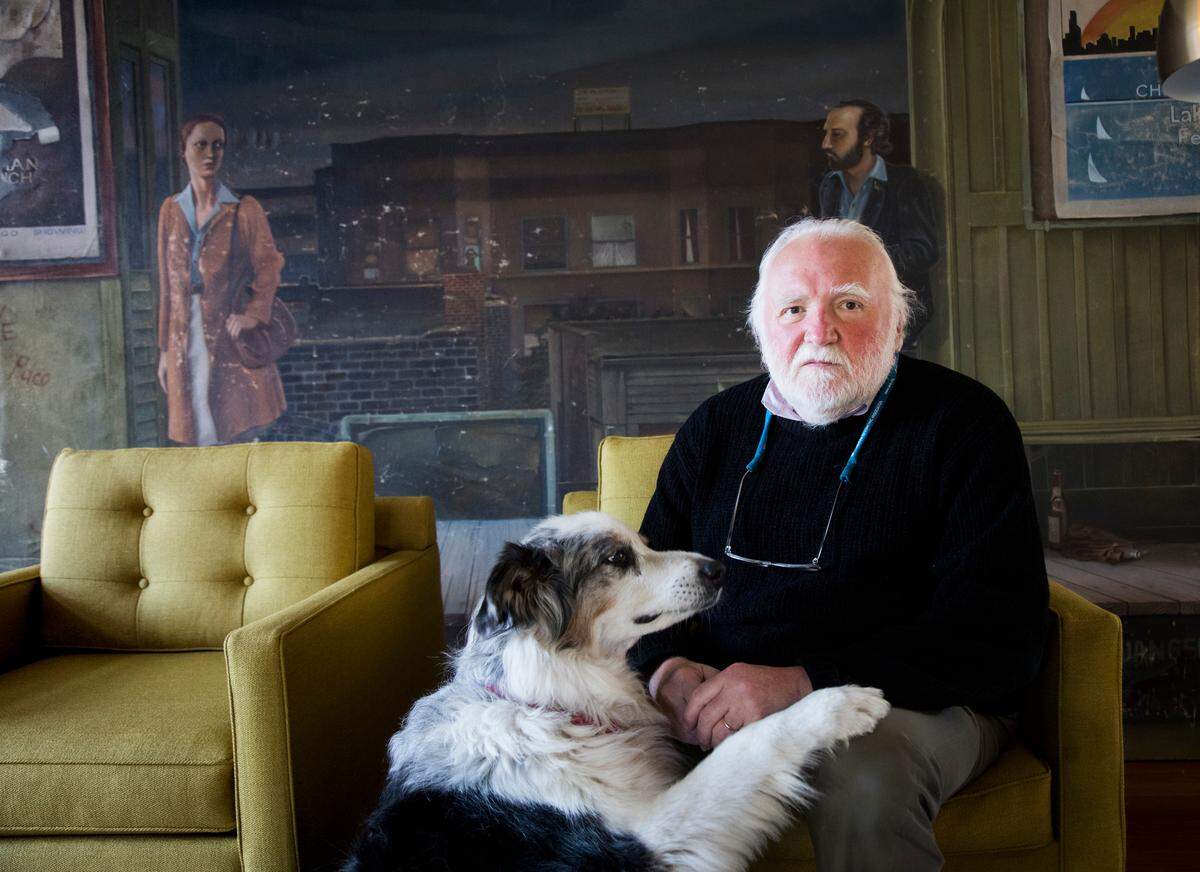
‘You have a duty to help your fellow man’
Most of Kloc’s extended family — his parents’ siblings — were killed in the Holocaust. His mother, Libby Kloc, escaped Poland for Russia during the war, ending up at mines in Siberia.
His father, Sam Kloc, served in the Polish underground, which resisted the Nazi occupation of Poland.
After the war, Sam Kloc traveled to Siberia to find Libby, and the couple walked across Russia and Eastern Europe before arriving in Essen, Germany, Kloc told Idaho Public Television in an interview earlier this year.
“I don’t know how he did it, but he found her,” Kloc said.
After the war, Allied forces created displaced persons camps for Holocaust survivors and refugees who could not be repatriated. Kloc was born at one such camp in Essen, in 1947.
Three years later, his family emigrated to Brooklyn.
One of his earliest memories was of seasick passengers on the voyage across the Atlantic, and the shouts of “America, America” he heard when the refugees spotted the Statue of Liberty in the New York Harbor, according to a 2018 Statesman profile of Kloc.
Sam Kloc got a job in New York at a paintbrush factory, but became a baker after losing the tips of three fingers on the job.
Growing up, Kloc lived in Jewish neighborhoods, and played cards with friends whose arms revealed tattoos — marks given to prisoners at Auschwitz, a Nazi concentration camp — when they dealt out hands.

Kloc had an older sister who died during the war. His mother never spoke of how she died, and he never learned her name, Kloc previously told the Statesman. He also had a younger sister, Bonnie.
In New York, his parents volunteered with a Jewish organization that helped resettle refugees in the U.S.
He previously told the Statesman that the U.S. should learn from its past failures with refugees. In 1939, the nation turned away the M.S. St. Louis, a ship with over 900 German Jews hoping to escape the Nazis.
“We are supposed to be the standard-bearers for good things,” he told the Statesman. “The refugee issue in this country right now, it’s hard to imagine people not wanting to help. … I would hate to think we have gotten so callous that we would turn the needy away.”
He added, “You have a duty to help your fellow man, by not turning away, by giving them a helping hand to raise themselves by their own bootstraps.”

Kloc attended New York City Community College and Western Michigan University, according to the Democratic caucus release. In 1983, he married Joan Wallace.
He worked for public radio in Detroit before getting a job at Boise State Public Radio.
Before he died, Kloc emphasized the importance of history, noting that his was the last generation directly linked to the Holocaust.
According to the Anti-Defamation League, 2021 had the most antisemitic incidents in the U.S. on record. Former President Donald Trump had dinner with a Holocaust denier in November, along with Ye, the musician formerly known as Kanye West who has made a number of antisemitic remarks in recent months and has praised Adolf Hitler, the Nazi leader.
In March, Idaho Lt. Gov. Janice McGeachin gave a recorded speech at a political rally organized by the same Holocaust denier Trump dined with, Nick Fuentes. In a statement that followed backlash against her participation, she said she did not support “identity politics.”
“The more I see going on today, the more dire I think the situation is,” Kloc told Idaho Public Television. “You can’t just turn your head away and say, ‘Oh that’s nothing.’ You have a duty to help.”
This story was originally published December 8, 2022 at 3:03 PM.