These Boise urban farmers fought developers and won. 23,000 drivers a day feel the result
For over 20 years, developers wanted to establish what would become West Boise’s main shopping area, near the Connector and where the Boise Towne Square mall now sits. But there was a hitch.
Multiple developers came and went, unable to overcome a substantial obstacle: the Otts.
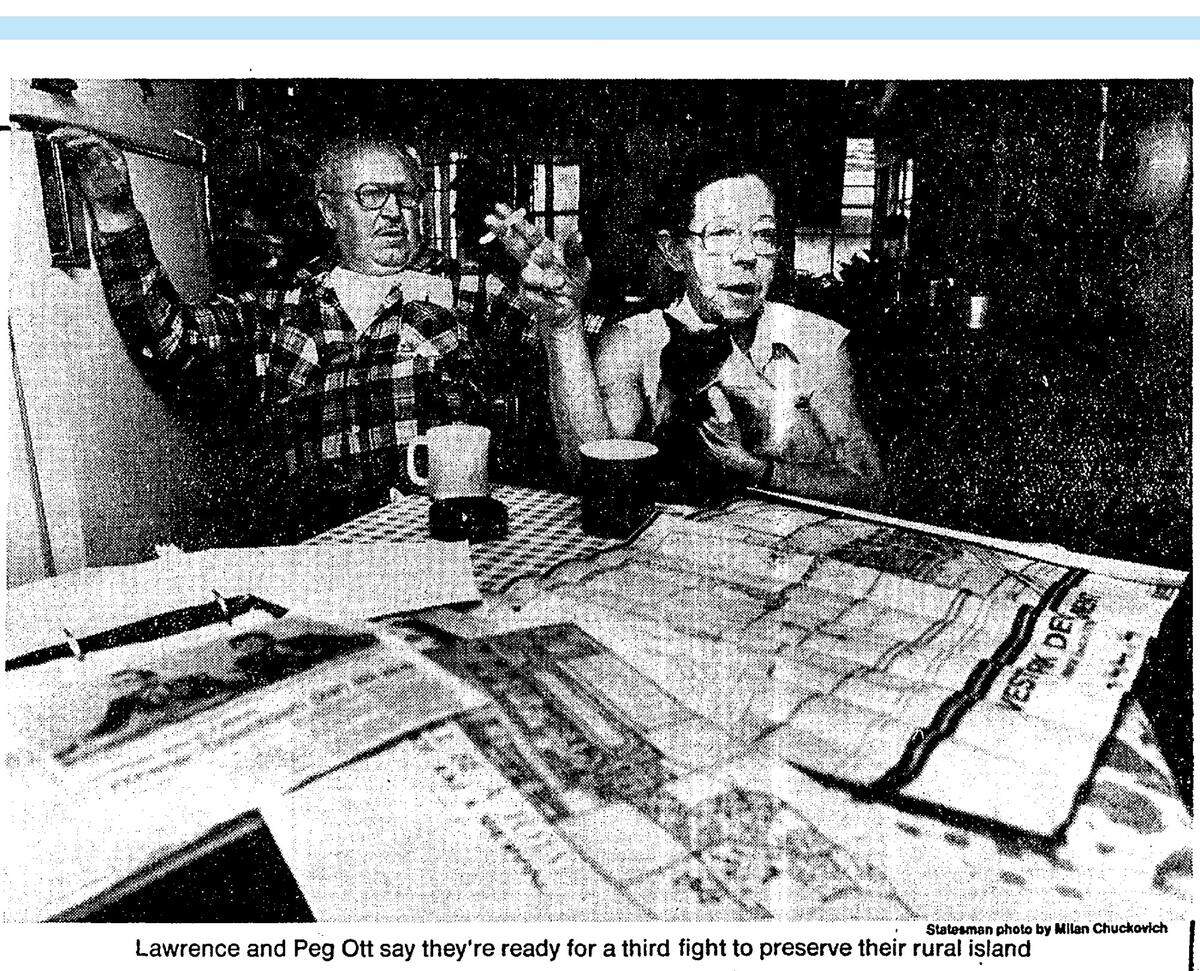
The owners of a 10-acre farm in West Boise with a farmhouse built in 1908, the couple wanted no part in the suburbanization of their hometown.
They had prime real estate, right where a mega-mall and shopping center could go — should go.
But the Otts weren’t budging.
Their obstinacy, their refusal to condone urbanization, caused a wrinkle in the streetscape of West Boise that drivers still experience today.
‘More wildlife sanctuary than farm’
In the 1970s, two mall developers wanted a piece of the area of land just north of the I-184 Connector, including Harry Daum, who had built the Karcher Mall in Nampa.
The Otts’ property, at 501 N. Ash Park Lane, was right smack in the middle of where a shopping mecca might be, and their refusal dashed at least two planned developments, according to Idaho Statesman reporting at the time.
Having moved from Big Pine, California, to Boise in 1960, the Otts had built a rural life miles from the big city — Boise — and settled down to grow hay and raise animals.
All sorts of animals.
Sheep. Turkeys. Peacocks. Five cats. A dog. Horses. A cow and calf. Geese. Chickens. Roosters. Rabbits. Ducks. Pheasants. Quail. Chukars. Hungarian partridges. Guinea hens.
“The Otts’ land is more wildlife sanctuary than farm,” said one Statesman article.
Peg Ott said she had a soft spot for animals, and could not turn away strays.
Two 100-year-old willows grew on their land, and their farmhouse had a dirt floor.
The Otts grew much of their own food in a garden, tended fruit trees and had a well and septic tank.
“I suppose we could get a sweet price for it,” Larry Ott told a Statesman reporter. “But we haven’t found a way to take it with us.”
One of the developers, Daum, offered them 10 times what other nearby landowners had been offered, Peg Ott told the Statesman in the 1980s.
She said she did not harbor ill will toward the developers, and said the difference between them and her was simple: “Their priorities are different. They’re in it for the money. I’m in it for the refuge and the birds and bees.”
A curve in the road
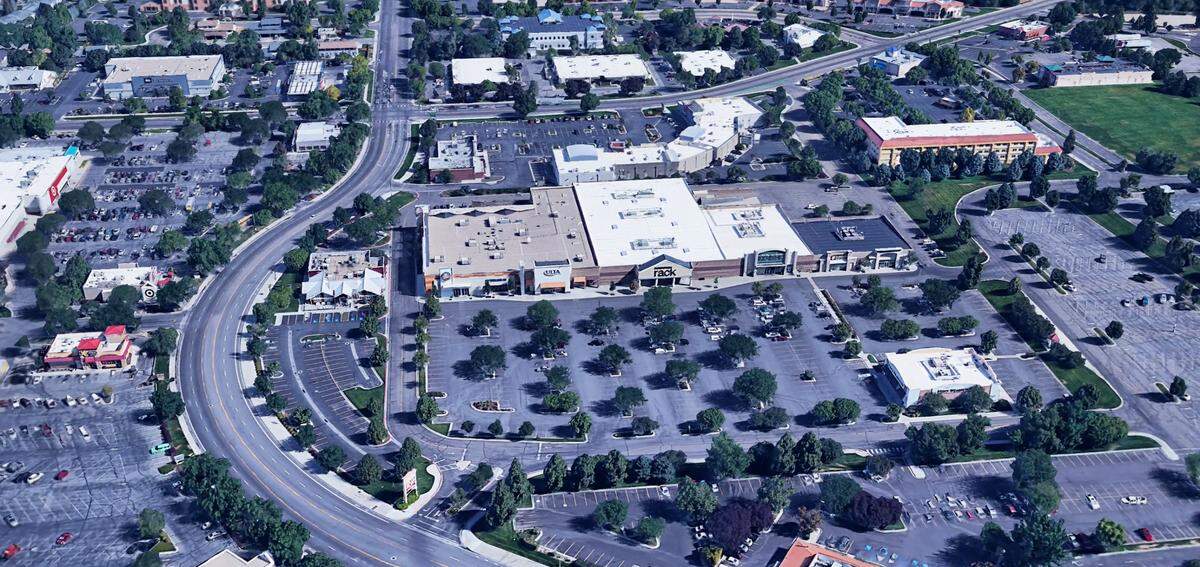
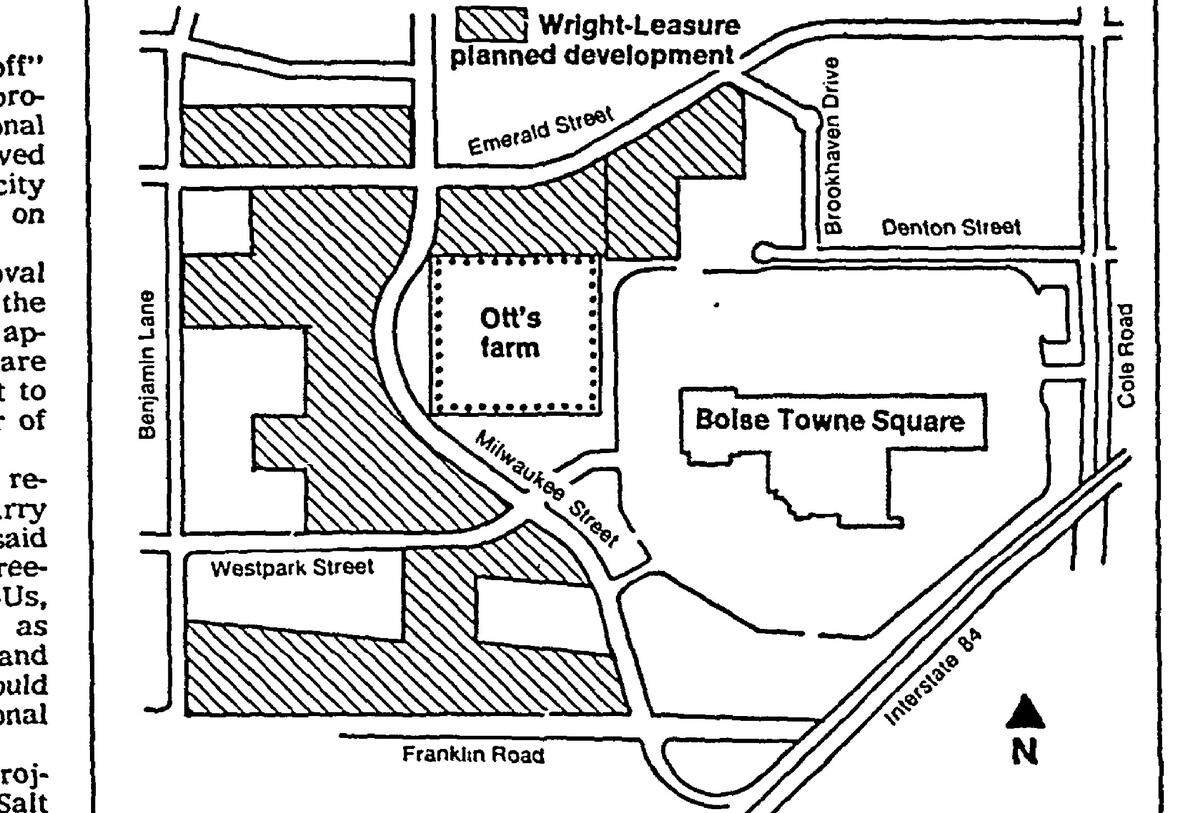
The Otts’ resistance meant that growth had to be built around them. That resulted in peculiarities that are still present today.
“This whole area was master-planned really in unison,” Jeff Huber, a broker with White-Leasure Development Co. who was involved in the development of the area, told the Boise City Council on Aug. 30. “Everyone thought that this road was gonna go straight through here. Everyone except Mrs. Ott and her farm.”
Huber was at the council meeting to appeal a decision by the Planning and Zoning Commission not to allow the Westpark Shopping Center, which is across the street from the mall, to expand an existing monument sign for its businesses.
Huber said one reason better signage was needed is because Milwaukee Street is curved between Franklin Road and Emerald Street, requiring drivers to focus on the road and preventing them from glancing for long at passing stores.
That curve is because of the Otts.
The wide grid of Boise’s main arterials, predictable in their regularity, made a concession to the Otts, and bent.
The segment of road that passes the former farm now sees a daily average of 23,163 vehicles, according to the Community Planning Association of Southwest Idaho.
An island in a sea of shops
In 1982, a new broker and a Salt Lake City developer forged ahead with another planned mall. And again, the Otts dug in their heels.
The previous decade, the Otts had assented to letting a local developer apply to have the area around them annexed by Boise and zoned for commercial buildings. But the condition, their attorney told the Statesman, was that the property would become a “community shopping center and office buildings” rather than a regional mall.
The developer, Larry Leasure, disagreed. He wanted to put in a large mall. He said the agreement the parties had signed had never limited what kind of mall he could design. A judge eventually agreed, and the mall was built.
But the Otts stayed, resulting in the “state’s largest shopping-center berm” to block out the sights and sounds of the mall, according to an article in the Statesman.
“A stone’s throw from one of the largest shopping centers in the Northwest ... the only sounds are the cooing of doves and the ticking of an antique clock,” the article said.
“We ignore it,” Peg Ott said. “I just don’t pay any attention to it.”
“There are people who think the only green that matters is the green of a dollar,” she said. “We don’t agree.”
A few years later, in 1987, more developers wanted more shopping on the land to the west of the mall, which required further annexation of Ada County lands. The Otts stayed, the stores were built, and another 10-foot berm was put in to shield the island of farm.
‘This was strictly rural’
When the Otts moved to Boise in 1960, there was no interstate. Their property was surrounded by dairy farms. The intersection of Cole Road and Fairview Avenue had two gas stations and an Albertson’s. The city limits were far to the east.
“This was strictly rural and changed through no fault of ours,” said Peg Ott in 1982. “I’m still in a rural district. I don’t know about everyone else.”
‘This is the only place for them’
By 1996, both Larry and Peg Ott had died. After their deaths, the land was sold, and what had been their farm is now where Old Navy and Dave and Buster’s are, Huber said.
Huber told the Statesman that he used to visit the Otts, who would invite him in for “cowboy coffee.”
The coffee was good — real good. The secret? Cans of condensed milk added to it, he said.
There were blue jays inside the house, a wood heater stove, and Peg was missing parts of her forefinger and thumb from a wood-chopping accident.
“I’d try everything possible to try to get her to sell her property,” Huber said, noting that she was offered millions of dollars. “We’ve all heard the term money talks, but apparently not to Mrs. Ott.”
In 1989, after the mall had opened, Peg Ott told a Statesman reporter that she’d only been to the million-square-foot shopping mall once, when a loose dog had chased the birds on her farm and she had taken it to the mall to return it.
“We know (the mall) is there, of course, but our place is about the same as it’s always been,” she said. “There aren’t as many quail and pheasants as there used to be, because there isn’t as much cover, but we have more of some critters. We’re up to about 45 ducks now. They come to us because this is the only place for them.”
The City Council unanimously overturned the Planning and Zoning Commission’s decision, allowing Huber and the shopping center to add the names of more businesses to their sign.
So next time you drive along that curve and look at those signs, or the next time you dine at Dave and Busters, think of the quail, the pheasants and the ducks that once were here. Think of Peg Ott.