Are you ticked about the Boise area’s growth? New survey results say you’re not alone
The topic of growth is unavoidable in the Treasure Valley. Idaho is the fastest-growing state, and cities like Nampa and Meridian are among the fastest-growing in the country. But most residents feel growth is happening too quickly.
In Boise State University’s most recent survey on growth, 82% of people in 2021 felt the Treasure Valley was growing too fast, a 5-percentage-point increase from the previous year. Thirteen percent said growth was happening at just the right speed, and only 2% thought growth was happening too slowly.
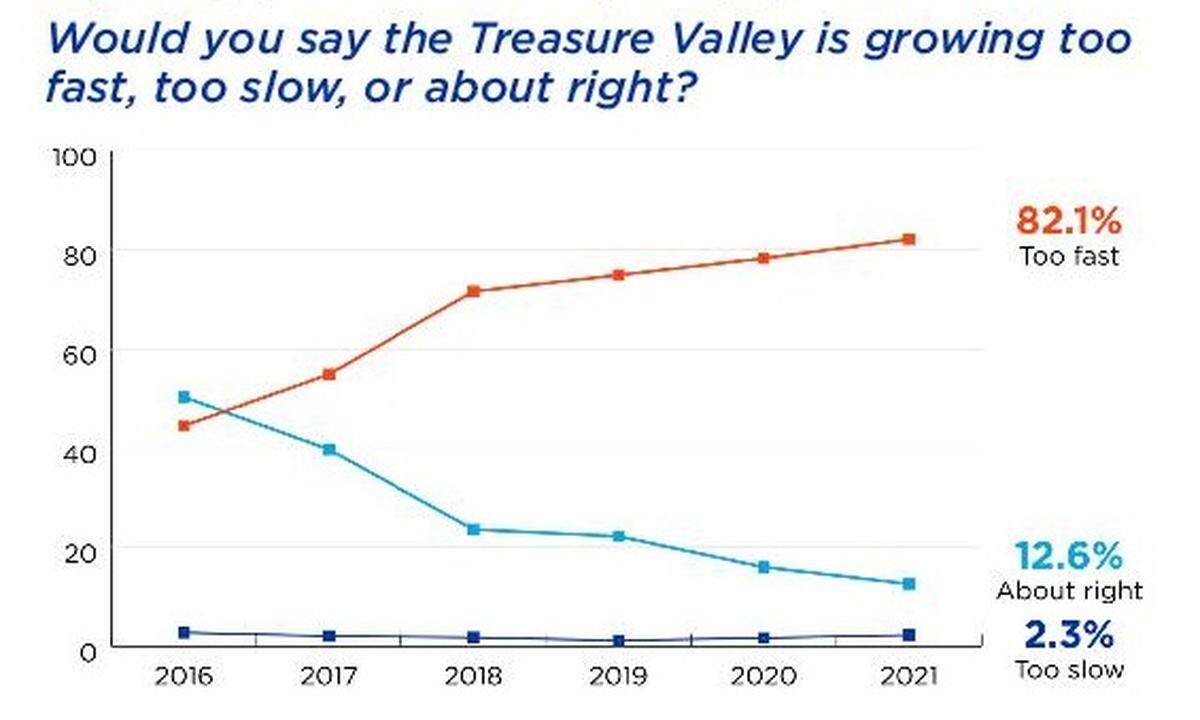
When Boise State began the annual survey in 2016, more people said growth was happening “about right” than “too fast.” But that changed in 2017, and the gap between the two has been widening ever since.
The survey was conducted Nov. 13-21, 2021, of 1,000 adults living in Idaho. The researchers evaluated the responses of 655 residents in and adjoining the Treasure Valley, which they said were demographically weighted to approximate 691 residents. Ada County residents made up 65.7% of the Treasure Valley respondents, Canyon made up 26.9%, Boise County 3.3%, Gem County 3.1% and Owyhee County 1.1%. They were asked additional questions specific to the Valley.
Housing a top growth concern
The survey didn’t dig into why people fell into the “too fast” faction. But Matthew May, survey research director for the School of Public Service, said concerns about housing were common. Homeowners worried about rising property taxes, and renters worried about the cost of housing.
While there was agreement on housing affordability becoming a more pressing issue, respondents were split on how to address this. When asked which type of building Idaho needs to meet the demand for more housing, 32.4% said new single and multifamily housing on undeveloped land. That was the most frequent response.
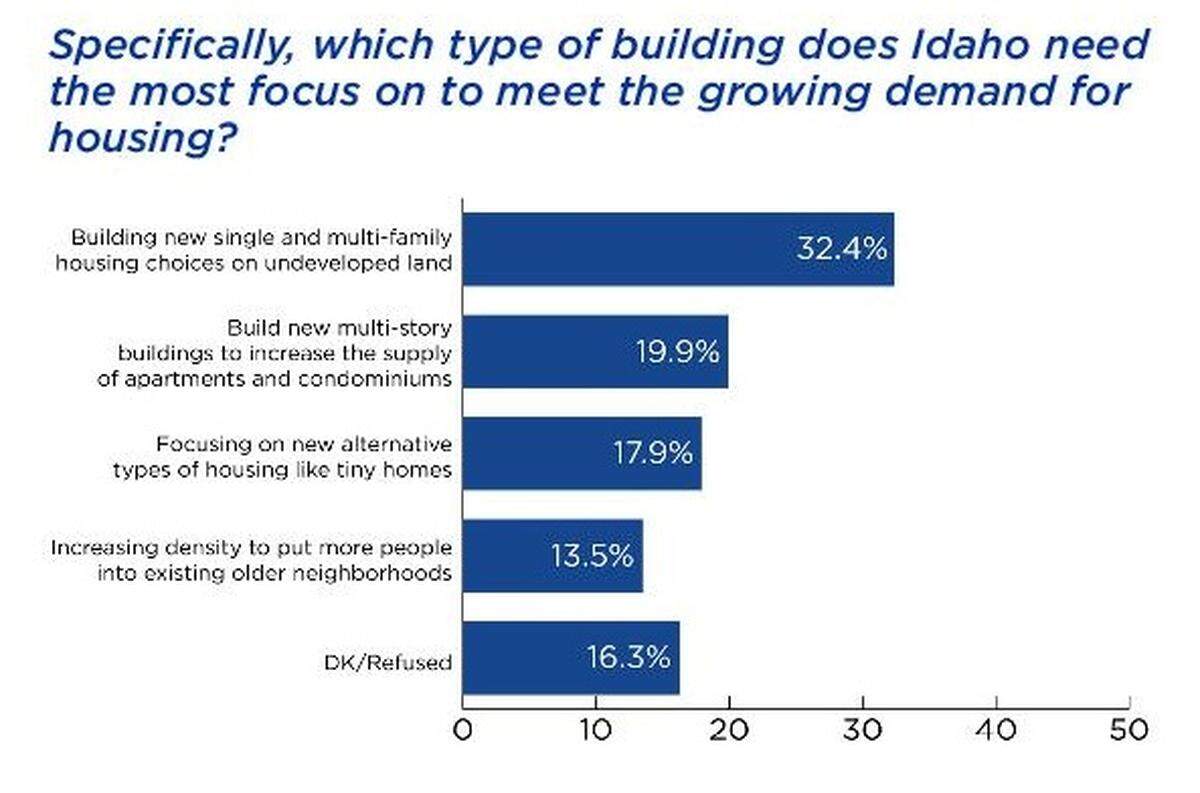
Building new multistory buildings with apartments and condominiums was favored by 19.9% of answers, new alternatives like tiny homes were favored by 17.9% and increasing density in existing neighborhoods was favored by 13.5%.
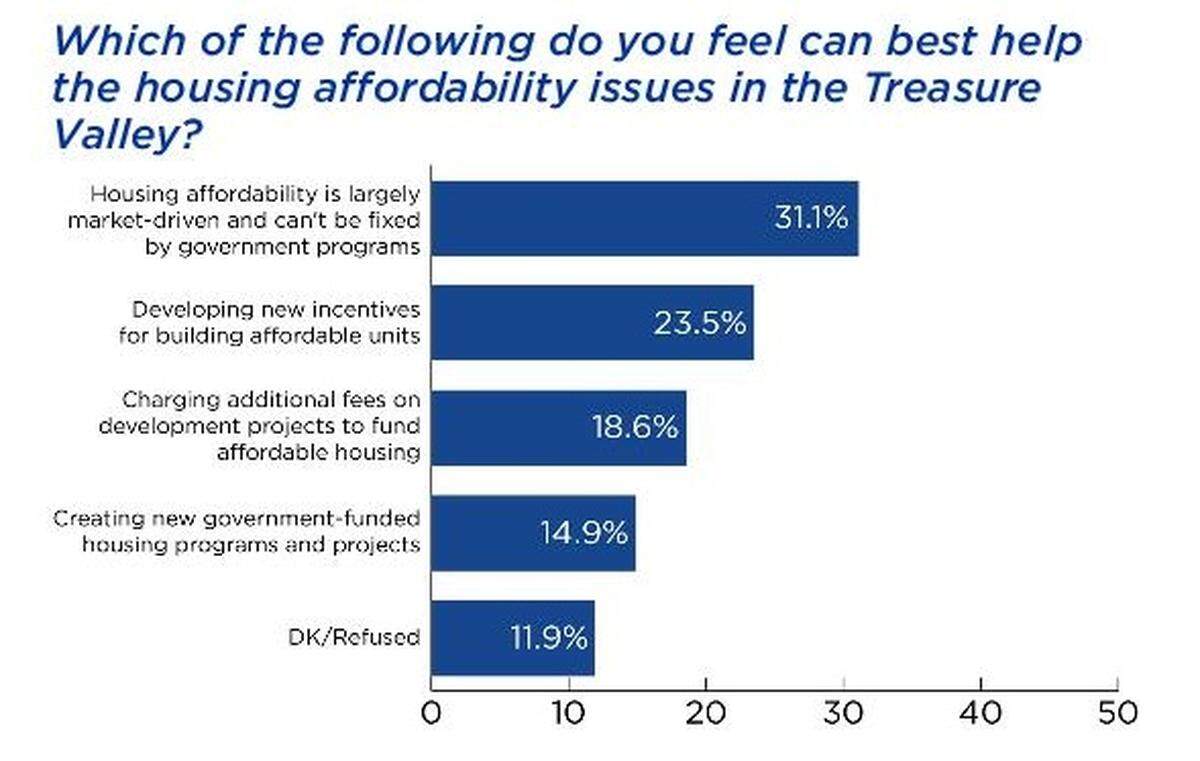
Asked what can best help housing affordability, 31% said affordability is largely market driven and the government can’t fix it. That was the most popular answer among four options.
“What I read into that is that people are open to having those conversations,” May said by phone, “but ultimately it’ll be dependent upon the vision for the community that they live in, the city they live in and where they think the valley should be going.”
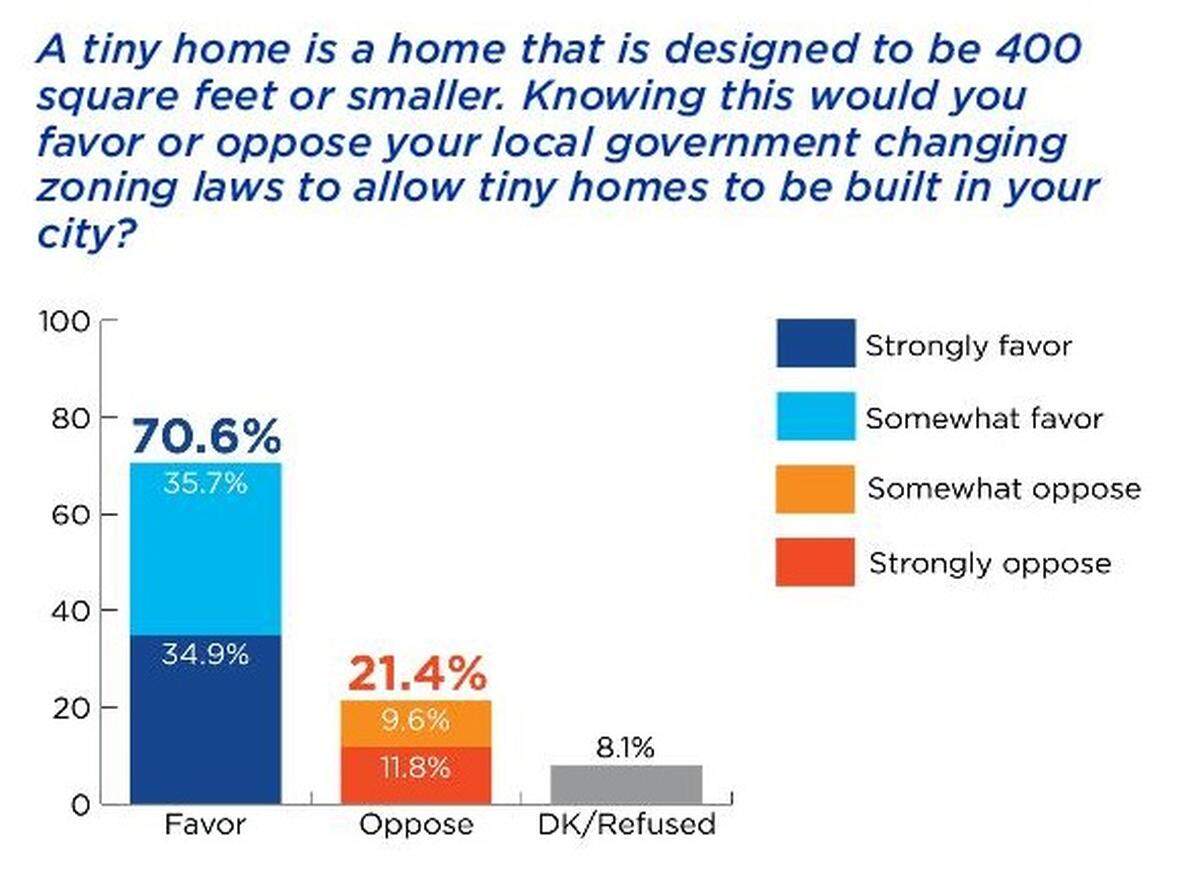
Seventy percent of survey respondents said they favor their local government changing zoning laws to allow tiny homes. Housing advocates view tiny homes as an example of how a variety of housing types can help address affordability.
Boise Mayor Lauren McLean told the Idaho Statesman that her priority is “housing, housing, housing.”
As Boise changes, she said she wants to protect the parts of Boise people love: the Boise River, the Foothills and affordability. The city’s zoning code rewrite and housing initiatives like the city’s land trust are policies intended to address the challenges of growth.
“Folks that work in Boise need to be able to afford a home in Boise,” McLean said by phone.
Nampa Mayor Debbie Kling told the Statesman that people in her city are “painfully aware” of the challenges caused by growth. When speaking with them, she hears most about traffic and safety. Kling believes “you can’t really stop growth,” because the government can’t control private landowners.
Kling thinks there’s a need for attainable housing for working-class people. That speaks to the variety of housing types, like apartments and town houses, that could help alleviate pressure people feel if they can’t afford a single-family home.
“There are not easy solutions to this,” Kling said by phone. “Unfortunately, Idaho is a desirable place. It’s unfortunate, because so many people are wanting to come here.”
Losing a sense of place
Caldwell Mayor Jarom Wagoner says he understands why people may dislike the idea of growth. Based on conversations with residents, he sees the sentiment as a reflection of how much people love the Idaho way of life.
“There’s the fear that we are going to lose what we love most about Idaho,” Wagoner said by phone. “... I think some people are worried about losing that wonderful sense of place, where you can go to the store and run into half a dozen people that you know.”
For years, the Treasure Valley has attracted people because of its quality of life. Boise in particular has received acclaim because of its bikeability and walkability.
McLean said Boiseans should be concerned about protecting their homes. To do that, she pointed to “community collaboration, good planning (and) often audacious goals.”
As the city grows, maintaining “people-centered neighborhoods” is key for McLean. She wants to create a variety of transportation options and keep the nearby outdoor opportunities intact.
“Boiseans value the place that we live, the people that make the city what she is,” McLean said, “and are willing to partner and come together to meet the needs of the moment.”
Who is responsible?
Yet whether residents want the state to do something about it was another story.
Just 26% of Treasure Valley residents said Idaho should address growth by stopping the recruitment of companies, even if it limits employment opportunities. The majority, 58%, think the state should continue to recruit companies with high-paying jobs, even if that means the population will continue to grow. Sixteen percent said they didn’t know or refused to answer.
Meridian Mayor Robert Simison sees the split among these answers as one of the central problems with growth.
You can’t have the positive opportunities that come with growth unless you also accept the challenges, he told the Statesman. When he ran for mayor, Simison said growth was the issue people most wanted to discuss. But when he tried to dig into what they didn’t like about growth, it was complicated.
“I would ask them questions: ‘Do you like the new commercial development?’ Well, of course they did,” Simison said by phone. “They like the new restaurants, the new places to go. There weren’t a lot of concerns about that type of growth.”
According to Simison, apprehension about growth stems from congested traffic and overcrowded schools. Simison said he responded by creating a staff position dedicated to tackling these two issues and working with the West Ada School District and the Idaho Transportation Department. New schools have also been opened in growing areas of Meridian.
“I think when the City Council is looking at growth through a different lens, with maybe a more keen eye on things like transportation and education, it allows them to consider what developments are appropriate,” Simison said.
Treasure Valley residents are less uniform when it comes to which level of government they see as best at responding to growth: 28% said cities, 21% said the state, 16% said counties and 7% said the national government. Republicans in the Treasure Valley said the state government was the best at handling growth, while local Democrats said city government.
According to the survey, 33% of those in Ada County see cities as best at responding to growth, compared with 22% in Canyon County.
Simison said when it comes to certain aspects of growth that people expect to see addressed, the city can do only so much. When it comes to schools, roads and tax laws, cities are often at the financial mercy of decisions made by state legislators.
“In the case of schools, I think that financial cost is supposed to be borne by the state Legislature, and they had a great opportunity to help address those expectations and those financial costs with the $1.9 billion surplus,” Simison said. “But it’s getting people into positions who care about our priorities, who then go and try to make those priorities a reality here in our communities.”
The four Treasure Valley mayors agree that coordination is increasingly important, especially as more development has turned independent cities into a regional conglomerate.
McLean said the Treasure Valley’s growth is “a truly a regional issue.”
As the growth has accelerated, local governments are hearing the cries from their constituents.
“We’re listening to our citizens and trying to make wise decisions,” Nampa’s Kling said. “It’s not a perfect world. And there aren’t any simple answers.”
This story was originally published July 10, 2022 at 4:00 AM.