Boise considers $100 million plan to make State Street a place where people want to live
Boise just took a key step toward sprucing up State Street, a busy commuter route that leaders hope will become a mecca for multifamily housing and transit.
Board members of the Capital City Development Corp., Boise’s urban renewal agency, approved plans for the creation of a State Street urban renewal district on Monday and directed the staff to submit it to the City Council for review. After years of discussions, the decision marks one of the first concrete steps toward the redevelopment of the historic roadway.
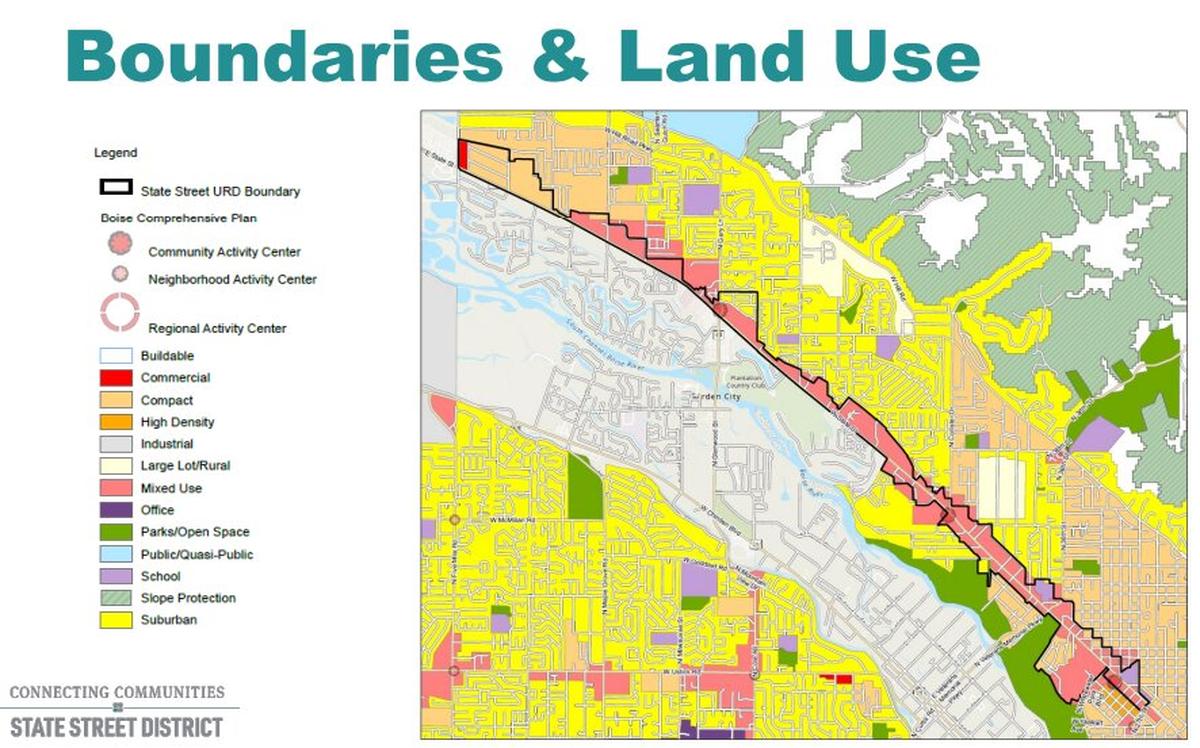
If the City Council designates it as an urban renewal district that would stretch down six miles of State Street starting downtown and ending at the border of Eagle, encompassing 668 property parcels across 577 acres.
Boise already has five such districts, which create improvement funds by freezing property taxes collected within the district. For 20 years, any new property tax revenue generated by new development or higher property values would go to funding public improvement within the district.
An economic feasibility study estimated that development fostered by the creation of this district would generate more than $103 million in additional property tax revenue between 2023 and 2042. Implementing the renewal plan would cost an estimated $122 million.
The creation of the district is intended to help implement a project to revitalize State Street. The broader State Street plan contains four key pieces: transit-oriented development, mixed-use development, public green spaces, and affordable and workforce housing.
“The alignment and focus on affordable housing and transportation is incredibly important,” Mayor Lauren McLean, who sits on the agency board, said at Monday’s meeting. “I appreciate all the outreach that was done and the feedback that was received and the attempt to do as much as possible to address those two very pressing needs within our community.”
Transit-oriented development
The roadway, which connects many areas to downtown, has struggled to deal with the increase in commuter traffic as the Treasure Valley’s population grows. The urban renewal agency wants to find way to reduce the number of cars traveling State Street.
The plan would add bus stations, bike lanes and pedestrian pathways. U.S. Rep. Mike Simpson has asked for $12 million in federal funding for improving the State Street bus system.
“With between 800 and 1,000 boardings a day, the State Street corridor is the highest ridership transit corridor in the Treasure Valley,” Simpson wrote in his request. “It provides important connections to businesses, government, offices, and educational institutions such as Boise High School and Boise State University. It also provides connections to everyday services, shopping and recreational activities for the 13,000 people living within 1/4 mile of the corridor.”
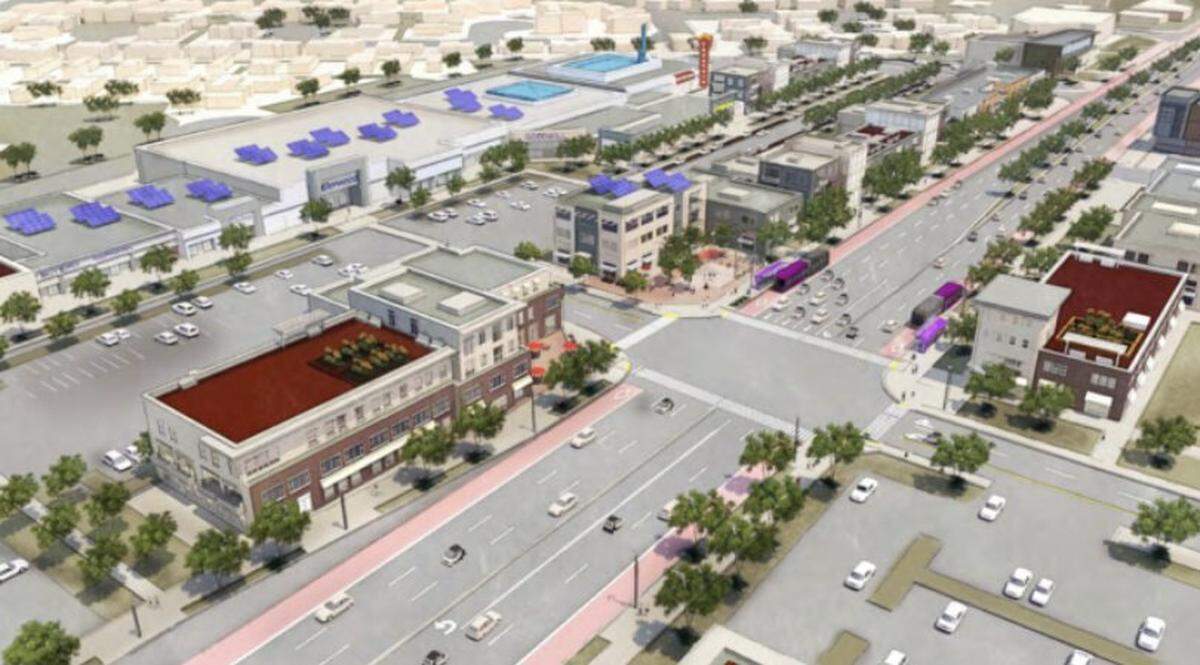
Planners have identified four intersections, or nodes, along the No. 9 bus route they where they want to focus redevelopment: Whitewater Park Boulevard, Collister Drive, Glenwood Street and Horseshoe Bend Road.
Each node would be designed as a dense, walkable neighborhood: More crosswalks and wider sidewalks. Two- to four-story buildings with ground-floor retail and apartments above. Parking lots located behind businesses rather than facing the road.
Bringing in business and housing
Through reimbursements on eligible public improvement expenses, the State Street plan would entice private developers to add both businesses and housing to the area. However, the community was not supportive of all types of mixed-use development.
“They wanted to see existing neighborhood-oriented businesses preserved,” Matt Edmond, CCDC’s parking and mobility director, said. “And there was an aversion to seeing big box (stores) or businesses that weren’t oriented to the neighborhood.”
To create the plan, the agency spent a year gathering community input. This included public surveys, open houses, community forums and neighborhood meetings. Urban renewal planners also spoke with other local agencies, including Garden City leaders, the Ada County Highway District, the Boise School District, Valley Regional Transit, Idaho State Historical Society and others.
Both the agency board members and community respondents stressed the need for more affordable housing in the area. Some board members were concerned that new development could push out current residents. The district includes 230 mobile homes across six mobile home parks.
Edmond said he doesn’t anticipate the redevelopment of the mobile home parks, but added that it’s possible developers will want to build on the properties because of their proximity to public transportation once new bus routes are added. While the agency can’t prevent the purchase of them, Edmond said project planners decided to keep those parks within the district to ensure the urban renewal agency maintained some level of control if they are developed.
“If it’s outside the district, at that point we really have no levers to use to try to incent(ivize) more affordable housing to deal with displacement,” Edmond said.
Place-making projects
Drive along State Street and the view out the window today is strip malls, fast food, car washes and parking lots. When an area becomes an urban renewal district, one of the goals is replace blight with features that will make people want to live and spend time there. The State Street plan would seek to do this by adding “place-making” projects such as festival streets, plazas, parks, art and green space. It would also work to preserve its historical elements.
Improving the attractiveness of the area could further attract housing and local businesses to State Street.
Next steps
The next steps in the process will be to submit the proposed urban renewal district to the City Council and hold public hearings. The Planning and Zoning Commission is scheduled to consider approving the plan on Monday, Sept. 13, and the City Council will hold a public hearing on Tuesday, Oct. 12. The Capital City Development Corp. hopes to submit it to the Idaho State Tax Commission by Dec. 31.
Sally Krutzig covers Treasure Valley growth and development. Have a story suggestion or a question? Email Krutzig at skrutzig@idahostatesman.com.
This story was originally published August 10, 2021 at 1:46 PM.