This Garden City man wants to build a shipping container park for artists, startups
Somewhere in the evolution of an arts district — between the opening of the first coffee shop and the introduction of $1,000-a-month “artist lofts” — comes the shipping container park.
Since he quit his job in Kansas City two years ago, Jason Jones and his wife have traveled around the country looking for the best shipping container projects in American cities’ up-and-coming neighborhoods.
He’s seen ones he likes, such as the colorful, mural-covered micro-mall called Churchill that became a destination in downtown Phoenix, and those he doesn’t, such as Las Vegas’s Downtown Container Park, an open-air entertainment venue complete with a shipping container playground.
And now, Jones hopes to build his own cargo-container market — in Garden City.
“We want to provide more affordable spaces for startups and for businesses,” said Jones, a high school science teacher with a passion for tiny homes who moved to Garden City last year.
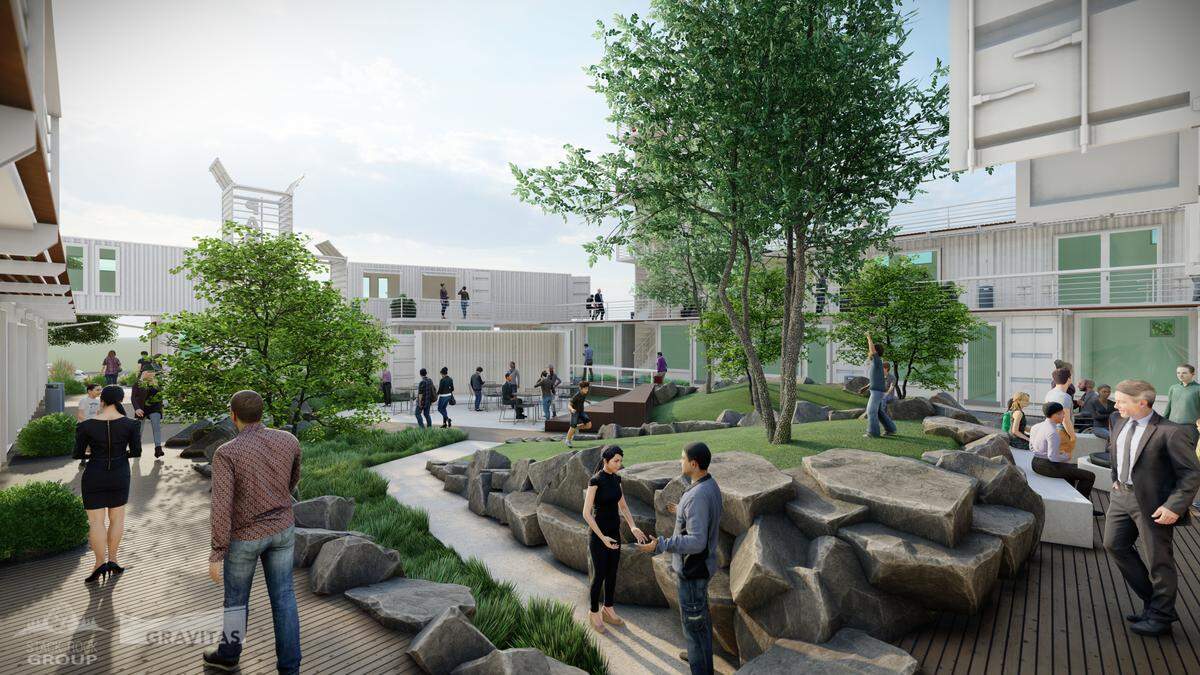
The project would use 40 cargo boxes, 300 square feet each, roughly the size of the interior of a school bus. The location, 208 33rd Street, is just feet from the Greenbelt and near the artist space Surel’s Place.
In total, the park would have 6,000 square feet of space, including two 750-square-foot, two-story apartments. Jones and his wife plan to live there if they can get the project built.
That’s a big if. In February, Garden City banned shipping containers after its planners were inundated with projects that used them as the primary building blocks.
The ban affected ongoing projects as well as existing businesses that operated on temporary permits. The Eddy — an outdoor bar that previously operated out of a recycled cargo container at the 34th Street Market — was forced to move into a new space this summer.
Can the Live-Work-Create district help?
Jones points out the use of shipping containers around the city, such as at the Yardarm, a popular surfer-themed bar right next to the Greenbelt.
And he believes that he’s found a loophole in the city code that would allow him to move forward with his project. The project is located in a special zoning district in Garden City — the Surel Mitchell Live-Work-Create district — that encourages industrial-style designs. Jones plans to argue that his project fits.
If he can jump over that major hurdle, Jones estimates the project would cost $2 million. He plans to rent the micro-spaces out to artists and small businesses, such as small salons or restaurants.
“We’ve been surprised to see that you could do everything you want to in 300 square feet,” Jones said.
Inside the container park, Jones is planning a 5,000-square-foot courtyard with benches and landscaping.
The project is considerably smaller than similar setups in other cities. Phoenix’s Churchill contains 14,000 square feet of retail space, plus a 9,000-square-foot open space with games and TVs — in total, about the size of a hockey rink. Boxyard in Tulsa, Oklahoma, offers 10,000 square feet of retail on a 14,000-square-foot lot.
The birth of ‘cargotecture’
Cargo containers were created in the 1950s to make international shipping more efficient. In recent years, they’ve become a cheap alternative to typical construction material. The “cargotecture” is everywhere — from the affordable homes built by Boise-based IndieDwell to dorms and offices.
Jones is working with Garden City-based designer Derek Hurd, who founded the firm Gravitas.
“I was interested in it because it’s different,” Hurd said. “It’s going to fill a need that artists and creatives have and provide an environment where you’ll find people building, painting, baking — the community wants that.”
Other promised shipping container projects in Garden City have stalled out in recent years. David Herman, the son of a Sacramento, California, shipping company executive, promised to build a subdivision of $152,000 houses made from cargo containers but couldn’t get a bank to finance the project. Plans for a cargo-box coffee store fashioned from two 8-by-40-foot containers stacked on top of one another have also faded.
Jones will bring the project before Garden City’s design review committee on Monday, Oct. 7.
“These days in Boise it’s so hard to find an affordable space,” Jones said. “This development could bring a lot more people down to Garden City.”
This story was originally published September 26, 2019 at 5:00 AM.