This woman led Idaho’s suffrage movement. After 92 years, her grave will get a headstone
Boise pioneer Corilla Robbins led a remarkable life.
She crossed the Plains from Missouri to Idaho, leading an ox team on a prairie schooner with her husband and four children in 1876. She rode to Idaho City in Boise’s first horse-drawn taxi — the passenger compartment boasting a shiny body, glass windows and upholstered seats.
In 1903, when the first automobile arrived in Boise, a roadster, she was the first woman to take a ride. And when the first airplane arrived in 1919, an open-air Curtiss, naturally, Robbins, then 73, was among the first to jump aboard the bi-plane and fly over Boise.
“That was some ride,” Robbins told the Idaho Statesman after the flight. “Believe me, I wouldn’t have missed it for anything.”
What Robbins didn’t get when she died in 1927 at age 81 was a headstone. For 92 years, her grave in Pioneer Cemetery on Warm Springs Avenue has remained unmarked.
“She has no marker, and we’re going to get that fixed,” lifelong Boise resident and history buff Bob Austin Jr. said.
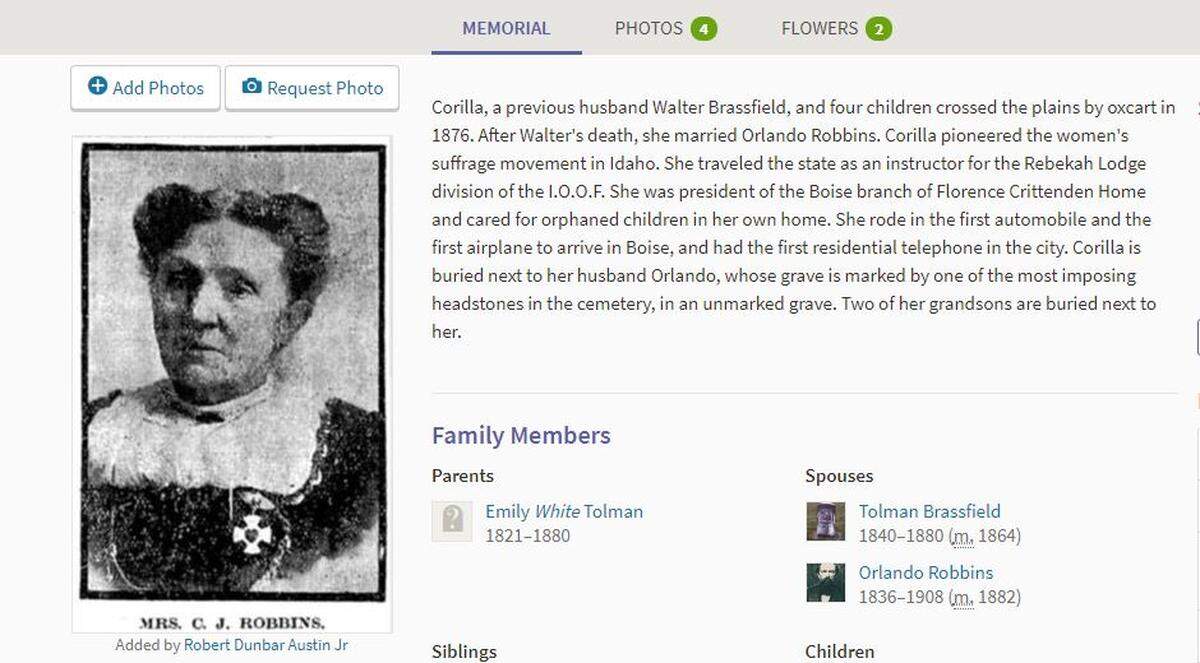
Austin, who spent four decades with the Idaho Air National Guard, is spearheading a GoFundMe drive to raised $400 to pay for a headstone. As of Thursday, $305 had been raised.
The headstone will go next to the 10-foot-high pedestal that marks the grave of Robbins’ husband, territorial Ada County Sheriff Orlando “Rube” Robbins. Robbins, her second husband, also served as Boise’s police chief from 1895 to 1897, according to a history of the Police Department by Boise historian Arthur Hart.
“He erected this monument to himself and left nothing for her,” cemetery walking tour guide Stevenor Dale told former Statesman columnist Tim Woodward in 2014. “She was buried in a grave that wasn’t even marked. All we know is that it’s somewhere near his.”
Austin, 74, said Corilla Robbins was prominent on her own and deserves recognition. She led the suffrage movement in Idaho, which in 1896 gave women the right to vote, the fourth state to do so.
Robbins toured the state establishing Rebekah lodges, a service organization for women affiliated with the Independent Order of Odd Fellows. She also cared for orphaned children in her home on Warm Springs Avenue, which was located two blocks west of Pioneer Cemetery, where Robert Noble Park now sits. The house was outfitted with the first residential telephone in the city.
At age 79, Robbins was arrested for operating a maternity (“lying in”) hospital in her home without a license. A jury found her guilty. She was fined $50, equivalent to $722 today.
The conviction was overturned on appeal.
Austin learned about Corilla Robbins through a post on a Facebook group that focuses on Boise history.
“She was a pretty remarkable woman,” Austin said. “She was a doer.”
For more than a decade, Austin has added biographies of relatives and friends he worked with at the Air National Guard and the Army Guard to pages remembering people on the Find A Grave website. He submitted a short biography of Robbins and two photos, one of her and one of her husband’s grave.
“Everybody deserves to be remembered,” Austin said. “There are a lot of people in cemeteries who have no markers.”
Boise Valley Monument Co. is preparing the headstone, which will include Robbins’ name, dates of birth and death, and a drawing of a prairie schooner. Austin said it should be ready for placement in the next month.
“Now people will know who she is,” he said.
This story was originally published March 29, 2019 at 7:54 AM.