Idaho’s incomplete, error-prone coronavirus data falls short of what other states offer
Earlier in the coronavirus pandemic, public health agencies in Idaho were required to fill out a form on each case of COVID-19. The Centers for Disease Control and Prevention form gathered data on whether patients had 12 known COVID-19 symptoms or preexisting medical conditions like asthma or diabetes, and whether they had been tested for 10 other illnesses like influenza.
The form also told a story about the patient. It asked dozens of questions that could chart the spread of COVID-19 through the state and record what it did to the bodies of Idahoans who caught it.
How were the patients identified for testing? Did they travel to Wuhan or live with a COVID-19 patient? Were they a health care worker? When did their symptoms begin and end? Did they develop pneumonia? How about acute respiratory distress syndrome, where a person’s lungs stop working? Did they end up in the hospital, in the ICU or on a ventilator? Did they die of COVID-19?
The CDC says it uses surveillance data to help monitor and respond to the spread of COVID-19.
But the case report form no longer is required by the CDC, public health agencies told the Idaho Statesman. And while the state and local agencies try to gather as much detail as they can, epidemiologists are managing a flood of new cases to investigate.
“There are certain items that are required under Idaho law, but it is minimal information about the person and the condition name,” said Dr. Kathryn Turner, the deputy state epidemiologist, in a written statement provided to the Statesman by the Idaho Department of Health and Welfare. “We request that the public health districts fill out as many fields as they can while they are talking to the patient and provider, but the volume of cases is such that it is difficult to spend an hour or so on every single investigation. The public health districts are trying to make sure that the patient’s hospitalization status, onset date, disposition (dead/alive) and whether they are a health care worker are being populated for every case, and that the other information is completed as they are able to get the information and enter it into the system.
“… Data entry is very important, but it won’t break the chain of transmission.”
It’s more important, Turner said, that epidemiologists focus on tracing and notifying close contacts of patients, and providing education and support for patients and contacts. However, Central District Health and South Central Public Health District recently told the Statesman that the caseload has reached a point where they no longer can even reach out to all contacts of known cases in hard-hit areas like Ada and Blaine counties.
There’s also a long backlog of cases for epidemiologists to get through, said Niki Forbing-Orr, the spokeswoman for Health and Welfare. Some patients are hard to reach or even unconscious if they’re on ventilators. So, while Oregon tracks and releases more granular information and status reports to the public on a regular basis, Idaho is releasing limited data.
Why does it matter what the state is tracking?
There are several reasons to gather data about the new coronavirus as it spreads in Idaho, said Dr. Amesh Adalja, senior scholar at the Johns Hopkins Center for Health Security.
“The more data you have, the easier it is to pick up certain patterns that aren’t readily apparent without that level of detail,” he told the Statesman.
There are big-picture reasons for tracking cases of COVID-19, he said — to conduct research studies or to understand the course of the disease. But there also are “real-time needs for data” like monitoring ventilator use to figure out how many machines Idaho will need, he said.
The Idaho Statesman has sought much data that Idaho can’t provide, and readers have asked us for data that, when we dug deeper, we found doesn’t exist. Here’s what we’ve learned about Idaho’s coronavirus data:
How many of Idaho’s health care workers are infected?
The Idaho Department of Health and Welfare said last month that epidemiologists weren’t asking people with COVID-19 whether they worked in health care — at least, not on a consistent basis. They would take down that detail if it came up during their investigations, such as where the person went and with whom they interacted. Of the 1,210 people who tested positive as of April 7, the state didn’t know whether 450 of them worked in health care. Of the infected patients whose occupations were known, about 13% worked in health care.
The state on March 31 began publishing a number for Idaho health care workers who have tested positive for COVID-19, and Turner says that’s now on the list of priority questions for patients. While the state had been collecting that information, it started to post the information after multiple inquiries by Idaho Statesman reporters, including a request that the state begin to share the numbers with the public on the official coronavirus website (coronavirus.idaho.gov).
There were 153 health care workers who had contracted COVID-19 in Idaho through Sunday, according to the state’s website.
It is important for Idaho to know when health care workers are infected “because they are the first line of defense” in the fight against the coronavirus, Adalja said.
If we know how many nurses, doctors, respiratory therapists and other front-line workers are infected, we have a better idea of what COVID-19 is doing to Idaho’s health care workforce. And knowing that health care workers are contracting the virus can help to drive better policies and ensure they have adequate protection, Adalja said.
In addition, it can help flag outbreaks.
“Health care workers are often the canary in the coal mine,” he said.
St. Luke’s and Saint Alphonsus health systems have declined to say how many employees have been infected by the coronavirus, how many have been quarantined and where they work. The health systems cite personnel privacy.
Why does the Idaho Statesman report different case numbers than the state?
Coronavirus case numbers are posted most days by each of the seven health districts and the Idaho Department of Health and Welfare (district reporting has been inconsistent on weekends).
The Statesman relies largely upon the numbers published by the health districts, which have proven more accurate. Health and Welfare reports cases based on the numbers sent to it by the districts, but there’s often a discrepancy between what the districts report publicly and to the state.
Early on, there was a delay, resulting in districts reporting larger numbers than the state. More recently, the numbers have been closer aligned except in the counties covered by Central District Health (Ada, Elmore, Boise and Valley).
On April 3, the state reported 29 more cases in Ada County than CDH — even though the departments posted numbers minutes apart. The gap was actually larger until the Statesman questioned the difference and CDH provided an updated number. On Wednesday (April 8), CDH reported 23 more cases and one more death than the state.
Several times, the state has reported a case in a county that didn’t have one — including Lewis County for several days. Another time, it reported a case in a county that doesn’t exist.
And for a few days, the state’s county-by-county numbers didn’t actually add up to the total number of cases it reported. This led to the state reporting 11 “new cases” that didn’t exist on one such day.
The data-tracking problems led to Gov. Brad Little — who had just mentioned the impact his stay-home order is having — being asked Thursday night about a jump to 121 new cases that day, when the actual number was 94. The difference was largely due to the state having to include cases from Ada County that CDH had reported the day before.
“We had a little bit of a reporting problem,” Little told Idaho Public Television in the live Q&A.
This confusion has continued with the reporting of deaths. On Wednesday, a death that had been reported Monday in Payette County was removed from the state and Southwest District Health counts without notice. The only way to know it was gone from the state site was to scroll through every county on a map, looking for changes.
The Payette case was removed from the death total because the district was “waiting for cause of death confirmation,” Southwest District Health spokeswoman Katrina Williams said in a text message to the Statesman later that night.
A Payette death was included again Saturday with no explanation about whether it was the same death originally reported five days earlier or a new one.
Why don’t we get more info on individual cases, like where the patients live and work?
The seven health districts began a series of conference calls to prepare for the coronavirus pandemic in January, Williams said. Among the decisions made was to release case information only at the county level to protect patients’ privacy. The concern was that in small communities “a woman in her 40s who just got back from traveling” would be so specific that people would know who it is, she said.
In some parts of the country, case data is provided by city (California), zip code (Florida) and even neighborhood (Denver).
Even across Idaho’s health districts, reporting policies vary. Some have provided basic demographic and condition information for most cases, while others have done that only for the first case in each county.
Some workplaces have publicly acknowledged when they’ve had confirmed cases — like Micron, the Boise VA Medical Center and Boise State University. But the health districts will only name businesses if they determine there’s a risk of public exposure.
The epidemiological teams at the health districts inform the known “close contacts” of people who test positive. A close contact is considered someone who was within 6 feet of the person for 10 consecutive minutes. Even then, the close contacts usually won’t be told who exposed them — only that they were exposed.
We’ve heard family members of coronavirus patients often don’t get tested. Are they included in the case count?
Health and Welfare added “probable” cases to its website Thursday, a number separate from the official count.
The initial posted definition was so broad that it would cover any person living in a county with community transmission (Ada, Canyon and 11 others), and anyone who has visited such an area. “A person, with or without respiratory symptoms consistent with COVID-19, who had known contact to a laboratory-confirmed case or travel to or residence in an area with sustained, ongoing community transmission, and who was not tested using molecular amplification techniques for COVID-19,” the definition read.
That was much different from the definition provided by Idaho North Central District, which was the first Idaho health district to report probable cases. The North Central definition required symptoms and a direct connection to a lab-confirmed case.
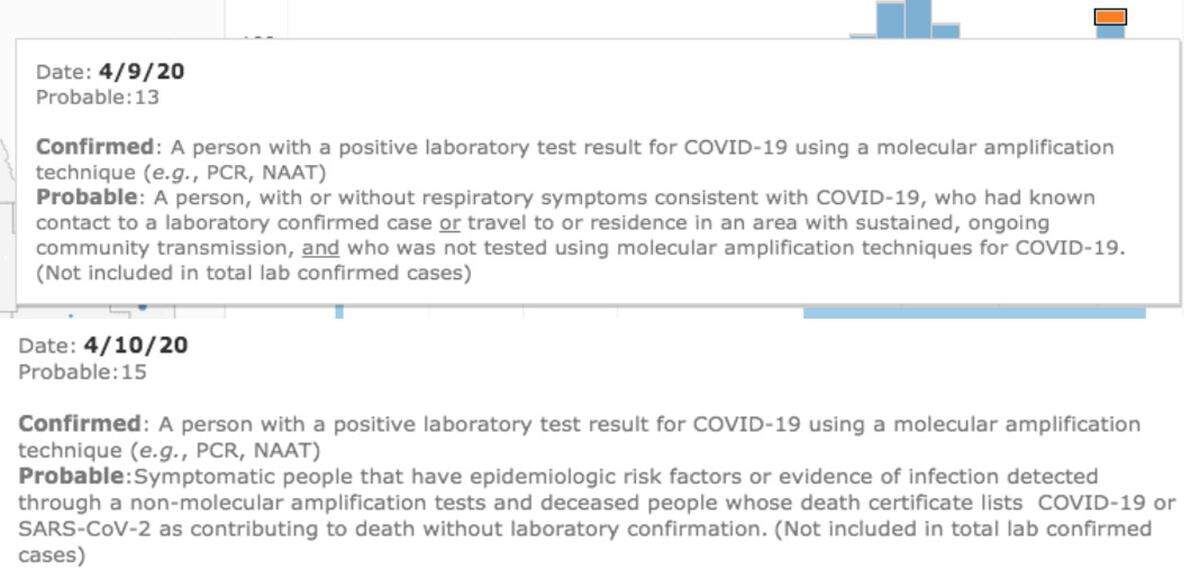
On Friday, Forbing-Orr told the Statesman that a probable case was someone with “clinically compatible symptoms” who didn’t have a positive test “using a molecular amplification method” and was a close contact of a lab-confirmed case, or was a resident of or had recently visited “an area with ongoing community transmission.” It’s also possible for someone who dies to be a probable case if COVID-19 or SARS-CoV-2 is listed as a cause of death, she said.
Later Friday, Health and Welfare’s website produced a more technical definition: “Symptomatic people that have epidemiologic risk factors or evidence of infection detected through a non-molecular amplification tests (sic) and deceased people whose death certificate lists COVID-19 or SARS-CoV-2 as contributing to death without laboratory confirmation.” North Central’s definition also changed to a more concise version of the state definition.
North Central reported two probable cases in Nez Perce County through Friday, while Eastern Idaho Public Health reported 14 — including five tied to one confirmed case. The state reported a total of 32 probable cases in the first four days.
Some patients have recovered, right? Do we know how many?
The Idaho Statesman asked March 23 about whether the state would report recovered patients, as some states and countries do.
“We don’t do case follow-up for acute diseases, so we don’t track that info,” Forbing-Orr wrote.
Ten days later, on April 2, Health and Welfare Director Dave Jeppesen was asked the same question by an Idaho Public Television viewer.
“That’s actually a great question,” Jeppesen said. “We do know that we’ve had lots of people that have recovered from having the coronavirus. … As we move forward, that’s something that we’d like to add, to make sure people can understand that not all 891 people are currently sick.
“We’ll be working to get that data out. It’s a little bit tricky from a data capture perspective, but we have some ideas of how we can start to put that data up on the website.”

A week later, only the Panhandle Health District and Eastern Idaho Public Health were reporting recovered patients. The Panhandle website explains that it uses “no longer monitored” instead of recovered, which reflects patients who no longer need to isolate. Through Friday, 24 of 48 Panhandle patients had met that criteria. EIPH indicated 12 of its 33 confirmed cases were no longer monitored as of Sunday.
Jeppesen was asked again Thursday on the weekly IPTV Q&A about recovered patients. He said the state hoped to have that information within another week, but it would only be an estimate.
“We’re going to use our best science to really estimate how many of those individuals have recovered,” he said.
Why is there a delay in reporting deaths?
The first COVID-19-related death in Idaho happened at least several days before it was announced, according to the Blaine County coroner’s office. The date and location of death hasn’t been released for any of Idaho’s 27 deaths related to the pandemic, and in many cases the sex and age range weren’t provided, either. It’s also unclear what prior health issues have played a role in the deaths.
The Idaho Department of Health and Welfare is reporting only the total number of deaths for the state and the number of deaths per county on its COVID-19 data dashboard. Multiple health officials said they can only report a death when a death certificate has been completed and coronavirus is determined to play a role in that death.
When patients die in a hospital, their death certificate is typically completed by a physician. If individuals die at home or outside of a medical setting, the county coroner performs a death investigation and completes the certificate. In some cases, that information is reported directly to the Idaho Department of Health and Welfare, but in other cases information is given to the appropriate health district. Officials were not able to provide an explanation as to why cases would be reported to one authority rather than the other.
What do we know about deaths?
By Sunday, Idaho had reported 27 coronavirus-related deaths in four of its seven health districts: Southwest, Central, South Central and North Central. Each of the districts is reporting different details on local deaths.
Williams, the spokeswoman for Southwest District Health, said she aims to include five pieces of data in a news release for the first death in each county: age range, sex, county of residence, underlying health conditions that may have contributed to death and whether the deceased died at a hospital or elsewhere.
Reports show six deaths in the Southwest District. The first, announced March 26, was a man over 70 years old who had underlying health issues and was hospitalized, Williams told the Statesman. The two subsequent deaths involved a man in his 80s with underlying conditions who was hospitalized, and a woman in her 80s with underlying conditions who was hospitalized before returning home for hospice care, Williams said. Details weren’t provided for deaths since then.
The Boise-based Central District has reported six deaths, all in Ada County. The first, reported March 28, was an individual older than 60 who had preexisting health conditions. The person’s sex was not provided, nor were other details on the date of death or the preexisting conditions. No details have been provided for each of the five subsequent Ada County deaths related to COVID-19.
Spokeswoman Christine Myron said the district has “been notified directly by the hospital on the day of death or shortly thereafter. However, this is voluntary reporting on their part. The more formal process involves the state epidemiology program gathering information from the vital statistics program on deaths where COVID was listed as a contributing cause of death.”
Myron said other details on coronavirus-related deaths have not been made public due to privacy concerns.
There have been 10 deaths in South Central health district counties — the most of any district in Idaho. Brianna Bodily, spokeswoman for the district, said it also would report details only for the first coronavirus-related death in each county.
“There is a fine line that we have to toe … with providing enough information that we empower people to make excellent decisions to protect themselves,” Bodily said in a phone interview. “However, there is some information that goes beyond empowering and is unnecessary information that … can distress (people) even further.”
The South Central health district provided the age ranges of two men in Blaine County whose deaths were announced March 26 (the first in the state). It also reported the first death in Cassia County on March 30, in a woman in her 70s with existing health problems. On April 3, South Central officials announced a woman over 70 years old in Twin Falls County had died after being hospitalized. She also had underlying health issues. And on April 8, district officials said a woman over 70 in Jerome County had died, with age considered a factor.
No details have been provided on the additional deaths reported in the district, and Bodily said those won’t be released.
“Once someone has died from COVID-19, they are not a threat to anyone else,” she said.
The North Central District has seen five COVID-19-related deaths, all in Nez Perce County. All were over the age of 50 and four out of five were men, according to the district’s website. The district noted the first person who died had health issues related to old age. No other details were provided.
“Additional case-specific information is confidential and won’t be released because we are protecting the privacy of the patients and we only release information that will help protect the public,” spokeswoman Tara Macke said in an email. “Case specific information would potentially be identifying because the number of people in our counties within our health district are so small.”
What’s the racial mix for Idaho’s cases? Is that being tracked?
We don’t yet know the race or ethnicity breakdown for Idaho’s confirmed coronavirus cases. On Friday night, Health and Welfare began releasing preliminary race and ethnicity breakdowns for fatalities. Fourteen of the 27 Idaho deaths were white and two were Asian or Pacific Islander. All 16 of those were listed as non-Hispanic. But there are 11 cases for which state officials didn’t know the race or ethnicity of the person who died.
“The race/ethnicity data the department currently has is incomplete; the department has it for some cases but not for all of them,” Forbing-Orr said. “It’s not currently commonly collected for communicable disease investigations, but that is something the department may change in the future.”
Southwest District Health, which encompasses Canyon County and the largest Latino population in the state, told the Statesman on Wednesday that the district wasn’t collecting race or ethnicity data for COVID-19 cases or fatalities.
“Ethnicity is not consistently reported and is often unknown or unconfirmed,” Williams said. “Ethnicity does not provide a clear picture of the virus’ impact on our communities and should not be used as evidence of any trends.”
The Idaho Statesman has filed public records requests for the race and ethnicity breakdown of confirmed coronavirus cases in the state and by county.
What data are other states tracking and providing to the public? Who does it right?
Each state is reporting information on coronavirus differently. We looked at each state’s publicly available coronavirus data to see how Idaho stacks up.
Idaho’s state coronavirus website offers data on the following: number of COVID-19 tests conducted statewide, number of confirmed cases and deaths by county, age and sex of patients in aggregate, number of hospitalized patients and patients admitted to intensive care units statewide, and number of health care workers diagnosed with COVID-19 statewide. The last three numbers are cumulative totals based on completed investigations.
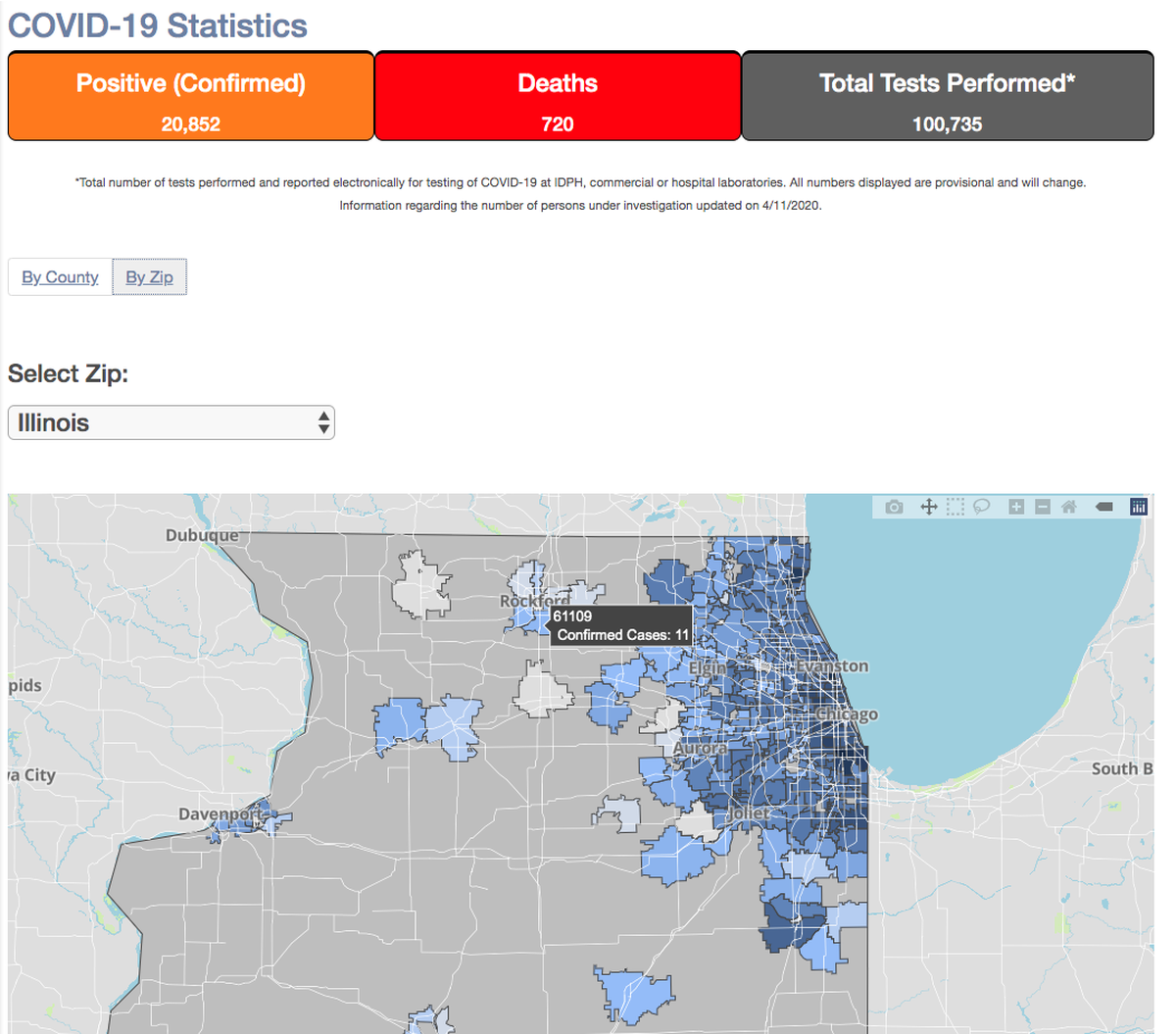
Compared to many other states, it’s a minimal amount of data. Only a handful of states, including Kentucky, Kansas and Iowa, have similar or less information publicly available.
Most states report the number of individuals who have recovered from COVID-19. Many report hospitalization and ICU data on a county level — and Santa Clara County in California provides daily data on hospital beds and ventilators used and available. The vast majority of states track how many tests have been conducted per county. (Idaho doesn’t track the number of tests by county or health district, Idaho Department of Health and Welfare officials said last month.)
North Dakota and Minnesota report patients’ likely source of exposure to coronavirus. Alabama is among several states that, like Idaho, report how many health care workers have been diagnosed with COVID-19. Most of those states also report COVID-19 diagnoses in nursing homes, prisons, homeless shelters and other types of living situations. (The Idaho Department of Correction is tracking testing and confirmed cases on its website.)
Colorado shows case outcomes by age group. Alabama, Illinois and several other states have breakdowns of the ethnic and racial backgrounds of those diagnosed and, in some cases, those who have died of COVID-19. Louisiana and Mississippi are among the states that track which preexisting health conditions may have contributed to the deaths of people diagnosed with COVID-19.
Idaho neighbor Oregon is among the states with the most thorough public data. Oregon releases weekly and daily reports detailing everything from hospital capacity to frequency of reported symptoms in COVID-19 patients.
This story was originally published April 13, 2020 at 4:00 AM.