It’s the size of 6 football fields. What’s St. Luke’s up to in Meridian?
AI-generated summary reviewed by our newsroom.
- St. Luke’s Health System opens $36M, 330,000-square-foot distribution center in Meridian.
- The center centralizes supply chain operations and reduces third-party costs.
- Automated systems and storage prepare the system for disruptions and growth.
If you see a health care provider at a St. Luke’s Health System center and receive medication, chances are you’re not thinking about how the drug made its way to you. You’re probably just glad it did.
Same goes for the gloves on your provider’s hands, or the gauze or syringes they use, or many other tools of the medical trade.
That’s in part because of the people behind the scenes who spend a lot of time thinking about such things — people like Adrian Wengert, the supply chain vice president for St. Luke’s.
Wengert said that in 2016, he began to wonder whether the health system, Idaho’s largest, could build the capacity to bring supply and distribution of pharmaceutical and medical supplies in-house. Nearly a decade later, St. Luke’s has opened a 330,000-square-foot consolidated services center in growing Meridian.
The center, roughly the size of six football fields, provides medical supply distribution and pharmacy services for St. Luke’s eight medical centers and 370 clinics, with the ability to stock 6,000 supplies, according to a news release. The more than $36 million development sits west of Black Cat Road and north of the interstate in the Meridian Commerce Park.
“Prior to this investment, we were using third parties, and while those relationships were invaluable to us, we needed to have more control, more oversight and more visibility to our inventory demand,” Wengert said at a grand opening ceremony Wednesday.

Automated services, ‘state of the art’ technologies
The center boasts 27 robots, according to St. Luke’s. These include automatic storage and retrieval systems, or “pickers,” which locate supplies or medication to fulfill an order. Part of the decision to pursue automation was because of “challenges in this labor market,” Wengert told the Idaho Statesman in an interview.
He said the center competes with others, notably Amazon, for workers.
The center employs about 70 people, though that number could grow, according to Kelly Curtis, St. Luke’s VP of pharmacy. Curtis told the Statesman that pharmacists from other St. Luke’s locations might relocate to the center if services are further consolidated.
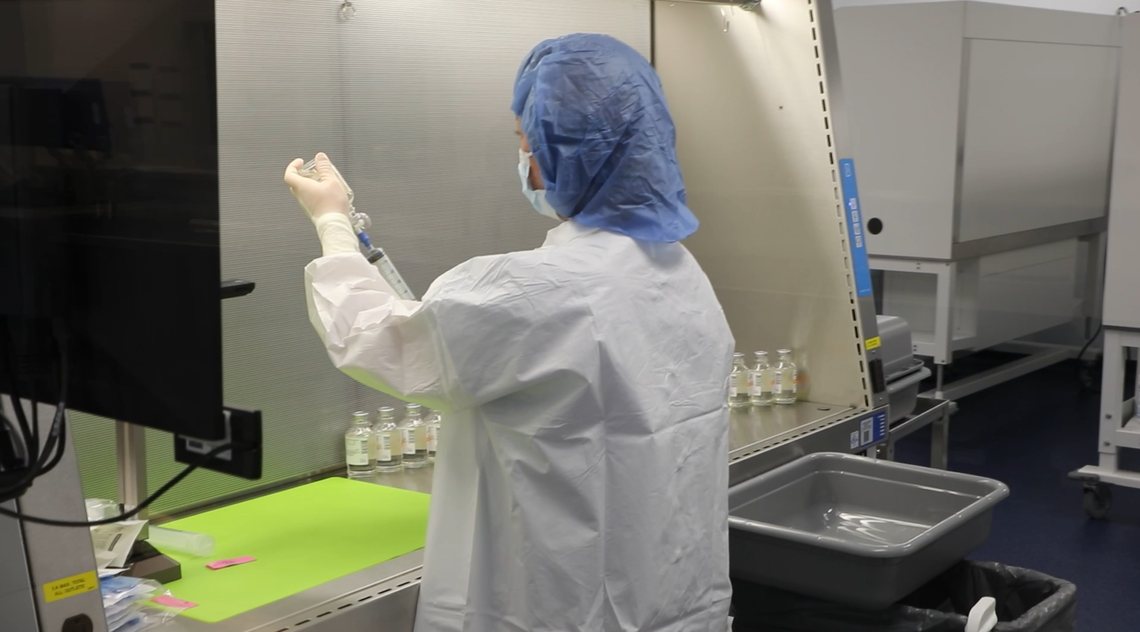
Curtis noted that the center has a “state of the art clean room,” allowing workers to mix infusions and IV fluids on a larger scale, and is St. Luke’s “home for home infusions,” including chemotherapy.
It also has office space.
Consolidated distribution center to save St. Luke’s ‘millions’
Over the next 10 years, the center is expected to save the health system “millions of dollars” that it can “reinvest in patient care and care innovation,” Wengert said. That’s by contracting directly with fewer suppliers and eliminating some distributors.
The cost for both suppliers and for St. Luke’s goes down, he said, “so it costs us less to buy the same stuff.”
Standardizing and centralizing the process, he said, “ultimately makes health care less complex, which is good for our culture, and it’s good for our patient experience as well.”
The center also cuts down on labor costs for services that were previously outsourced, automates some responsibilities, buys and stores supplies in bulk, and reduces waste — such as expired medication — by being more in tune with demand, according to St. Luke’s.

‘Buffer’ against supply chain disruptions, tariffs
The center will do more than save money and streamline services, Wengert said. It “allows us to buffer some of the supply and drug volatility” that can come from external factors, he said.
St. Luke’s President and CEO Chris Roth pointed to the COVID pandemic and natural disasters in recent years that have caused supply-chain disruptions, as well as drug and supply shortages. Last year, Roth noted, Hurricane Helene tore through a major pharmaceutical manufacturing plant in North Carolina that produces intravenous fluids for hospitals nationwide.
Though the idea for the center came before the pandemic in 2020, Roth said at the ceremony, “As we’ve reflected ... on the last few years, boy, has this decision been validated, unfortunately, over and over and over again.”

Another uncertainty that the center could help St. Luke’s brave, according to Roth and Wengert: tariffs. Some health care organizations across the country have raised alarms that higher tariffs, including with China, could increase the costs of medical supplies and devices, as well as pharmaceuticals, according to the Association of American Medical Colleges.
Roth and Wengert did not cite concerns about a specific tariff, but said the center’s increased storage capacity and a new “forecasting and demand planning tool” would help the health system be better prepared.
“When we know that we need to hedge our bets against some of the tariff tensions, or we need to create a safety stock ... we can make some strategic and advanced buys that usually result in some cost-savings efforts as well,” said Wengert.
Room to grow: Center to add services?
St. Luke’s started designing the center in 2019 and began building it in 2023. According to permits filed with the city of Meridian in 2023, construction was estimated to cost $34.3 million. A year later, the health system filed two more permits to install interior storage racks, conveyors and the automated retrievers, costing $2.3 million.
A spokesperson for the health system did not provide a total cost for the development, but Wengert said costs rose from when initial estimates were made in 2019, causing some aspects of the plan to be placed on hold.
Some of those services may yet be added, though. Roughly 25% of the center’s footprint is “shell” space — ready for future expansion.
“If the communities we serve continue to grow at the rate that they have been, that’s how much space we would need to expand into,” Wengert said. “That should take us through the next 10 years.”
This story was originally published July 24, 2025 at 4:00 AM.