President Trump takes aim at one of the biggest private investments in Idaho history. Why?
One of the largest investments in Idaho’s 134-year history could be in question after President Donald Trump called for the end of a $280 billion subsidy program called the CHIPS and Science Act.
The law, which passed with bipartisan support in 2022, directed $52 billion in federal funding to boost semiconductor manufacturing in the United States, though Idaho’s congressional delegation voted against the legislation.
“Your CHIPS Act is a horrible, horrible thing,” Trump said during an address to Congress Tuesday night. “We give hundreds of billions of dollars and it doesn’t mean a thing. They take our money and don’t spend it.”
But the calls come as Micron, a multinational semiconductor company that was founded and headquartered in Boise, is well underway on a $15 billion expansion of its Southeast Boise campus with a subsidy under the law.
In December, after Trump’s election, and after Trump had criticized the CHIPS Act as wasteful, the Biden administration awarded Micron more than $6.1 billion in federal subsidies to help pay for new chip-making plants in Boise and upstate New York. Boise’s share was $1.5 billion.
The Commerce Department said then that it was disbursing money based on Micron’s completion of project milestones. But the department did not say what those milestones were and whether some were yet to be met. So it wasn’t clear Wednesday whether Micron already had all its promised money or not — and if not, whether the rest would actually be paid.
Micron did not immediately return a voicemail or email request for comment.
Trump said the nation could attract more semiconductor investment through the use of tariffs, rather than subsidies, and touted a $165 billion investment from Taiwan Semiconductors to build a plant in the U.S. He said Congress should get rid of the CHIPS Act and House Speaker Mike Johnson should use any leftover funds instead for reducing the nation’s debt or “any other reason you want to.”

Idaho congressmen support Micron, not CHIPS Act
Though Idaho’s congressional delegation, which is all Republican, voted against the CHIPS Act, members support bolstering the nation’s semiconductor manufacturing and Micron’s expansion.
U.S. Sen. Mike Crapo is open to some adjustments to the law but opposes a full repeal, according to Melanie Lawhorn, communications director for Crapo.
“The CHIPS Act included billions of dollars in additional spending unrelated to semiconductors, which is why he ultimately voted against the bill at the time,” Lawhorn said by email.
But she said the legislation would not have passed had Crapo not voted earlier in favor for two key measures that made it into the final bill: funding grants for reshoring semiconductor manufacturing and the Facilitating American-Built Semiconductors Act.
Lexi Hamel, communications director for Rep. Mike Simpson, said Simpson “has been very supportive of Micron’s efforts and building a critical facility in Idaho,” but opposed the bill for reasons similar to Crapo’s. In 2022, Simpson said the final bill “sends billions of taxpayer dollars to Democratic wish list items that have nothing to do with countering China’s stranglehold over critical resources.”
Idaho Sen. Jim Risch and Rep. Russ Fulcher did not immediately return requests for comment. Risch has been supportive of Micron’s expansion in the past and attended the groundbreaking with Micron’s CEO and Idaho Gov. Brad Little.
Risch said during the groundbreaking that Idaho’s delegation voted no on the legislation after significant spending was added to the bill unrelated to the $52 billion for semiconductors, according to prior Statesman reporting. Risch said that he and the Idaho delegation “painfully voted no” knowing that the legislation would still likely pass.
Expanding Idaho’s technology footprint
Micron builds computer microchips and dynamic random-access memory semiconductors used in everything from smartphones to video game consoles. With 5,400 employees in Boise as of May 2024, the company is Idaho’s largest for-profit employer and the nation’s largest maker of memory, a class of semiconductor chips.
The $15 billion expansion is one of the largest investments in state history. The company has said its new semiconductor chip manufacturing plant, or fab, would directly employ 2,000 people and create 15,000 jobs in the community.
The fab is the first dynamic random-access memory manufacturing plant built in the United States in 20 years, Scott Gatzemeier, Micron’s corporate vice president of U.S. expansion, previously told the Statesman.
“It’s incredibly exciting to bring manufacturing back to the U.S.,” Gatzemeier said.
The development has spurred further investment in Southwest Idaho, with technology-adjacent and logistics companies jumping into the market to support the company. The company has also partnered with 14 universities across the Northwest, including at Boise State University and Idaho State University, and helped fund programs that would boost the semiconductor workforce.
Boise Mayor Lauren McLean, in an emailed statement, said the CHIPS Act is helping to bring memory chip manufacturing back to the United States, create domestic jobs and increase national security.
“The federal program’s investments provide our local economy and job market a once in a lifetime moment of opportunity for Boise’s future, and we will continue to work with Micron in order to support their expansion,” McLean said. “We look forward to being a national and global hub for memory technology, where Boiseans have economic opportunity for generations to come.”
The call to end the CHIPS Act comes after Bloomberg News reported that about 60 employees with the government office responsible for the program had voluntarily left or were terminated as Trump and billionaire adviser Elon Musk have tried to cut the federal workforce.
Semiconductors were invented in the U.S., and the country remained the leading producer for decades, but production capacity has dropped from about 37% in 1990 to 12% today, according to prior Statesman reporting. The U.S. has dropped to fourth place behind Taiwan, South Korea, Japan and China.
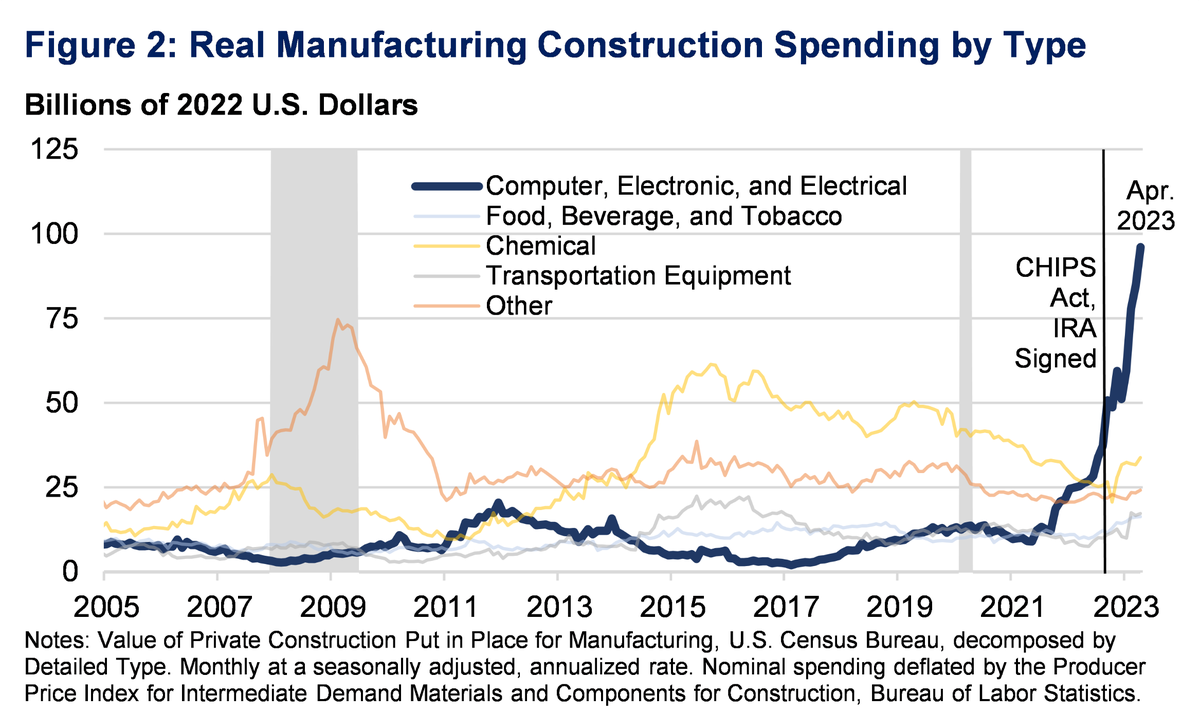
The CHIPS Act drove a national boom in construction spending for manufacturing facilities, with spending nearly quadrupling since the start of 2022 for computer, electronic and electrical manufacturing.
Micron CEO Sanjay Mehrotra previously told the Statesman that the CHIPS Act would help grow domestic memory production from under 2% to 10% of the global market over the next decade and would make the U.S. the “home to the most advanced memory manufacturing and R&D in the world.”
This story was originally published March 5, 2025 at 4:09 PM.