Harris Ranch homeowners and builders are locked in battle over Boise taxes. Now this
After years of fighting, the pieces are set for a $22 million Idaho Supreme Court battle involving a group of Boise residents, a special Boise taxing district and a local real estate developer.
Each group has filed its opening arguments to the state’s highest court.
The group, the Harris Ranch CID Taxpayers’ Association, argues that the taxing district in Boise’s Harris Ranch community is unlawful and unfair. CID stands for community infrastructure district. The association alleges that the district’s board illegally approved $5 million in bonds, $10 million in extra property taxes and $7 million in additional payments to the developer of Harris Ranch in October 2021 — which the districts homeowners must foot the bill for.
Both the taxing district and Doug Fowler, the president of Barber Valley Development, which is building the community on behalf of the Harris Family Limited Partnership, have rejected the homeowners’ claims that the district and payments were illegal.
“(The homeowners) have for more than three years persisted in using expired claims to throw sand in the gears of the (taxing district) and grind it to a halt,” wrote Hethe Clark of Boise’s Clark Wardle law firm, which is representing the Harris Family Limited Partnership.
While the lawsuit has prevented the construction of certain things such as the proposed Alta Harris Park, Barber Valley Development has continued to build new homes, apartments and condos.
The Idaho Legislature authorized community infrastructure districts in 2008 with the intention of having growth pay for itself by making property taxpayers within district boundaries pay for it, rather than taxpayers citywide.
In the Harris Ranch Community Infrastructure District, homeowners pay taxes for infrastructure improvements the developer builds, like roads and roundabouts.
The homeowners, led by residents Larry Crowley and Bill Doyle, say the taxing district forces them to pay 40% higher taxes than those outside the district, including homes in Harris Ranch right across the street from Crowley and Doyle. That’s because those homes were built before the district was created, and existing homes were excluded on purpose.
An Ada County judge ruled against the homeowners in April 2023, rejecting all 16 of their arguments, before they appealed to the Supreme Court. This is the first time the Supreme Court has considered a case on community infrastructure districts, and a decision in the homeowners’ favor could reshape the future of these districts.
Two more districts have been proposed for the Avimor planned community along Idaho 55 in North Eagle and the incoming Valnova community to the west of Avimor.
“Although petitioners only appealed decisions made in October of 2021, they asked the district court — and now ask this court — to review the legality of numerous past decisions and events,” according to the district’s response. “None of those historical decisions were appealed within the statutory period, and therefore the district court appropriately declined to review most of them.”
Here are answers to four key questions raised by the appeal.
1. Was the Harris Ranch taxing district formed correctly?
The homeowners have a long list of issues, but the heart of their argument is the claim that the Harris Ranch CID was created incorrectly and therefore all actions since have been in violation of Idaho law.
They say a lobbyist for the real estate and construction industries pushed through the passage of the law in 2008 and that the Harris Family Limited Partnership built the Boise CID for its own benefit.
“Since its creation, the city (of Boise), acting through the Boise CID, has issued almost $20 million in bonds, and made more than $17 million in payments to the developer,” according to the taxpayer association’s brief. “Almost every one of these payments has been unlawful, often for not just one but several different reasons.”
The district, in its 88-page response, said a lobbyist being involved with the passage of the CID Act was irrelevant to the case and that the creation of the law and district are outside the scope of the lawsuit.
“Much of (the homeowners’) statement of relevant facts consists of allegations which are not relevant to this proceeding, have no support from the administrative record and were not among the issues presented to the board (of the CID),” wrote attorneys Melodie McQuade and Blake Ringer of Boise’s Givens Pursley law firm, which is representing the district.
The attorneys wrote that they would not respond to each and every one of the homeowners’ allegations because of page limitations and because “many of the statements are opinion statements or otherwise unsupported by any record.”
2. Did the developer manipulate the district boundaries unfairly?
Another line of attack was that Barber Valley Development and the Harris Family Limited Partnership carved out the Harris family’s homes in the center of the community to free the family from $110 million in taxes imposed on other homes in the district.
“As a result of these abuses, the map of the Boise CID looks like a giant jigsaw puzzle with a third of its pieces missing,” the homeowners said.
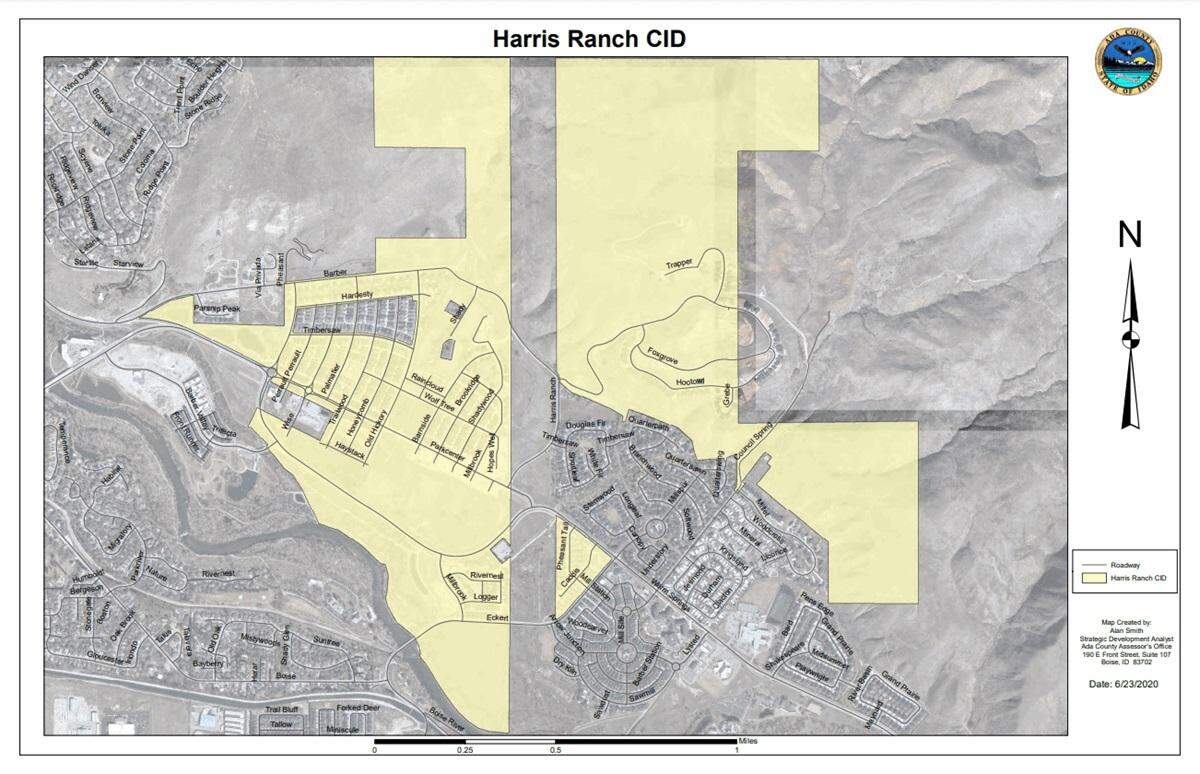
The district excluded homes that were already built at the time of the district’s formation. Crowley and Doyle previously told the Idaho Statesman they believed this was because the residents who lived there at the time wouldn’t have supported the creation of the district, which would have made them pay higher taxes.
“When the Boise CID was formed and the bond ‘election’ was conducted immediately thereafter, there was not a single homeowner within the Boise CID’s boundaries,” the homeowners said in their brief. “That is because the boundaries of the Boise CID were gerrymandered by the city and developer to exclude the 500 or more already existing homes in the Harris Ranch development.”
McQuade and Ringer said the allegations over gerrymandering did not have a factual basis and asked the Supreme Court to throw out that assertion — along with all unsupported statements in the homeowners’ brief.
“For this accusation, petitioners cite their own objection letter,” McQuade and Ringer wrote. “To further describe the district boundaries, petitioners cite to the Ada County Assessor’s online interactive map … which is not part of the administrative record.”
3. Taxation without representation in Boise?
A core argument of the homeowners is that the district issued bonds improperly and a single voter approved them, rather than a representative slice of those who would pay the taxes.
The district authorized just under half of the total $110 million in bonds in 2010, but the homeowners said there was only one qualified voter out of the four votes cast.
“That voter was a ranch worker for the Harris family living on their property as a tenant,” they said. “He registered to vote immediately before the ‘election,’ did not own any property in the Boise CID and thus was never going to pay any of the $110 million of property taxes.”
Idaho law, they said, prohibits local governments from incurring debt payable from taxes without prior approval by the people who will pay the taxes.
“Not a single person who would pay the estimated $110 million in additional property taxes was entitled to vote,” the homeowners said.
The district’s lawyers say that argument is invalid, because it is based on documents outside the administrative record, and the election was not a part of the appeal before the Supreme Court.
Clark, the lawyer for the Harris Family Limited Partnership, wrote that the homeowners’ argument would mean that any taxing district would need to re-do an authorizing vote once the district’s population turns over.
“(The homeowners) can offer no ‘wrongdoing’ in terms of compliance with the CID Act; instead, they suggest that the (taxing district) is an alter ego of the city of Boise in a transparent attempt to invalidate the general obligation bond election,” Clark wrote.
4. System improvements vs. project improvements. What’s the difference?
A major point of the homeowners’ argument is that the tax money they’ve paid has gone toward “project improvements” that only benefit Harris Ranch rather than “system improvements” that benefit the broader region.
Most of the improvements, they said, have been in front of single-family homes and are still owned by the developer.
“The CID Act and its legislative history make clear that CIDs only have the power to pay developers for the costs of ‘system improvements’ that primarily serve the broader region, and not ‘project improvements’ that primarily serve a particular development,” the homeowners wrote.
The lawyers for both the district and Harris Family Limited Partnership clapped back, saying that the distinction between system and project improvements does not appear in the CID Act and comes from a different, and nonapplicable, Idaho statute.
“There is not a single reference in the CID Act to ‘system improvements,’ and there is no incorporation by reference in the CID Act of any system-improvement-related test,” Clark wrote.
What’s next for Harris Ranch?
The homeowners have until Friday, Aug. 9, to file their response to the taxing district and developer’s briefs, but Crowley told the Statesman that they are asking for a five- to six-week extension to accommodate the caseload of Nicholas Warden, their attorney.
Once the homeowners file their reply brief, the Supreme Court will review them and schedule oral arguments. It is likely to take several months before oral arguments begin, Crowley said, depending on how busy the court is.
This story was originally published August 2, 2024 at 11:56 AM.