AG: Gas retailers overcharged motorists early in pandemic. Much harder to prove again
READ MORE
Why are Idaho gas prices so high?
We take a look a the current issues around Idaho’s soaring gas prices, and a new state law that erodes the protections against price gouging.
Expand All
Editor’s note: This is the last in a two-day series of reports examining Idaho’s gasoline prices. Previously: Why are gas prices so high in Idaho?; Get ready for gasoline prices to spike.
Two weeks after Gov. Brad Little declared a state of emergency at the start of the coronavirus pandemic in March 2020, the difference between the wholesale and retail price of gasoline in Idaho shot up to 70 cents.
That was nearly five times the highest margin — the difference between the price dealers pay for gasoline and what they charge customers — recorded between 2006 and 2019. During that span, the margin ranged between 2 and 15 cents per gallon, according to records kept by the Idaho attorney general’s office.
Attorney General Lawrence Wasden later investigated the situation and reached a $1.5 million settlement with Idaho’s three largest convenience store chains. While Maverik, Jacksons Food Stores and Stinker Stores denied they did anything wrong, they agreed to provide $1.5 million in discounted gas in 2021 to settle claims they overcharged customers.
If the governor declared a similar emergency today, Wasden would find it much tougher to accuse gasoline dealers of overcharging customers. The 2021 Idaho Legislature passed a law prohibiting the attorney general or courts from considering the margin to determine whether motorists are being gouged.
“It’s made it much more difficult to determine whether we have excessive and exorbitant prices,” Brett DeLange, an assistant Idaho attorney general who monitors gas prices through the state, said in a Zoom interview. “The Legislature opted to amend the law as it did, and so that’s the law we have on the books now.”
Gas retailers pushed for the bill to restrict the attorney general’s ability to regulated price-gouging.
“Now Attorney General Wasden or a court would have to look at whether the price is too high,” DeLange said. “Well, how do we know the price is too high if we don’t have the margins to consider?”
Idahoans have complained about high gas prices almost as long as gasoline has been sold in the state. In 1941, Gov. Chase Clark was so incensed over a penny-per-gallon increase that he threatened to have the state operate its own gas stations to ensure consumers paid a fair price.
“I don’t want to hurt the dealers, but if the major oil companies will make no concessions on this raise, I think it is the duty of the state to act,” Clark said. “We are figuring out at just what points storage tanks should be placed throughout the state.”
At the time, a gallon of regular gas was selling for 20.6 cents. That’s equivalent to $4.02 today, according to an online inflation calculator operated by the U.S. Bureau of Labor Statistics.
Clark, a Democrat who served as governor from January 1941 to January 1943, was the father of Bethine Church and father-in-law of future U.S. Sen. Frank Church. He threatened to call the Idaho Legislature into special session to deal with the matter.
“There is no excuse for the increase,” Clark said in an April 1941 story in the Idaho Statesman. “It is just an attempt to stick up the people.”
A month later, the retail price rose nearly 4 cents.
Clark also sought an investigation by the U.S. Department of Justice into what he called “price fixing and monopolistic practices of the oil companies in Idaho.” Clark backed down after a federal agency ordered gas prices on the West Coast reduced a half-cent.
Around the same time, the Idaho Legislature considered a bill to let the Idaho Public Utilities Commission fix the price of gasoline. A bipartisan group of Republican and Democrat lawmakers voted it down.
In 1941, a Twin Falls entrepreneur expanded his business to Boise, promising to fight Standard Oil Co. and other major producers by offering cut-rate gas prices. Farris Lind became known as “the stinker,” which later morphed into him calling his company Stinker Stores.
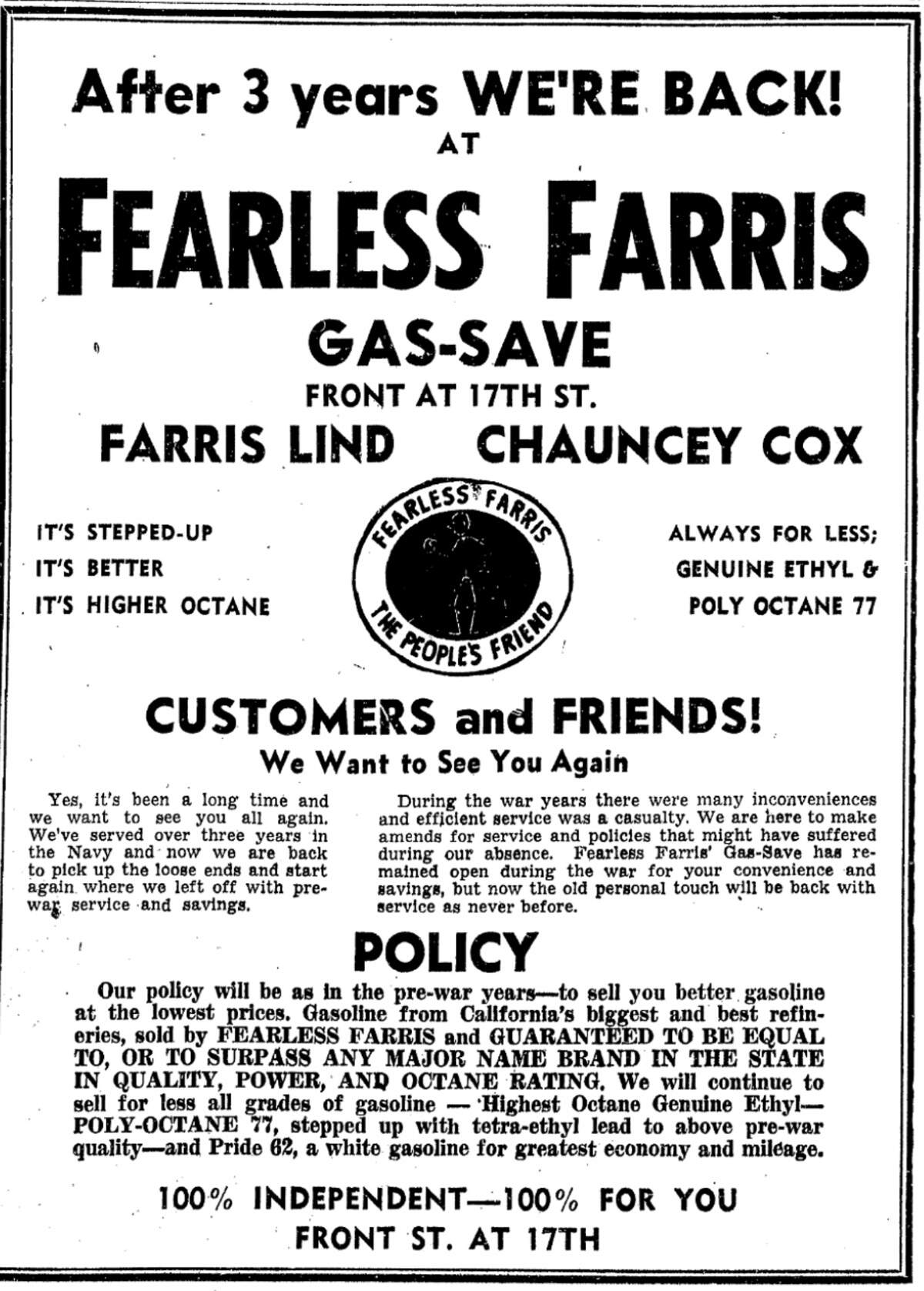
Thirty-five years later, Lind spoke of his business accomplishments.
“We were competing with billion-dollar companies,” Lind said. “The big kick to me is that a hole-in-the-wall, an independent, a guy who is under a certain handicap, can still become the No. 1 gas peddler in Idaho.”
In 1973, Arab countries imposed an oil embargo on the United States and some of its allies to retaliate against American support of Israel during the Yom Kippur War. Gas prices took off, leading to long lines. Many stations ran out of fuel, inflaming those still waiting in line.
Prices increased from 40 cents per gallon before the crisis to 50 cents. Federal officials imposed a maximum highway speed of 55 mph in an attempt to save consumption by the gas guzzlers of the day, many of which got only 15 miles per gallon.
In 1979, it happened again, after the shah of Iran was deposed, the country cut oil production, and OPEC, the Organization of Petroleum Exporting Countries, boosted prices. That summer, gas prices in Idaho topped $1 a gallon for the first time.
In the early months of the coronavirus pandemic in 2020, the price of gasoline dropped as demand tanked after workers were sent home and families traveled less. A month before the pandemic began, the average pump price for regular gas was $1.95 per gallon, followed by a 3-cent drop in March 2020. By April, it fell to $1.45.
Retailers said expenses shot up as they increased wages to retain workers and they spent money for protective gear, extra sanitizing chemicals and plexiglass dividers to protect workers and customers. Yet the stations’ gas profits increased, DeLange said.
Little’s March 13, 2020, emergency declaration triggered Idaho’s price-gouging law, which prohibits selling fuel, food, drugs or water at an exorbitant or excessive price during a declared state of emergency. It was the first time the law has been used since it was implemented in the aftermath of the Sept. 11, 2001, terrorist attacks on the East Coast.
Within three weeks of the order, the convenience stores were selling gas at three to four times the historical margin between wholesale and retail gas prices, the attorney general’s office said.
Since 1998, the Idaho attorney general’s office has conducted several investigations into motor fuel prices. No violations of Idaho law were found in reports issued in 1998, 2006 and 2008. To settle the 2020 probe, Maverik and Jacksons provided $600,000 each in customer discounts in 2021, while Stinker provided $300,000.
The attorney general’s office regularly monitors wholesale and retail gas prices through a subscription to the Oil Price Information Service, which analyzes the industry. Statistics gathered from OPIS provide historical data on the margins between wholesale and retail prices in Idaho.
The average margin in 2020 was 19 cents per gallon, up from 13 cents in 2019. In 2021, the average dropped to 16 cents a gallon, although it nearly doubled from 15 cents in August to 29 cents a month later.
The margin reached 32 cents in October and November and 42 cents in December. Those are high, though well below the early pandemic levels.
“Prices are high now, but the reason the margins are less is that the wholesale price is quite a bit higher than when Attorney General Wasden opted to take action,” DeLange said.
Some Democratic U.S. senators have called for suspending the federal gas tax for the rest of 2022 to help motorists struggling with rising gas prices.
Sens. Mark Kelly of Arizona and Maggie Hassan of New Hampshire introduced a bill that would suspend the gas tax, which has remained at 18.4 cents per gallon since 1993. Money from the tax goes into a trust fund used for highway construction and maintenance projects and public transit.
The bill calls for money from the general fund to replace what would have been collected from the tax to keep the trust fund solvent.
The bill faces an uphill battle to become law, in part because the gas tax is already too low to cover the costs of federal highway spending, causing Congress to dip into general revenues — and contribute to the ballooning federal debt — by not raising it.
This story was originally published February 24, 2022 at 7:00 AM.