Face shields. An app to track coronavirus. These Boiseans are engineering solutions.
Before the coronavirus even reached Idaho, Amy Vecchione was making plans to help.
In February, Vecchione, an associate professor of emerging technologies and experiential learning at Boise State University, began to notice stories on social media of people in China and Italy reverse-manufacturing tools like face masks and respirators.
“I was interested in what they were doing — and why we weren’t doing anything in the U.S.,” she told the Statesman in a phone interview.
As head of Boise State’s MakerLab, a workshop full of engineering tools like laser cutters and 3D printers, Vecchionestarted to make plans to manufacture simple face shields using the tools she had at hand. The Face Shield Initiative was born.
The project started small, at first with just a few people in the MakerLab. Then Vecchione called up a few friends she knew with 3D printers. They called their contacts, too. In two weeks, Vecchione has recruited dozens of individuals, companies, schools and libraries with access to 3D printers and laser cutters to help make masks for local and international hospitals facing shortages of personal protective equipment.
“It’s a 3D printer army,” she said.
The Face Shield Initiative is one of many projects started in the last month by local innovators working to overcome the unforeseen problems of the pandemic. Around Boise, software engineers, small-scale manufacturers and designers are racing to concoct products that can help both health care workers and everyday Idahoans navigate the new reality of life with the coronavirus.
“People are overwhelmed, and they don’t know how to make sense of this,” Vecchione said. “Part of what we’re doing is trying show how we can all contribute.”
Face Shield Initiative takes off
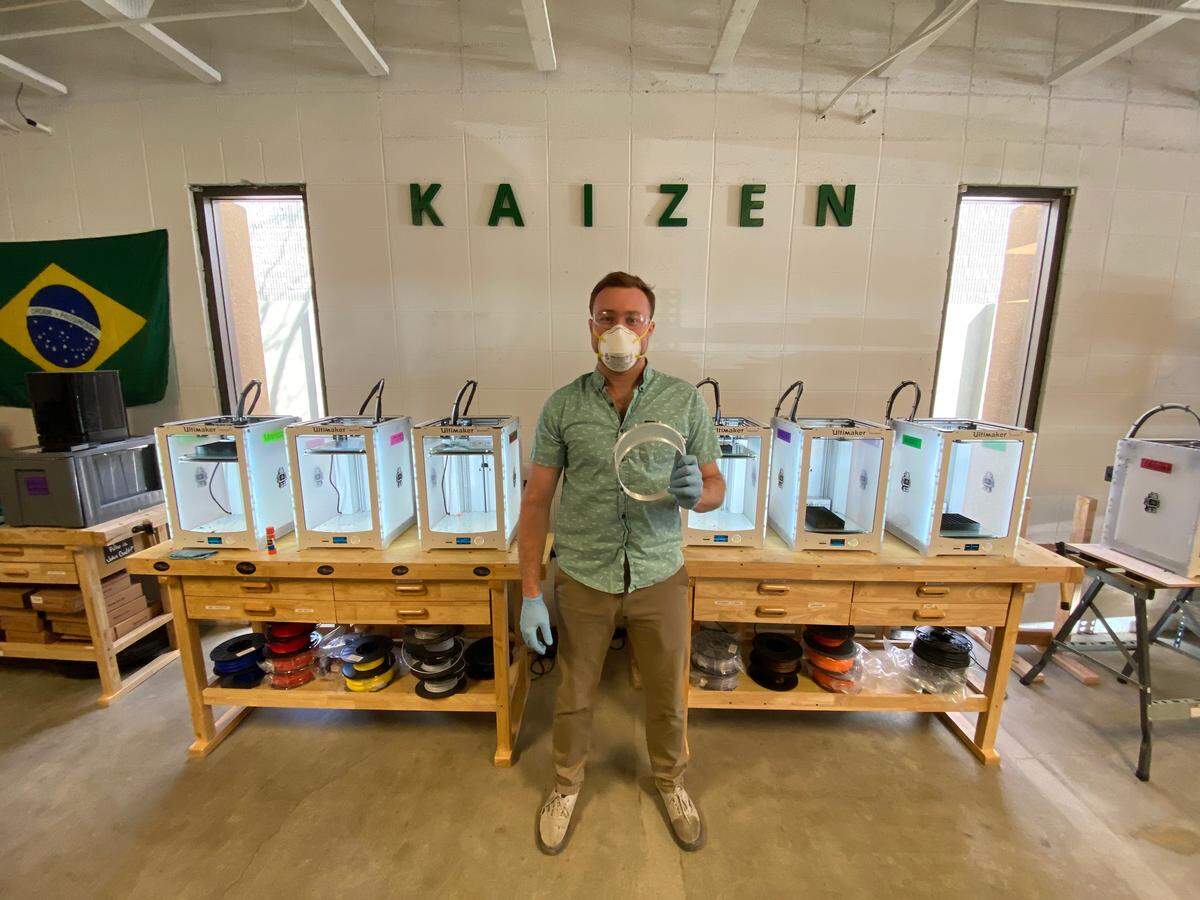
Justin Shook was one of the first engineers Vecchione called. He owns Shook Ideas, a product development and consulting business in Boise, and quickly got to work printing an open-source design that Vecchione shared with him.
The design was simple — a headband, built to be adjustable, that clipped onto a plastic shield that covered the entire face.
After printing the prototype, Shook was told to drop it off at a table outside the MakerLab, located in the Albertsons Library. There, he was surprised to see dozens of bags piled up on the table, with perhaps 100 prototypes, designed by fellow volunteers.
Now, he’s waiting for Vecchione to select the best prototype, so he can print as many as he can at his office off Curtis Road. Each headband will take about three hours to produce. With the seven 3D printers in his workshops, Shook estimates that he can print 56 headbands per day if he runs his machines 24 hours straight. He is working to make the design even simpler, so he can print faster.
Back at the Boise State MakerLab, the headbands will be assembled with one of the plastic shields that Vecchione has been laser cutting. Altogether, each complete face shield takes four hours to make.
The shields are designed to be reusable and easily sterilized by local hospitals. Vecchione hopes to make 1,500 by the end of next week, and distribute them to hospitals operated by St. Luke’s, Saint Alphonsus and Saltzer Health.
Through one of Boise State’s partners, the Gorongosa National Park, the Face Shield Initiative will also send products to Mozambique. The East African country, with few health care workers and supplies, has struggled to prepare for the coronavirus outbreak.
“They’re trying to get their hands on any resources they can,” Vecchione said.
The face masks haven’t received approval from the Food and Drug Administration, which ensures they are meeting safety standards. Vecchione knows that, but she did research to make sure that the products will be useful to health care workers.
“This will protect them more than nothing,” she said.
3D printing also takes a long time, making it an inefficient long-term solution to address shortages of personal protective equipment, Shook said.
But it can be a stopgap solution for PPE as larger manufacturers retrofit their factories to churn out face masks and other medical supplies.
“I’m hoping to show that in the U.S., individuals and the community can come together ... because we know it’s the right thing to do,” Shook said.
Designing an app to track coronavirus
Over 100 miles away from Boise, in Sun Valley, the coronavirus outbreak inspired Leif Elgethun to launch a very different project.
The idea came from Elgethun’s day job as CEO of the Boise startup Retrolux, which helps lighting contractors retrofit commercial and industrial buildings with energy-efficient lighting. As the coronavirus pandemic spread, Elgethun heard from several contractors who were barred from entering project sites because of concerns that they would get others in the building sick.
“Cleaners, contractors were getting pulled off of contract sites or getting a lot of rapid-fire new rules to access those job sites,” Elgethun said in a phone interview. That inspired him to ask: “If someone went into a building and got sick later, how do we let that site manager know that that person has tested positive for the coronavirus?”
He’s now working with a founding team of about 10 Idaho coders and designers on an application called Safe Access. It would allow building managers to track visitors, ask them about their symptoms, and then trace whether they fall ill after leaving the building.
“We want to ultimately provide that long-time traceability ... so we have a tool to identify outbreaks in the future, who’s been where, who they may also have been in contact with — so those people can self-quarantine,” Elgethun said.
Many of the people working on the project are volunteering their time to launch the app, Elgethun said. Every one of his seven Boise employees at Retrolux has also jumped on board.
Elgethun’s team aims to launch the product next week. He hopes enough will download a premium version to allow the eventual hiring of employees to sustain the app.
“We look at this as a good opportunity to give people who are underemployed an opportunity to give back to the community and find purpose,” he said. “We are also committed to ensuring we hire as many people locally in Boise as possible.”
Elgethun said he is inspired by his team’s dedication.
“This has really reinforced the positive power of our collective good,” he said. “People really do want to use their talent to help during a crisis.”
This story was originally published April 3, 2020 at 5:00 AM.