Idaho health care workers: We need more masks. ‘We feel like sitting ducks.’
Neilly Buckalew was fuming when she left a local rehabilitation hospital on Wednesday. The physical medicine and rehabilitation doctor had brought her own N95 mask to wear as she cared for patients and — as she told the Statesman later that day — wasn’t allowed to wear it.
The mask can protect health care workers from the new coronavirus. N95s are in short supply at hospitals nationwide. That is why Buckalew brought her own when she came to Boise as a traveling physician to fill in for the week, she said.
“This is happening all over the country to nurses and doctors,” Buckalew said in a Facebook post. “I told them, I will wear it if I deem it necessary. They can fire me if they dare.“
They did dare, and she was fired over her insistence that she wear her mask, she said.
Buckalew is one of several Idaho health care workers who told the Statesman they worry they aren’t protected from infection as the number of COVID-19 cases in Idaho climbs.
They have reason to worry. Already, the Treasure Valley’s two big hospital systems, St. Luke’s and Saint Alphonsus, have had multiple medical workers test positive for the virus, and many more are staying home in quarantine as they await test results. Both health systems declined to disclose the number of workers who tested positive, the number who are quarantined or where those employees work.
The state on Monday had occupational data for 152 people in Idaho diagnosed with COVID-19. Of those, 22 — nearly 15% — said they work in health care, said Niki Forbing-Orr, spokeswoman for the Idaho Department of Health and Welfare.
Some workers told the Statesman that they believe their hospitals or clinics are working hard to protect them, but they worry that a nationwide shortage of personal protective equipment could hinder Idaho’s ability to respond to the crisis.
Some workers, like Buckalew, said they feel vulnerable to the virus, afraid of spreading it, and alarmed by what they see as an uncoordinated response to COVID-19.
Some said they have already been told to reuse masks.
Doctors, nurses fear mask shortages
Buckalew drove down to Boise to spend last week working at the Saint Alphonsus Regional Rehabilitation Hospital on Emerald Street and Curtis Road, a small hospital where patients go for rehabilitation from conditions like strokes and spinal injuries.
She brought five N95 respirators to wear — one for each day she was scheduled to work, she said. The tight-fitting masks can filter small particles from the air, offering health care workers more protection from the coronavirus.
“Our lives are in serious danger. If we die or walk out, the nation is screwed,” Buckalew wrote on Facebook.
The rehab hospital where Buckalew worked is a joint venture between Saint Alphonsus and Encompass Health, an Alabama-based health care company. Encompass Health sets the policies there, according to a Saint Alphonsus Health System spokesman.
“We continue to tap every resource available to provide personal protective equipment that meet the needs of our patients and staff as we deliver much needed care to our patient population,” Johnny Smith Jr., vice president of marketing services for Encompass Health, said in an email.
When asked specifically whether doctors, nurses and other staff are allowed to wear personal protective equipment they bring, Smith said, “Our focus is to use personal protective equipment that helps prevent the transmission of the virus. We have issued guidance permitting employees to wear their own commercially-produced masks if they are suitable for hospital use and are worn appropriately.”
At least one medical association has come out in support of allowing doctors to use their own personal protective equipment during the crisis.
Buckalew says a supervisor gave her a few different reasons why she couldn’t use her own N95 respirator.
One reason, she said: Any N95 masks had to be specially fitted to her, according to Occupational Safety and Health Administration rules. That’s a requirement OSHA temporarily lifted this month, in response to the public health emergency.
Another: “If you wear an N95, everyone is going to want one, and we can’t give them one.”
PPE shortage puts health workers at risk
The new coronavirus, which causes COVID-19, is a stealthy pathogen. It can infect people without making its presence known for days or weeks. Most people who contract it have mild symptoms, and some have no symptoms, even while they are contagious. Others experience severe illness and need to be hospitalized. A fraction need intensive care, need a ventilator to breathe, or die from the illness.
Hospitals in China, Italy and now the U.S. have been overwhelmed by patients sick with COVID-19. Idaho joined several other states last week in ordering residents to stay home — an effort to slow the spread of the coronavirus, so that Idaho’s hospitals can keep up with the outbreak.
Nurses and doctors have spoken out across the country and the world about a shortage of masks and other personal protective equipment, or PPE. It presents a two-fold crisis: a wave of contagious patients, hitting as PPE supplies run dry. Nurses in California and health care workers elsewhere have reported being told they cannot bring their own masks.
Health care workers point out that without protection, they may become the patients.
“The severe nationwide shortage of PPE is putting those of us on the front lines, including here in Boise, at profound risk,” said Shelley Brock, a certified surgical technologist at Saint Alphonsus Regional Medical Center.
Buckalew told the Statesman, “There’s no rule book for this, and there’s no time for errors.”
Hospitals say they have enough masks for now
St. Luke’s and Saint Alphonsus health systems operate most of the hospitals that will care for COVID-19 patients in the Treasure Valley and South Central Idaho. Both systems said they are prepared with enough supplies, but that their supply chain teams are monitoring the issue daily.
“So far, we’ve been able to adjust (to have enough supplies) where needed,” said Beth Toal, spokeswoman for St. Luke’s Health System. “It continues to be a challenge that all health care providers are facing.”
The shortage is one reason both Saint Alphonsus and St. Luke’s suspended elective surgeries earlier this month, the spokespeople said.
“It not only helps limit exposure risk to patients, staff and providers; It also helps with the conservation of limited supplies,” Toal said.
When asked whether Saint Alphonsus allows its doctors, nurses and staff to bring their own PPE if they don’t feel protected, spokesman Mark Snider said the hospital system has “sufficient PPE, so there is no need for providers to bring their own.”
Snider said the health system is “carefully managing our inventory, but at this time, we are able to meet our needs and give our colleagues and providers the appropriate level of PPE.”
Dr. Steven Nemerson, chief clinical officer for the Saint Alphonsus Health System, said in an emailed statement that the system has enough to protect “colleagues, patients and visitors” but doesn’t have enough “to provide PPE upon demand without medical indication.”
Patrice Burgess, a family physician who works for Saint Alphonsus, said she worries more staff will have to leave the hospitals as the pandemic spreads in Idaho, at a time when they are desperately needed.
“Those that aren’t sick are having to work harder, because we have people out on quarantine or are out awaiting results,” Burgess said.
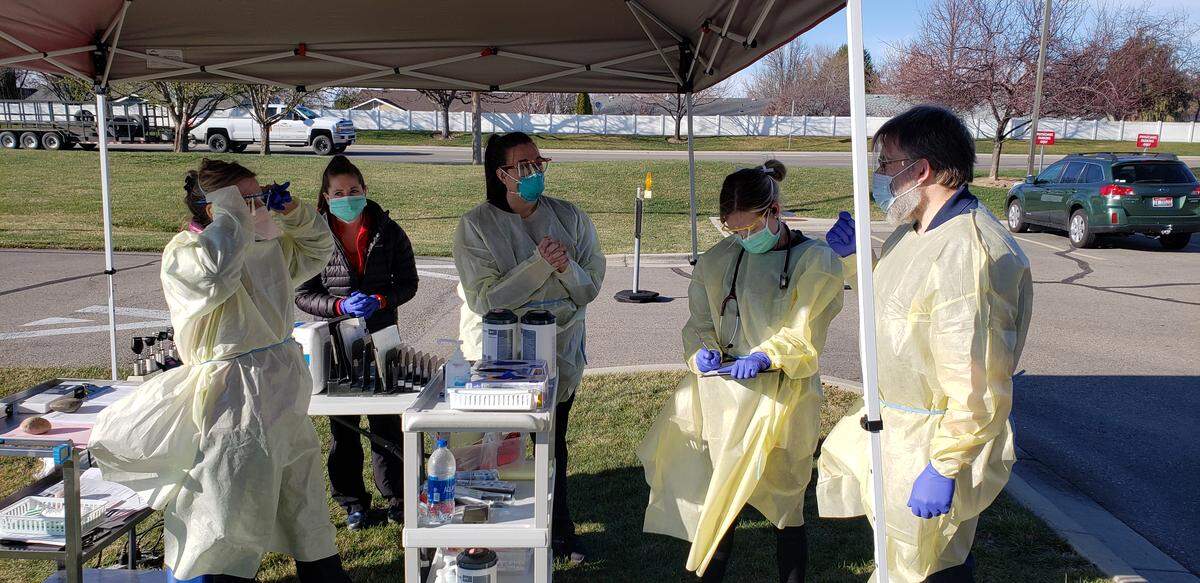
Doctors, nurses, others worry they will get COVID-19
Idaho’s hospital systems are currently “doing a good job on supplies,” said Dr. Heather Hammerstedt, Idaho chapter president of the American College of Emergency Physicians.
But doctors in Idaho have seen what is happening in other parts of the country, like New York City. They are worried about managing the influx of patients — especially when a patient can appear so healthy that a doctor wouldn’t normally need a mask.
“We’re on like mile 1 of a marathon and have already seen what’s coming,” Hammerstedt said. “Many of us, especially in emergency medicine, are buying (or) have bought our own respirators in case we start running short.”
Physicians would like more communication from state officials on the plans for acquiring and distributing masks, gloves, gowns and other supplies, she said.
“And we need better communication, period,” she said. “We’re out here like an army with no ammo.”
Health care providers told the Statesman they need the federal government to use its powers to ramp up production of masks and other equipment — in addition to distributing what is in the national stockpile.
Burgess said the system is trying to conserve equipment for when it is needed.
“We haven’t felt like we don’t have what we need at this moment,” she said.
Some health care providers told the Statesman they’re already being told to reuse masks, to conserve supplies so they have enough for a wave of patients that may come through the doors in the coming weeks or months.
“Just a week ago, we were rationing masks in the operating room, and some staff had been asked to reuse them,” said Brock, the Saint Alphonsus surgical technologist. “It’s relaxed a bit since then, but there’s no telling how long that will last. We realize the hospital is doing the best they can to protect us under the circumstances with the PPE they have available.”
Health care workers like Brock are urging people to stay at home — if not out of concern for their own lives, then for those who are risking theirs to fight the pandemic.
“We feel like sitting ducks,” Brock said. “If our entire workforce gets sick at the same time, we are all going to be in deep trouble, and that’s where we are headed.”
This story was originally published March 30, 2020 at 6:31 PM.