Is the middle class shrinking? Here’s how much you need to be in Idaho’s middle class
It’s safe to say that most Americans have heard the phrase “the middle class is disappearing” at least once in their lifetime.
As the richest class gets richer and more households fall below the poverty line, many are noticing a shift.
But how different is the modern-day middle class from a decade ago?
What is considered middle-class today?
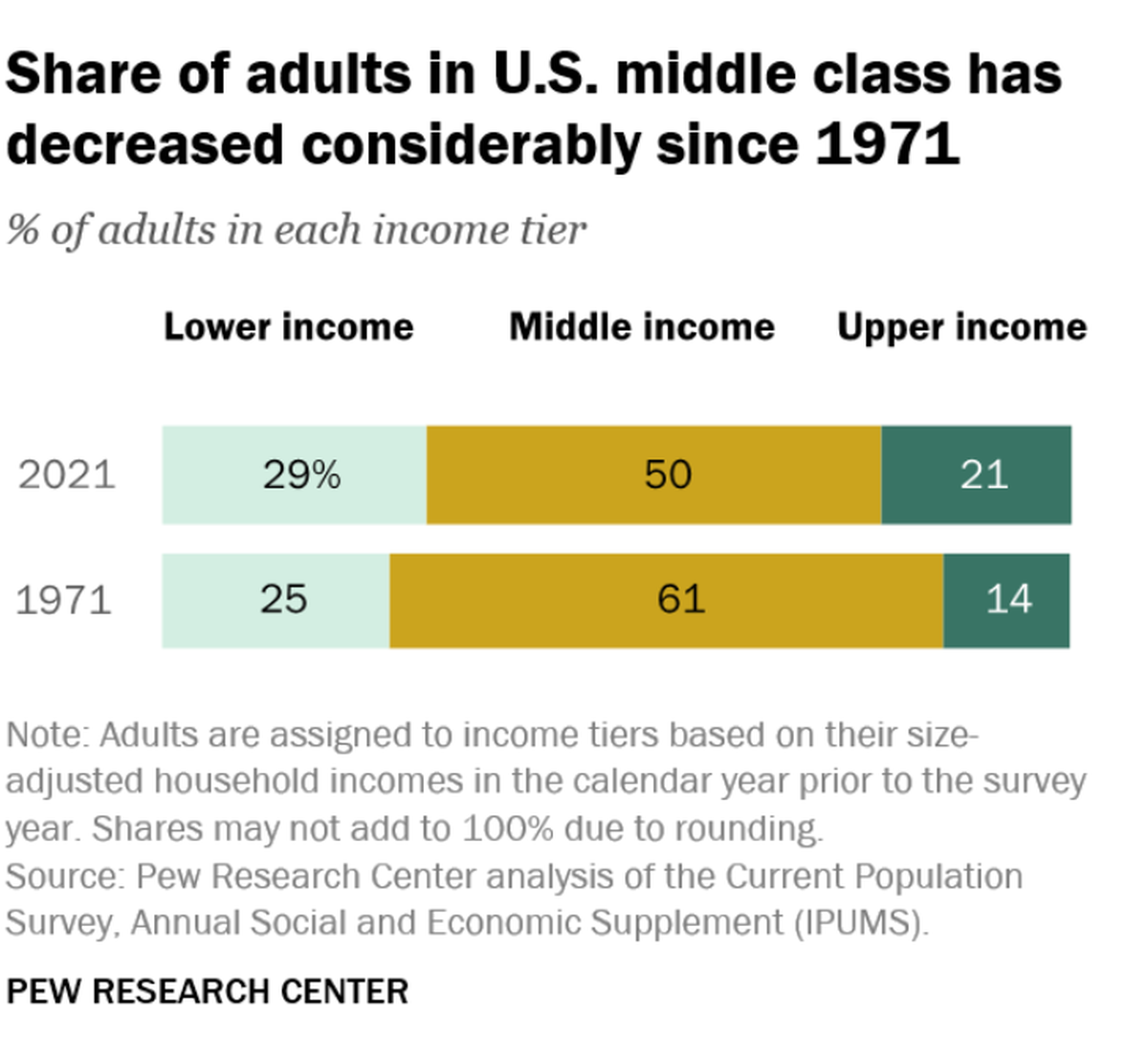
The Pew Research Center says that more than 60% of U.S. households were considered middle-class in the 1970s, but that percentage fell to 50% in 2021.
In the 1970s, the median middle-class income was about $59,900; by 2020, it had risen to $90,100.
Using data from the U.S. Census Bureau, the personal finance resource GOBankingRates analyzed data from the 2022 American Community Survey to determine the income boundaries for the middle class in each state based on data for 2022 — the most recently available complete data.
Nationally, the middle class in 2022 included households with incomes between $50,100 and $150,300.
In 2012, a decade earlier, the middle class included households with incomes between about $35,400 and $106,100.
What about Idaho? How has the middle class changed in the Gem State?
Middle-class decreases in Idaho
When comparing each state, Idaho had the fifth-greatest change in middle-class income between 2012 and 2022, according to GOBankingRates.
In 2012, Idaho’s middle-class income range was about $31,343 to nearly $94,030.
In 2022, the range was $46,809 to almost $140,428. That’s a 49.3% change.
Interestingly, the most significant changes in middle-class income over the last decade are in the country’s western half, including some of Idaho’s neighbors.
Oregon had the greatest change, with the middle-class income range increasing by 53.2%, closely followed by Washington at 52.1%.
In 2012, Oregon’s middle-class income range was nearly $33,400 to about $100,100. By 2022, it rose to a range of $51,100 to about $153,300.
Here are the top 10 states with the greatest change in middle-class income:
Oregon - 53.2%
Washington - 52.1%
Colorado - 50.4%
California - 49.7%
Idaho - 49.3%
Utah - 49.3%
Montana - 46%
Tennessee - 45.1%
Rhode Island - 45%
Massachusetts - 44.8%
This story was originally published June 4, 2024 at 3:19 PM.