
‘He was the perfect guy at the perfect time.’ Durcan prepares to retire as Micron CEO
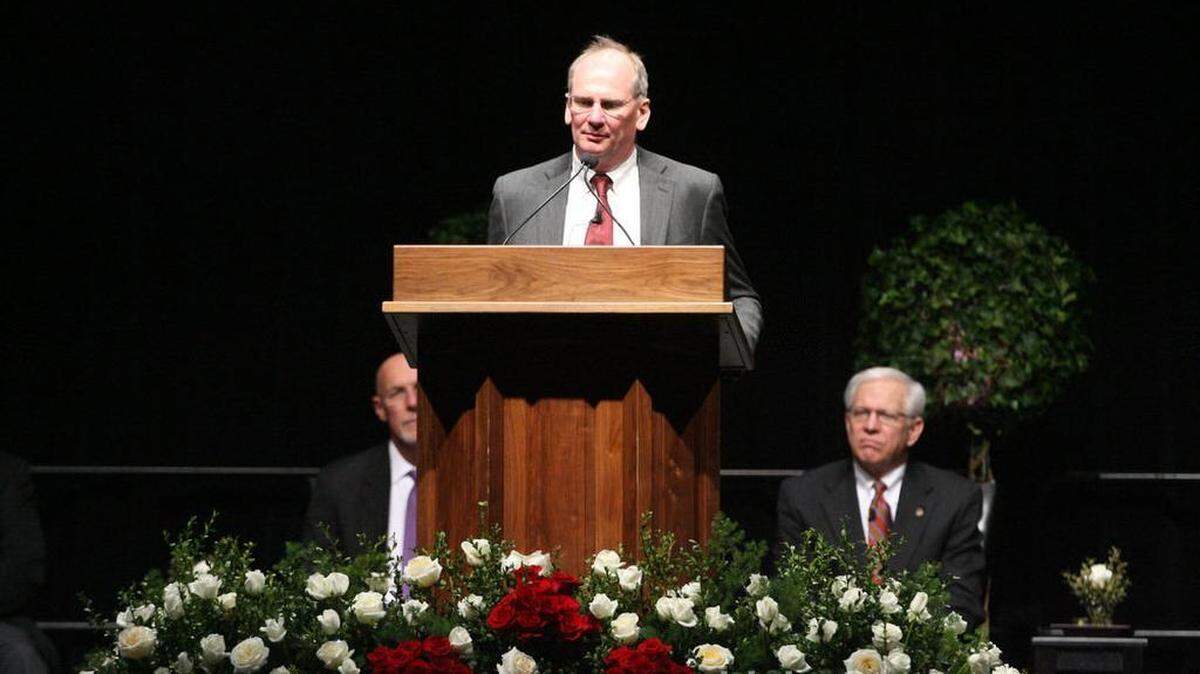
Mark Durcan, the Micron Technology Inc. CEO who revealed Thursday his plan to retire, will leave the company strong and competitive, analysts and Idaho business leaders say.
“Markets are doing really well for them,” said Mike Howard, a semiconductor analysts for IHS iSuppli and a former Micron employee. “Financially, they are an extremely strong company. If there is a good time, now is probably one of them for him to sort of exit.”
Durcan also will leave with respect from the business community and others for the philanthropic work Micron has done under his watch to improve technology and education. Most notable is the $25 million investment in a Material Science Building at Boise State University to enhance education and research on the cutting edge of engineering.
“He’s been a tremendous leader,” said Jay Larsen, Idaho Technology Council president.
I don’t think there is any question he rescued Micron at a moment when no one knew what was going to happen next.
Bob Kustra
Boise State University presidentDurcan 55, will continue as CEO while the company’s board of directors looks for a replacement. He has worked at Micron for 32 years.
A special board committee is searching for candidates.
“Mark Durcan recently discussed with the board his desire to retire from Micron when the time and conditions were right for the company,” Robert E. Switz, board chair and member of the search committee, said in a press release.
“As CEO, he has successfully guided Micron’s strategy and growth for the past five years and has allowed the company to initiate this transition from a position of strength.”
PROVIDING CONTINUITY
Durcan leaves a legacy as a strong CEO, especially for someone who never planned to have the job.
In early 2012, Durcan announced he was leaving the company as president and chief operating officer, to spend time with hits family.
Then on Feb. 3, 2012, CEO and board chairman Steve Appleton was killed in the crash of an experimental aircraft near Boise Airport.
“(Durcan) got dragged back into it to run the company,” Howard said. Durcan took the reins of what is now the third-largest memory chip maker in the world and the largest for-profit employer in the Treasure Valley.
Durcan didn’t respond to an interview request Thursday. But he talked to the Statesman in 2012 about his decision to stay on at Micron.
“That seemed like the best thing to do, because there is continuity there,” Durcan told the Statesman. “I knew the board supported me and we could continue moving forward.”
Appleton’s death shocked the company and the community. He was Micron — a forceful, high-profile and charismatic figure who’d led Micron for 18 years. He’d been a tennis star at Boise State, he flew planes in airshows and drove race cars. He grew Micron into a global leader in the memory chip business on a massive campus that greets travelers arriving in Southeast Boise along Interstate 84.
Durcan faced a workforce at Micron that was fearful and stunned over Appleton’s death.
“He certainly was a pillar in our community at a time when we needed a strong pillar,” said Bill Connors, Boise Metro Chamber of Commerce president and CEO.
There is nothing interim about my role as CEO of Micron.
Mark Durcan
shortly after becoming Micron CEO in 2012‘HE’S THE GUY’
Durcan seemed the inevitable choice to fill the gap immediately following Appleton’s death.
Bob Kustra, Boise State University president, said he talked with a member of Micron’s executive team hours after Appleton’s death. How was the company going to replace Appleton? Kustra asked.
“We have to convince Mark Durcan to change his plan and come back to the company. He’s the guy who can make this work,” Kustra recalled being told.
“He came along at a moment that was absolutely critical for Micron’s future,” Kustra said.
In the days after Appleton’s death, Durcan met with team leaders, sent out a company memo and talked to people in the hallways — always, he said, with the same message: “We were going to have continuity, and that we would be all right and that (we had) a lot of good things going for us. And I would be willing and happy to stay on if that’s what the board wanted to do.”
Durcan quickly established his presence on the job. In a meeting with analysts in Scottsdale, Ariz., a week after Appleton’s death, he stuck to his continuity message: He was in charge and planned to stay.
“I can’t do anything half-assed,” he said at the time. “I’m not as good as Steve at some sports, but I’m a hard-nosed competitor. There is nothing interim about my role as CEO of Micron.”
GROWING MARKET SHARE, PRODUCTS
As a CEO with a background in engineering and techology, Durcan worked with then-President Mark Adams to ensure a seamless transition.
He’s credited with carrying through on Micron’s plan to purchase Elpida Memory Inc., a bankrupt Japanese chip maker, in 2013 that helped solidify Micron’s place in the computer memory chip world.
Elipda’s purchase increased the company’s market share and provided new products to help its then-ailing mobile phone memory business.
He also pushed the company to develop long-term business relationships to supply products to companies in the automotive industry, for example, that positioned the company to become more than a maker of memory chip.
Durcan’s retirement announcement doesn’t come as a surprise to those who have watched him and the company over the years.
But his absence will be felt. “A lot of deep history with everybody who is working there,” Howard said. “A lot of them probably started after he did. I think he is going to be sorely missed.”
Bill Roberts: 208-377-6408, @IDS_BillRoberts
About Micron
▪ Number of employees: 32,000 worldwide, 6,000 in Boise.
▪ Micron makes memory chips for a range of products including PCs, automobiles and mobile phones.
▪ Micron was founded in 1978 and went public in 1984.
▪ Micron is headquartered in Boise.
▪ Latest quarterly revenue: $3.97 billion, up 19 percent from the same quarter last year.
▪ Micron stock closed at $24.79 Thursday, up 4 cents for the day.
This story was originally published February 2, 2017 at 7:05 PM with the headline "‘He was the perfect guy at the perfect time.’ Durcan prepares to retire as Micron CEO."