He was one of Idaho’s top track stars. Now he slides face-first down the ice.
How would you feel standing at the top of the scariest ski run you can imagine?
That’s about how Andrew Blaser felt as he learned skeleton — one of the least-understood sports in the Winter Olympics.
“When you stop crying, you can see where you’re going and it gets a lot more fun,” Blaser said last month as he prepared for his first season on the World Cup tour.
And no, he isn’t kidding.
“I literally was crying,” he said. “My coach would push me off the top.”
Blaser, 30, grew up in Meridian and was a track standout at the University of Idaho, where he competed in the decathlon. He decided to try bobsled after college — like three-time Olympian Nick Cunningham of Boise State did — but that didn’t work out in part because Blaser struggled to gain the necessary weight.
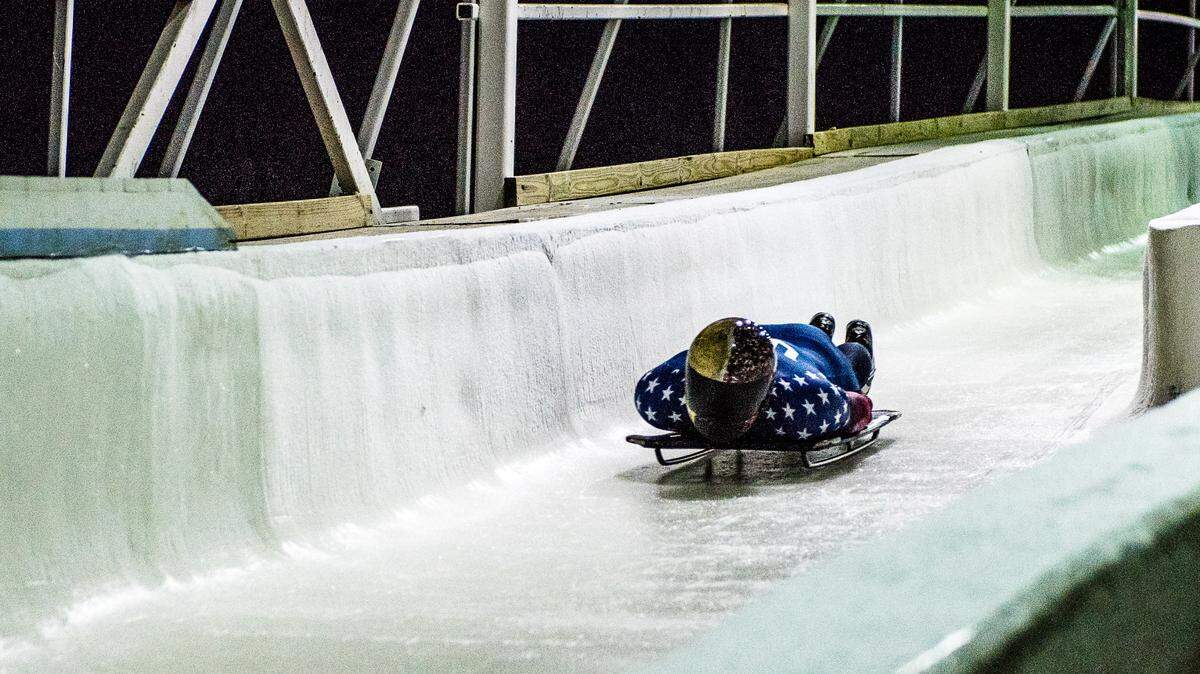
Skeleton uses the same track as bobsled and is part of the same federation, so Blaser tried that, too. It’s the sport where riders jump onto a sled at the top of the icy track and zip along face-first at speeds topping 80 mph with their chins centimeters from the ice.
“I’m not a thrill-seeker,” Blaser said, “so it’s a little different to be on a giant, out-of-control, frozen-water sled. ... My coach encouraged me to look at other options. Finally, I bought some new equipment and settled in and got much better in a very short time frame. But I kind of had to force myself to do it every day.”
And now that dedication is paying off.
Blaser spent the past three seasons competing primarily in North America, never finishing higher than eighth at the national team trials. But at the trials this year, he finished first among the men competing for the second spot on the World Cup team.
That puts him in the running for a spot on Team USA for the 2022 Winter Olympics in China. The U.S. usually gets two or three spots in men’s skeleton.
“He slightly doubted his ability to make World Cup this year,” said Lauri Bausch, a skeleton coach with the U.S. bobsled and skeleton federation. “I think it was more of a dream. … I completely see him sitting in that position going to Beijing.”
Blaser has the advantage of learning the World Cup tracks this season, which should help him achieve higher finishes next season, Bausch said. That sets up perfectly going into the Olympic year.
“2022 is always going to be the goal,” Blaser said. “It’s an Olympic sport — that’s really the peak of the pyramid. You work all this time for one two-week experience. But I’m also trying to keep things in perspective and realize there’s four years of work that go in between each one of those.
“If 2022 doesn’t happen, I want to be OK with that. Whether or not I am is a different story.”
Blaser, whose brother Sherm is the Kuna High football coach who just won a state title, won three state championships and earned 11 state medals on the track team at Meridian High.
Blaser’s 2012 track season at Idaho was spectacular. He scored a school-record 40 points at the WAC Indoor Championships, including wins in the heptathlon, high jump and 60-meter hurdles. He earned first-team All-WAC honors in five events and the Vandals won their first WAC championship. At the WAC Outdoor Championships, he was named the Outstanding Field Performer and received the High Point Award for scoring a school-record 44 points — the most by any NCAA athlete at a conference meet that season. He won the decathlon and 110 hurdles and finished third in four other events to grab six first-team All-WAC awards.
He detoured to bobsled and skeleton instead of a pro track career and has bounced around Boise; Park City, Utah; Lake Placid, New York; and Colorado Springs depending on the training season. He also spent time as a track coach at Utah State in his first year out of college.
Blaser stuck with the icy track despite the challenges in large part because of the people he met there. This is his fourth full season of skeleton after experimenting with bobsled and skeleton for a couple years.
“Half of it was not letting an athletic event beat me, and half of it was not wanting to walk away from friends,” he said. “I was coaching track at Utah State. I walked away from my job. If I wasn’t very good, that would be for nothing.”
The joke on the U.S. team is that Blaser has “quit more than anyone on the team,” he said. But this year, his comfort level has spiked.
“This is the first time it’s felt like I’m consistently improving and figuring things out and not ready to feel like I’ve run my course here,” he said. “I’ve had a lot of emotional battles and financial battles and physical battles with it. This year I came into it with a really different mindset and really attacked the beginning of our season.”
He has one of two U.S. “funded sleds” on the World Cup this season, which covers his travel costs. But he has put himself in this position by working as many hours as possible at restaurants in Park City, Meridian and Colorado Springs when he’s available. The Ram in Meridian even helped him transfer to a sister restaurant in Colorado Springs, he said.
At the first two World Cup races this season, he finished 23rd out of 27 racers on Dec. 8 and 22nd out of 27 racers on Dec. 13 in Lake Placid. The tour moves to Europe in January.
Bausch remembers Blaser getting so anxious before races — even before walking a new track — that he’d vomit. The nervous act was a holdover from his days running track, she said.
The World Cup will be a chance to see how much he’s grown, she said. She noted improvement last season, when Blaser was able to compete more and earn many more runs on the tracks. In previous seasons, he might only get 10 runs in an entire season, she said. He quadrupled that last season.
“To an extent, it was literally people being, ‘Dude, snap out of it, you’re better than you think,’ ” she said. “… I think he realized at some point he did have a fairly natural grasp of it. And sometimes the bumps, bruises, flips, the really awkward moments — it just happens in this sport.”