Idaho’s high school classification system is outdated. This new policy will help fix it.
Idaho took another step toward fixing its archaic system to organize high school sports Wednesday.
Football teams can now petition down a classification — and remain eligible for the playoffs — starting in the fall of 2022 following an 8-6 vote from the board of the Idaho High School Activities Association. Previously, schools could only change classifications for all of their sports.
This is an idea that is long past its time. It creates flexibility in a rigid system. It provides a lifeline for struggling programs. And it puts the focus on what actually happens on the field instead of arbitrary enrollment boundaries.
I often argue the IHSAA should go further and faster in its reforms. But we should give the state activities association credit for its slow but steady march to modernize. Because the current system is pushing programs around the state to the brink of collapse.
“Sometimes they need that opportunity to petition down, not necessarily to make their schools competitive, not necessarily to win a state championship, but to save programs,” said Tim Perrigot, an IHSAA board member, former football coach and Wendell superintendent, during Wednesday’s meeting.
“That’s the term that kept coming up the most in that meeting we had with football coaches. There needs to be an opportunity for schools to save their programs.”
Gripes about who plays in what classification run rampant in every state. The vast majority are hot air. But Idaho has a real problem staring it in the face. Look at Boise and Caldwell as examples locally.
Boise is the state’s fourth-largest school with 2,102 students in one of Idaho’s most affluent areas. Yet the Brave have just one winning season in the past 28 years and haven’t made the playoffs in 18 years, the longest active streak among 5A teams in the state.
Caldwell is Idaho’s 17th-largest school with 1,425 students in one of the state’s poorest areas. The Cougars haven’t posted a winning record in 15 years, the longest active streak in the 5A and 4A Southern Idaho Conferences. And they haven’t made the playoffs in 15 years.
But forget wins and losses. This is about survival. The programs at schools like Boise and Caldwell cannot survive on their current paths.
Decades of losing creates a death spiral that chases students away from the program, which leads to more losses, which convinces even more students to abandon the sport and makes it next to impossible to reverse course.
Boise narrowly avoided forfeiting varsity games in 2019. Caldwell couldn’t last fall, forfeiting its final three games when low turnout combined with academic issues to create a crisis.
That’s unthinkable at schools the size of Boise and Caldwell. Yet it’s the reality we face. And you can find similar examples around the state.
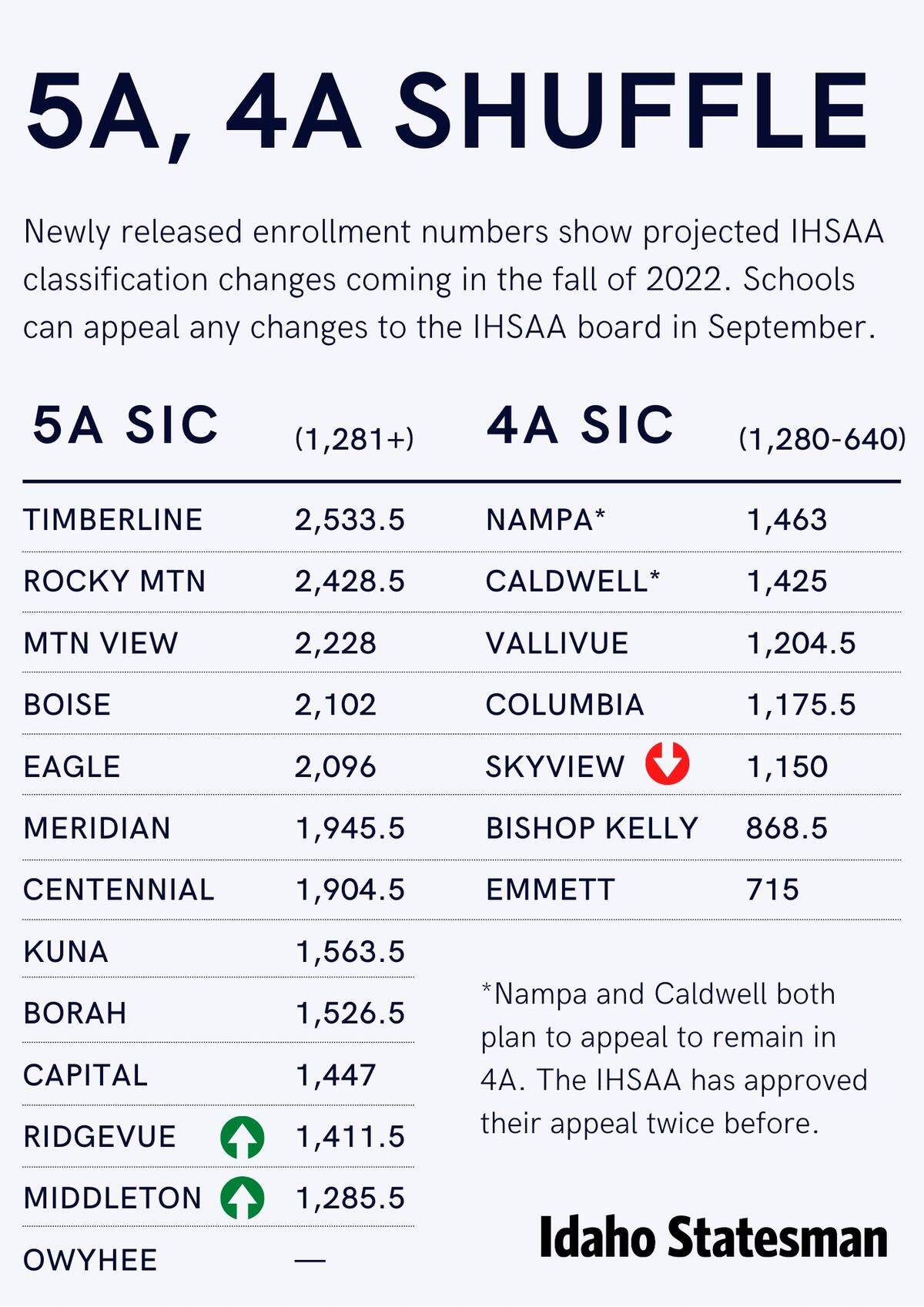
Ridgevue (4A) is 10-35 (.222) since it opened in 2016. But it can’t field a junior varsity team and needs an IHSAA exemption to avoid moving up to 5A in 2022 with 1,411 students. The 4A maximum is 1,280.
Payette (3A) is 20-74 (.213) since its last winning season and playoff appearance in 2009. The Pirates had to forfeit their entire league schedule in 2018 and finally snapped a 21-game conference losing streak last fall.
Wendell (2A) is 7-51 (.121) since 2014 and forfeited its regular-season finale last fall. Yet the Trojans are now the largest 2A school in the state and may need to move up to 3A in 2024.
Marsing (2A) is 5-50 (.091) since 2013 and has lost 34 straight 2A Western Idaho Conference games. Four of its five wins were against Wendell and Payette.
“Nobody wants to get beat 50-0, and it’s really no fun to win 50-0,” Ridgevue coach Tom DeWitz said. “I think they should do what’s best for kids, and what’s best for kids is to be placed where they are competitively equitable.”
The bottom line is enrollment is not everything in high school sports. It’s certainly a factor in wins and losses. But it’s not the only factor. And the sooner Idaho treats it as such, the better experience it can give students — which is the whole point of high school sports.
That’s a radical idea in Idaho. But it’s one other states have embraced with success from varying approaches.
“We can’t just sit in the olden days and the olden times and say, ‘This is the way it’s always been done,’ ” Sugar-Salem football coach Tyler Richins said. “We’ve got to put our heads together and try to make things better.”
Idaho took its first steps away from enrollment-only classifications in the 2018-19 school year, allowing schools struggling in the win-loss column to move down. But the IHSAA bungled the first go-round, casting the net too wide and allowing schools like Kuna and Idaho Falls to drop to 4A with 5A enrollment numbers.
Those two had no business playing in 4A and quickly proceeded to win eight state championships in everything from football to boys basketball to wrestling to cross country. That led to howls across the state and soured fans and school administrators on reform. But after that bruising, the IHSAA put schools under extra scrutiny for the 2020-21 school year. The tighter standards largely worked, allowing fewer schools to move down.
Those tight fists remain the key here, too. Everyone benefits when programs on the verge of extinction get a chance to stabilize and rehabilitate. But schools who’ve merely missed the playoffs for a couple years can stay put and get better. This needs to be reserved for those who truly need it.
This new rule actually will smooth out many of the complaints about the current petitioning process. The vast majority of schools asking to move down a classification are doing it for football. Getting hordes of students to turn out for basketball or volleyball isn’t crucial to success in those sports. And no golfer or softball player puts their personal safety at risk when their team is overmatched.
But Idaho currently uses a one-size-fits-all system for classification, dragging soccer and baseball teams to a lower class when the football program is the one that needs help.
It’s certainly easier to have all sports in one classification. It’s easier to just look at enrollment and tell schools that’s where they belong. It’s easier to turn a blind eye as football programs teeter on the edge.
But find me a single high school coach of any sport who says the easy road leads to the best outcomes.
This system is admittedly more complicated and requires more work. But it also creates a committee of football coaches to provide the first level of scrutiny, hopefully saving the IHSAA from another Kuna or Idaho Falls mistake.
Give me a room full of dedicated individuals over a set of arbitrary numbers any day of the week.
“Ultimately,” Richins said, “it’s about doing what’s right for the game of football in the state of Idaho.”
This story was originally published June 10, 2021 at 1:18 PM.