Boise State hoops coach says a first-half lead is ‘fool’s gold.’ Is that true?
In the space of just 11 days, Boise State men’s basketball found itself in two home games leading by at least 20 points in the first half.
And on both occasions, the Broncos were forced into overtime: First, a 30-10 first-half lead turned into a 91-87 overtime win over Nevada on Feb. 3, and then a 32-9 first-half lead over UNLV dissipated into an 86-83 loss this past Friday.
Boise State head coach Leon Rice said after the first 20-point blown lead, against Nevada, that a first-half lead is “fool’s gold” — a throwaway line that can be lost in the mix of an exciting home win.
“In the old days, you get a lead like that, and (you) were relatively safe,” Rice said after the Nevada game. “Nowadays basketball is so different, it’s almost fool’s gold.”
He said the phrase again late last week in the aftermath of Boise State throwing away a 23-point lead in the overtime loss to UNLV:
“First-half leads nowadays in college basketball are fool’s gold, so there’s always that,” Rice said.
The Nevada and UNLV games stand out for both the magnitude of the blown leads and recency bias, but they’re not the only examples of Boise State letting big leads slip. Back in November, the Broncos narrowly defeated St. Mary’s 68-67 despite leading by 13 points in the first half and by 14 points with just 4:24 left in the game.
Ahead of Boise State’s (15-10, 7-7 Mountain West) trip to conference-leading Utah State (22-3, 12-2) on Wednesday, the Idaho Statesman asked Rice why he thinks a first-half lead is fool’s gold “nowadays” compared to previous times.
“You watch games, both teams would dribble out the clock under a minute up eight (points). Now it’s like that game’s still in balance,” Rice said.
“You’re like, ‘Oh, they’ve got a 10-point lead in the second half.’ These are two good teams, and that thing’s gone in a minute,” Rice continued. “There are so many good players, there’s the 3-point line, the ability for teams to just turn it on a dime with defense and fouling and a missed free throw, then another 3 and 6-point, 7-point swings.”
Is Rice correct that first-half leads are “fool’s gold” in college basketball?
It’s difficult to quantify across all of college basketball the rate at which teams blow big first-half leads. Sure, there are high-profile examples throughout the past few decades, such as North Carolina blowing a 15-point halftime lead to lose 72-69 to Kansas in the 2022 national championship game, or Duke’s 22-point comeback to defeat Maryland 95-84 way back in the 2001 Final Four.
On a wider scale, a 2023 study produced by the Harvard Sports Analysis Collective didn’t focus on an increase in blown leads specifically, but it did find a pattern that first-half points generally are less predictive of winning compared to points scored in the second half.
The study, which drew data from the entire 2022 college basketball season, found that the moments leading up to halftime and immediately after it are more closely correlated with game success. Boise State experienced this against UNLV, in which a late flurry from the Rebels narrowed Boise State’s lead from 23 points to 11 by halftime.
“It was crucial in the last five or six minutes of the first half, instead of being up 23 and taking it further, they became the aggressor,” Rice said after the UNLV game. “And they scored every possession almost down the stretch of that first half.”
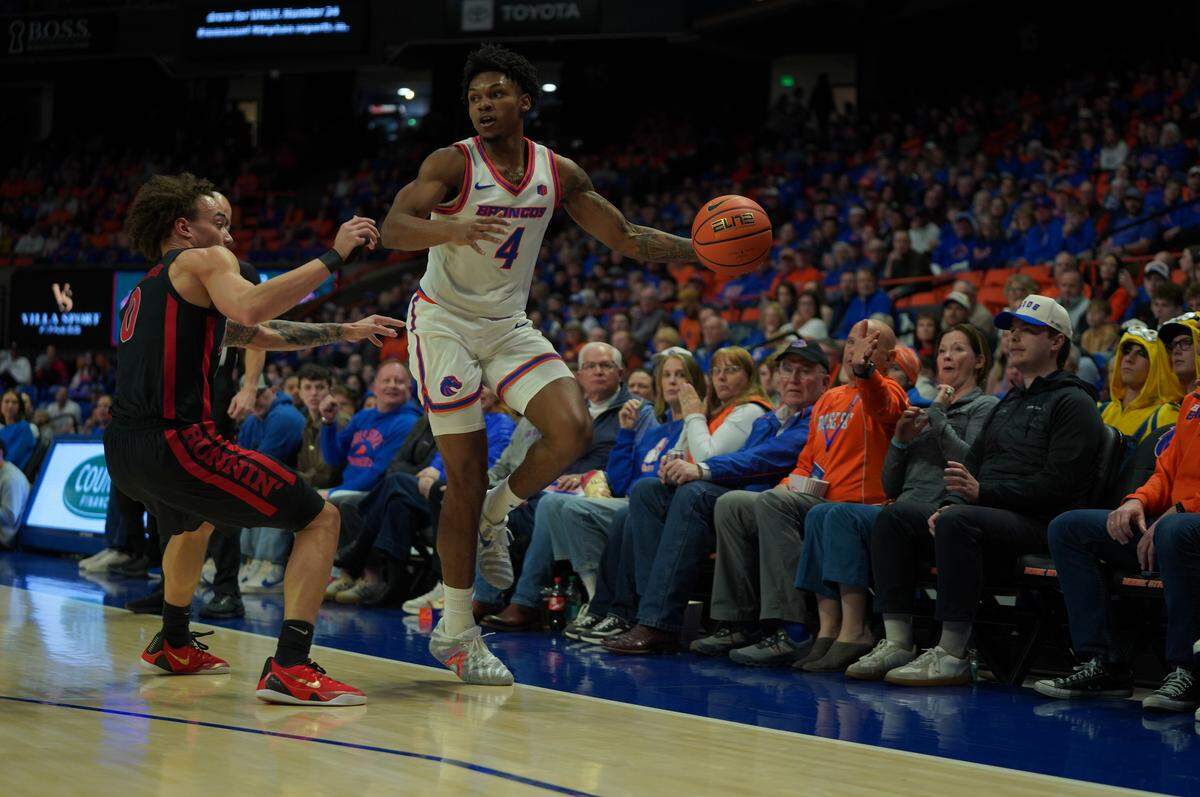
A bucket counts the same, whether it comes in the first minute or the 40th, so what could be the reason for first-half points being less indicative of success? One causal reason suggested by the study is the rubber-band effect: the idea that a strong start leads the winning team to take its foot off the gas, while an early deficit can prompt the losing team to band together to close the gap.
Boise State sophomore forward Pearson Carmichael unknowingly hinted at the effect after the loss to UNLV.
“I just think our defense got complacent,” Carmichael said after the loss. “It’s just something that we need to stay locked in at all times, no matter the score.”
Rice knows fans don’t like seeing the Broncos lose big leads — he’s at the forefront of hating a lead slipping away. On Tuesday, he acknowledged that his team could have done better in the loss to UNLV, particularly on rebounding down the stretch; Boise State was outrebounded 18-12 in the second half and overtime.
But he also acknowledged a potential contributor to the rubber-band effect: an opposing player being almost unguardable. This time around, UNLV guard Dra Gibbs-Lawhorn scored nine points in the first half and 25 in the second half and overtime.
“When you go back and watch film, sometimes you think, ‘Well, we just let the foot off the gas,’ ” Rice said. “There might be some of that, but the other team had to do some things … there’s always the combination, because they still have to make the shots, and some of them are really tough.”
If the rubber-band effect comes into play on Wednesday night, the Broncos will be hoping it’s in their favor. Boise State travels to high-flying Utah State, which defeated the Broncos 93-68 at ExtraMile Arena last month. Tip-off at the Aggies’ Smith Spectrum is at 8:30 p.m. (FS1).