‘You can achieve great things’: Idaho State receiver might hear name called at NFL Draft
Recruiting college football players is an inexact science.
Some high school players make predicting their future easy. They’re simply bigger, better, stronger and faster than everyone on the field, and they have the stats to prove it.
Others slip through the cracks.
Former Idaho State wide receiver Tanner Conner can be counted among the hidden gems college recruiters probably wish they hadn’t missed.
Conner didn’t have a single scholarship offer from a college football program as a senior at Kentridge High School in Washington state, but he has a chance to hear his name called in the NFL Draft on April 28-30.
Conner — a 6-foot-3, 230-pound receiver — burst on the national scene with an impressive workout last month at the University of Washington’s pro day, which included a 4.37-second 40-yard dash and a 39.5-inch vertical leap.
He kept that momentum rolling with visits to the Miami Dolphins and Kansas City Chiefs, and a workout with the Seattle Seahawks. A recent mock draft from The Athletic’s Dane Brugler had Conners going to the Denver Broncos in the seventh round.
Playing in the NFL has always been Conner’s dream, he said, but achieving it seemed almost impossible. He described himself as a kid from what he described as a poor high school who then played for a college that competes at the FCS level and isn’t exactly swimming in resources.
“I think my story is going to inspire a lot of guys in similar situations,” Conner told the Idaho Statesman. “Maybe you don’t have the offers and the hype coming out of high school. Maybe you don’t have the resources available to players at bigger colleges, but as long as you continue to overcome obstacles and prove people wrong, you can achieve great things.”
The long game
In high school Conner was a skinny wide receiver on a team that ran a Wing-T offense, which offers precious few opportunities for receivers to shine. He caught just four touchdown passes during his junior and senior seasons.
Kentridge also wasn’t very good. The team won three games over those same seasons.
“In high school, our receivers spent practice working on blocking instead of running routes,” he said. “There was really no reason for college recruiters to notice me until they watched my film. It was just hard to get anyone to watch it.”
Conner was known by college track coaches, though. He was a force to be reckoned with in the 110-meter hurdles and a state champion in the 300-meter hurdles at Kentridge. He had scholarship offers from Power Five track teams, including Washington and Washington State.
The problem was that he dreamed of being on both football and track teams in college, and most of the coaches he spoke to were having none of it.
“I didn’t know if football was going to be an option,” Conner said. “It was really tough to focus on my long-term plan instead of just taking those offers.”
Fortunately for Conner, Idaho State track coach Hillary Merkley was one of the few who was open to his plan.
“When people make kids pick one sport, I think it closes a lot of doors and opportunities to develop or find their niche,” Merkley said. “Some kids miss out on opportunities that could take them to a different level because they don’t try multiple sports.”
During Conner’s official visit to Idaho State, Merkley introduced him to then-Bengals football coach Rob Phenicie and members of his staff. They took one look at his highlight film from high school and offered him a scholarship.
Merkley said Idaho State’s football coaches tried to convince Conner to focus only on football, but he stuck to his guns and it paid off. He set the 60-meter hurdles record with a time of 7.73 seconds at the Big Sky Conference indoor championship meet in 2019, and he competed in the 110-meter hurdles and 100-meter dash in multiple outdoor conference championship meets.
Conner also put on 50 pounds without losing a step — a feat he credits to time spent training for those short sprints, and one that completed his transformation from skinny receiver to NFL prospect.
“The biggest thing track taught me was how to properly run,” Conner said. “We started doing legit speed training during the summer before my last football season, and I was amazed at how many guys didn’t know how to use their bodies to produce the most speed and power possible.”

Conner was even more productive on the football field. He led the Bengals’ receivers in at least one statistical category in each of the past three seasons.
In 2019, he led Idaho State with eight touchdown receptions and was second on the team with 48 catches and 791 yards. He led the team with 34 catches and 685 yards in a six-game season that was played in spring 2021 because of COVID-19, and was again the Bengals’ top pass catcher last fall after hauling in 42 passes for 735 yards and four touchdowns.
“I have to give coach Phenicie a lot of credit for teaching me the game,” Conner said. “I feel like I can see the game from a coach’s perspective now.”
Phenicie was fired in November 2021 and is now an offensive analyst at Montana.
What position will he play?
Conner showed off his speed and power in front of scouts from 29 NFL teams at Washington’s pro day in March. He was so impressive that a group of them pulled him aside after his initial workout to run more drills.
He wasn’t just doing wide receiver drills, though. Conner said scouts wanted to see how he looked as a tight end, which came as a shock to him.
“Tight end would be different, but I understand the position and I’m not afraid to block bigger guys,” Conner said.
His size made him an asset in the red zone at Idaho State, and his speed created matchup problems for defenses. Those same assets could lead Conner to make a position change in the NFL. He said some teams like him as a traditional wide receiver. Others envision him as a tight end and even what he called a “power slot receiver.”
“I’m a little undersized to be a tight end, but that position is becoming more about being quick and agile in the NFL because teams are valuing more speed for mismatches,” Conner said. “Teams see a lot of utility and value in me, and they’re going to plug me in wherever they see fit.”
Other local FCS players to watch
Idaho
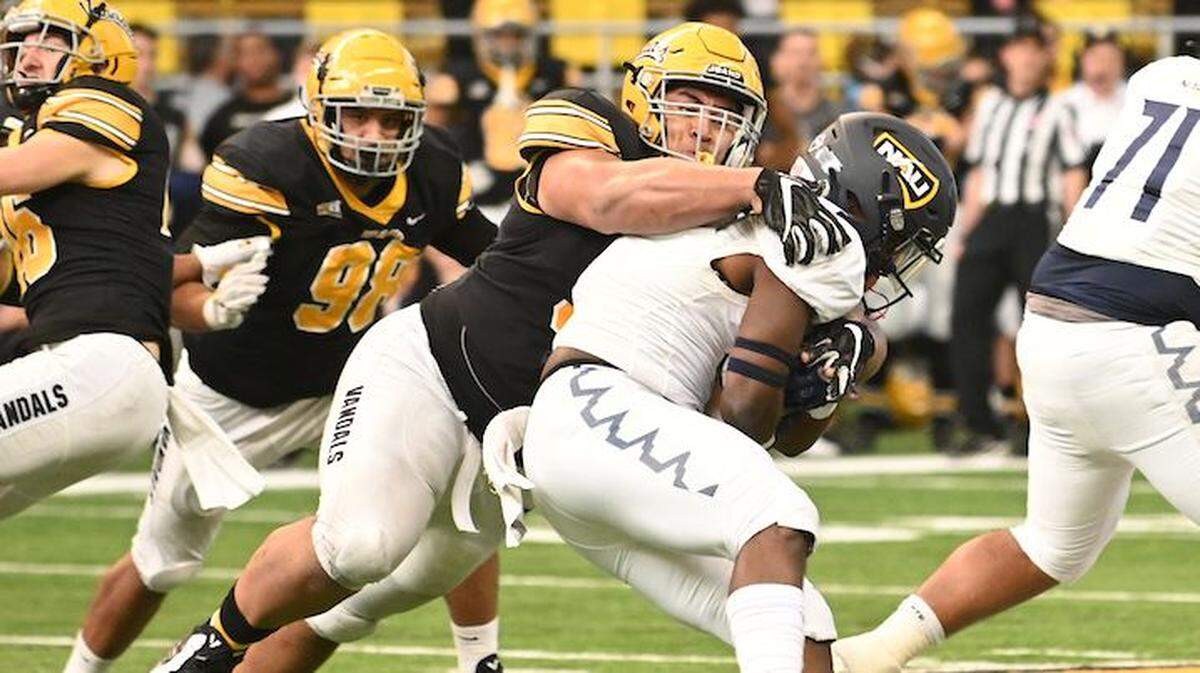
DL Noah Elliss, 6-4, 367 — Elliss appeared in 21 games on the interior of the Vandals’ defensive line in the past three seasons. Starting primarily at nose tackle, he finished his career with 93 tackles, 10 tackles for loss, three sacks and a fumble recovery. Elliss played in the East-West Shrine Game in February, and in a recent mock draft, Brugler projected that he will come off the board in the sixth round to the Atlanta Falcons.
Elliss’ older brothers, Kaden and Christian, were both linebackers for the Vandals before moving on to the NFL. Kaden was picked by the New Orleans Saints in the seventh round of the 2019 draft. Christian wasn’t drafted last year, but he signed with the Minnesota Vikings and is now on the Philadelphia Eagles.
Their father, Luther, also played in the NFL and spent five years as the defensive line coach at Idaho before joining the staff at Utah this spring.
LB Tre Walker, 6-1, 240 — Walker has earned All-America honors from multiple organizations the past two seasons. He’s a three-time HERO Sports All-American after earning first-team honors in 2019 and the spring 2021 season, and making the second team last fall. He was also named an All-American by The Associated Press, Stats Perform and Phil Steele during his career.
Walker finished his college career with 305 tackles, leading the Vandals with 105 last season and 138 in 2019. He posted 54 tackles in the shortened spring season of 2021 while playing just four games.