
Idaho’s ski season is short. Prepare your body to make sure you seize every opportunity.
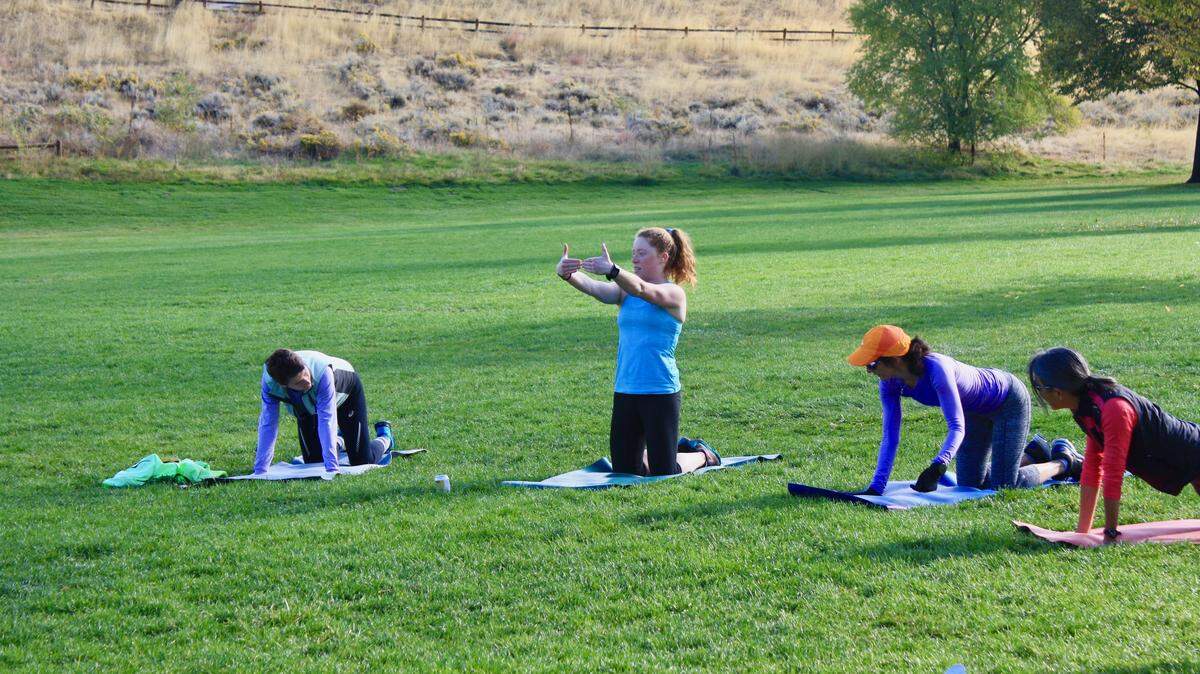
It’s a sunny Wednesday morning at Camel’s Back Park. Fifteen women on brightly colored yoga mats circle up and prepare to begin a series of core exercises designed to help them become better skiers.
The members of Boise Dryland follow along as coach Emma Donohoe leads them through sets of walking planks, side crunches, clamshells and kayakers. Donohoe demonstrates each exercise, offering modifications and adjustments on form and technique to keep the class accessible for skiers of all ages and abilities.
She counts down the last few seconds of a particularly grueling plank and everyone collectively collapses into a tired heap on their mat. Donohoe, who is also a coach for the Bogus Basin Nordic Team, has been in charge of Boise Dryland for two seasons, although the group has been around for nearly 10 years.
With a women-only session on Wednesday mornings and a Thursday evening session for everyone, Boise Dryland attracts participants who want to find early success on the trails when the snow arrives.
Success doesn’t necessarily mean being super fast and winning races. For many athletes, it simply means being fit enough and mastering technique enough to have fun.
There’s nothing worse than getting up to the mountain on the first day of good snow, getting all geared up, and realizing your body doesn’t remember how to ski. Or perhaps after 20 minutes, your wobbly legs demand that you’re done for the day and you sit in the lodge looking longingly out the window at the trails.
“Training is important because we only have snow for about three months of the year,” Donohoe says, “so if you are prepared, you’ll have an easier, safer, and more fun time on the snow.”
Donohoe says the goal of the workouts is to develop overall athleticism and to give people a chance to do things in a social group setting that they might not do at home. In addition to activities like ski bounding and intervals, athletes at Boise Dryland perform ski-specific exercises that will help them become more powerful, efficient and safe.
“We focus on balance, strength, agility and plyometrics,” Donohoe says. “People generally have an easy time training for endurance by hiking, running or biking, but most people aren’t going to go out and do agility ladders on their own.”
The elements Donohoe focuses on are essential to Nordic and alpine skiing. Balance, strength, agility and plyometrics are helpful in preparing your body, whether you’re on skinny skis or carving your way down an alpine run.
Kathy Stearns has been coming to Boise Dryland sessions for several years now and says that the off-snow training has helped her enjoy both types of skiing more.
“It’s totally different motions than I would normally do on my own,” she says. “Plus it’s fun; I really look forward to it. It makes me feel like a little kid again to skip and hop around outside.”
Stearns says she noticed a huge difference overall after her first year of dryland training, and now finds that the arm workouts are really improving her skate skiing.
Movement patterns are important, especially for a sport like skiing, for injury prevention to make sure that your body is moving in the right way. Donohoe emphasizes things like how to jump and land safely to keep skiers in top shape. “We do anything we can do to help prevent a high-speed crash on skis,” she says.
Donohoe says that variety is also extremely important in ski training. She suggests that people always mix up their routines with different types of training. If you’re an avid mountain biker, for example, try adding in an exercise class or doing some balance work to make sure your training is well rounded and effective.
Skiing is a highly technique-driven activity that asks your body to move in ways it’s not used to moving. While you certainly don’t have to be a professional or ultra-fit athlete to enjoy the slopes, it’s generally more fun if your body is prepared and you know how to safely perform the techniques that will allow you to enjoy yourself the most on the slopes.
As much as getting your body ready for ski season is important, getting your gear ready also should be on your to-do list. You don’t want to get all the way up to Bogus and realize you never bothered to fix the broken buckle on your boot or that your skis still have a dusty coat of storage wax from last season on them.
“We talk waxing quite a bit here in the shop,” says Tomas Patek, owner of World Cycle & X.C. Ski. “It’s really important to remove storage wax, clean your skis, and protect the bases with something new.” Patek’s shop often uses the thermal bag waxing method. “It does a wonderful job of really loading the ski with wax,” he says.
Gear care and preparation can make a huge difference in your ski season, as can dryland training. When you combine the two, you have a recipe for success on the snow.