
Why was Donald Trump Jr. in Idaho? To put our money in his pocket | Opinion
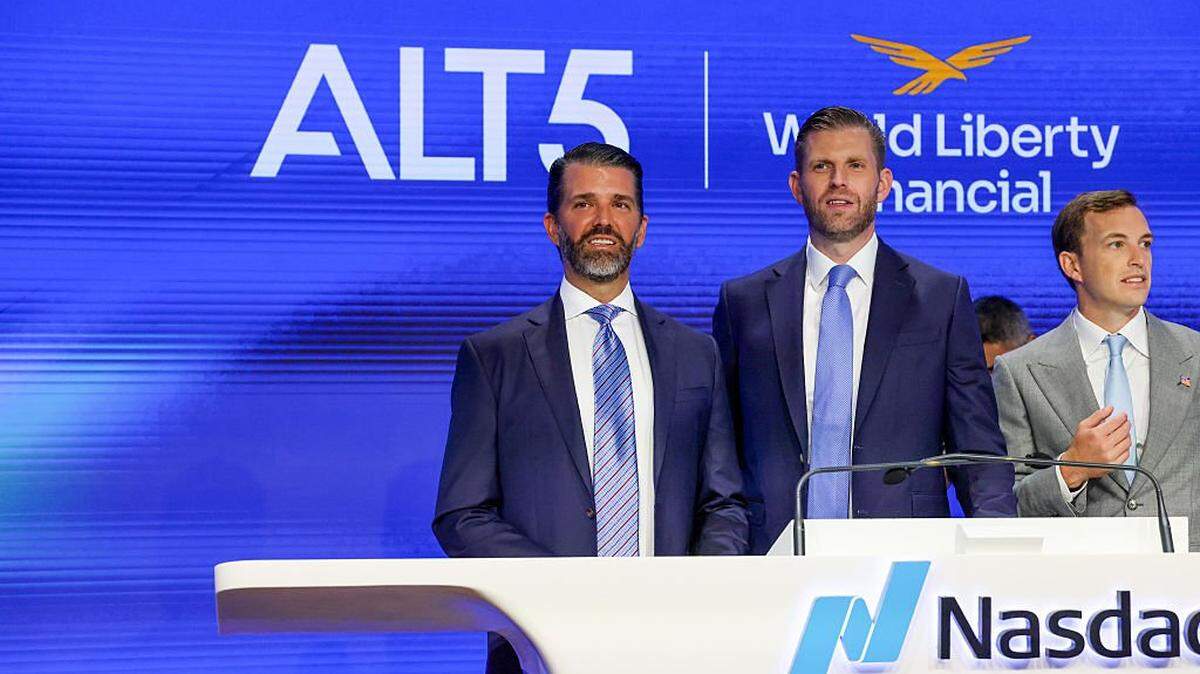
When a Trump comes to town, you’d be a chump to think that it’s for your benefit. He wants something, and it’s almost certainly your money.
And that’s true about Donald Trump Jr.’s visit to the Gem State this week.
Could it be that Trump’s real reason for being here wasn’t to hobnob with Gov. Brad Little, but to hawk House Bill 586, the FAST Act, as he did at a recent private lobbying event, according to invitations circulated beforehand and social media posts after?
The FAST Act is a bill that would allow Idaho’s state government to issue payments using stablecoins — a kind of cryptocurrency that is designed to have a constant value of $1, unlike other cryptocurrencies that are subject to wild price fluctuations.
And guess who owns a stablecoin issuer? Donald Trump Jr., of course.
He, along with his two brothers and two sons of President Donald Trump’s former lawyer and now Middle East Envoy Steve Witkoff, among others, own a firm called World Liberty Financial. Just recently, Donald Trump Jr. and brother Eric Trump sat for an interview on CNBC, making the argument that their stablecoin, called USD1, is an upgrade to the dollar.
How would the Trumps profit if Idaho government starts issuing payments in USD1? It has to do with how stablecoins work to ensure that they have a constant $1 value.
An issuer has to ensure that anyone holding stablecoin can always exchange it for a dollar. It can’t trust that there will always be a willing buyer on the market, so the issuer has to retain a large pool of dollars (or dollar-denominated, easy-to-sell assets like treasuries) so that it can credibly promise that you can always redeem your stablecoin.
Conveniently, treasuries pay interest. If you issue a stablecoin that is going to be the means of payment for U.S. states — even a very small state like Idaho issues many billions in payments each year — then you get to hold a lot of treasuries, and that means you get to pocket a whole bunch of interest.
So lots of passive income for the Trumps, and for Idaho taxpayers, financial risk: an old-fashioned, 1920s-style run.
Imagine if, even for a short period of time, the market becomes afraid a stablecoin is going to lose value. That means a bunch of people want to sell at the same time. If the issuer can’t quickly come up with enough dollars to cover all these sales, suddenly everyone’s guaranteed $1 asset will only sell for 90 cents, which makes more people want to sell, and you have a run.
This isn’t theoretical.
Something quite similar happened to an early stablecoin called USDC in 2023. It held much of its reserves at a bank that failed, leading to a surge in sell orders, and it quickly lost 10% of its value. In that case, the Federal Deposit Insurance Corporation was able to calm the waters by quickly restoring access to USDC’s reserves.
The federal GENIUS Act attempts to reduce the risk of these runs through reserve requirements and other regulations, but it remains untested, having only been passed in July.
And given that, just hours before Trump was wining and dining Idaho lawmakers, World Liberty Financial claimed that a “coordinated attack” by hackers and short sellers had caused USD1 to briefly fall below $1, it seems reasonable to remain skeptical.
If individual investors or firms want to expose themselves to these risks, that’s their prerogative. This bill is asking for that to be done with your money, quietly, without you having any real say in the matter.
If the case for this bill can be made publicly, why was it done at a closed-door lobbying session with hors d’ouvres, dessert and beverages at the Double R Ranch Club on Monday afternoon?
Lawmakers should be careful who they dine with. World Liberty Financial has been wrapped in scandal — not driven by left-leaning opponents of the Trump administration, but from solidly conservative outlets like the Wall Street Journal and the National Review, which described the company as “an ideal vehicle for leveraging political power in search of financial gain.”
As the Wall Street Journal reported, the company got crucial aid from Changpeng Zhao — founder of the crypto exchange Binance whom President Trump pardoned in October — and secretly sold a $500 million, 49% stake in the company to an Abu Dhabi royal referred to as the “spy sheikh” four days before Trump’s inauguration. Importantly, this investment came without a commensurate 49% share of the profits, making it an ostensibly terrible deal for Tahnoon bin Zayed Al Nahyan, the Emirati royal investor, Forbes points out.
Months later, the United Arab Emirates had access to sophisticated AI chips that it had previously been denied, the Wall Street Journal reported. Coincidence, probably.
Despite all the bad press, efforts to open state governments to stablecoin payment systems are beginning, and Idaho is an initial test case. A substantially similar stablecoin bill has already passed the Senate in West Virginia and is awaiting action in the House.
Think this bill isn’t about profiteering at your expense?
Here’s the test: If the bill comes up for a hearing, some inquisitive lawmaker should offer an amendment saying that these payments can only be made with stablecoins issued by firms that are fully U.S.-owned — which would disqualify World Liberty Financial, according to the Wall Street Journal’s reporting.
America First, right? Certainly the Trump family would have no objection to such an amendment. At least not if they have the public interest at heart, rather than their own.
Bryan Clark is an opinion writer for the Idaho Statesman.