
I want nuclear power in Idaho. The Jerome project isn’t it | Opinion
AI-generated summary reviewed by our newsroom.
- Sawtooth Energy lacks experience, financing and supplier deals for nuclear plan
- NuScale denies involvement as Sawtooth misuses its name in public project filings
- Project manager’s criminal history and vague funding raise serious credibility issues
I’m a fan of nuclear energy. I’m deeply worried about the impact of climate change on our world and our future, and I’ve long been convinced that nuclear energy will be a key part of solving that potentially existential problem, if we manage to do it. Wind and solar are great, and we need more, but I don’t think they’ll solve the problem on their own. And I think nuclear energy is better, both from a safety and environmental point of view, than many other forms of energy like coal.
I vocally supported the Idaho Carbon-Free Power Project, a plan to build a set of small modular reactors, or SMRs — near Idaho Falls, where I live — that were manufactured by NuScale Power.
So I was initially encouraged by reports that there was a plan that could develop NuScale SMRs in the Magic Valley by a company called Sawtooth Energy and Development Corp., which was formed in May. But the more I look, the less I like what I see.
It seems that Sawtooth has gone straight to public hearings for a right-of-way, stirring up controversy in the local community with plans for a multibillion-dollar, regulatorily complex and environmentally sensitive project without prior experience in the industry, without publicly known financial backing, without a supplier and without secured rights to connect to the grid.
I see no reason to believe a nuclear reactor will ever be built by Sawtooth, not least because the project manager was previously convicted of a significant financial crime.
A strange correction
One of my jobs at the Idaho Statesman is to edit and publish op-eds submitted by members of the community, and I recently published one authored by Idaho Conservation League Executive Director Justin Hayes. The basic point was that ICL was open to nuclear energy in principle, including the Sawtooth project, but it would be important to vet the project thoroughly from an environmental and feasibility standpoint.
After the piece published, I received a strange correction request from an unnamed representative at NuScale: “Currently, NuScale Power is not engaged with Sawtooth Energy and Development Corporation in any project capacity, nor have we authorized Sawtooth or any associated entities to make public statements or claims on behalf of NuScale.”
It didn’t seem to point out any real errors in the factual claims made by Hayes — he correctly summarized the plans laid out in a draft environmental impact statement released by Sawtooth, which said the project would “deploy six NuScale Power Modules (VOYGR units)” and dropped NuScale’s name 38 other times. Instead, NuScale wanted all references to its company scrubbed.
NuScale has not responded to repeated follow-up inquiries.
About the same time period, Sawtooth’s website was taken private, and the draft environmental impact statement it had previously published was taken down — internet archives show both were public the week prior. This was bizarre from a company that was claiming it planned to move forward quickly with a project on the same scale as the $9 billion Idaho Carbon-Free Power Project.
What does Sawtooth actually have?
I called Sawtooth Project Manager Dannis Adamson, a onetime Republican gubernatorial candidate, who said he had spoken with NuScale representatives by video conference and had sent them a copy of Sawtooth’s plans. He said he was surprised by the company’s rebuke but that it won’t derail the project because his company is talking with other suppliers, such as X-energy (which uses a much different reactor design than NuScale’s) and Holtec International.
“NuScale is not the only people on the block,” Adamson said in a July 24 phone interview.
Neither company responded to inquiries seeking to substantiate the claim Sawtooth is in talks with them. Sawtooth has since produced a new EIS which removes all references to NuScale.
Sawtooth’s plans indicate that it would connect its nuclear reactors to Idaho Power’s Midpoint Substation. I followed up with Idaho Power, which indicated there have only been very cursory, preliminary discussions with Sawtooth.
“We don’t have a direct relationship with them,” Idaho Power communications specialist Brad Bowlin said, though he emphasized that Idaho Power is required to allow power producers to connect to its distribution stations under certain conditions. The necessary step would be to complete a complex process called a generation interconnection study, which Adamson said hasn’t yet begun.
I asked Adamson if he could say anything about who is financing the project, which would require billions in capital. Adamson said the company would file for federal grants and tax credits, and the rest would be covered by loans or the company. I asked if he could say who is financing the company.
“No, I could not give you any names at this point in time,” Adamson said in the interview.
It’s important to emphasize just how strange that silence is, if Sawtooth has gained significant funding, because one of the best ways to convince potential lenders or investors that your project will be successful is by demonstrating you’ve already raised a substantial chunk of change.
How big?
The Carbon-Free Power Project hoped to build a set of NuScale reactors on roughly the same scale as Sawtooth Energy said it intends to. The Institute for Energy Economics and Financial Analysis, which is often skeptical of nuclear projects, estimated it would cost $9.3 billion by the end. In an email, Adamson said Sawtooth hopes to complete the project for no more than $7.5 billion.
That is a lot of funding to raise, especially given Adamson’s prior federal felony conviction.
Adamson’s conviction
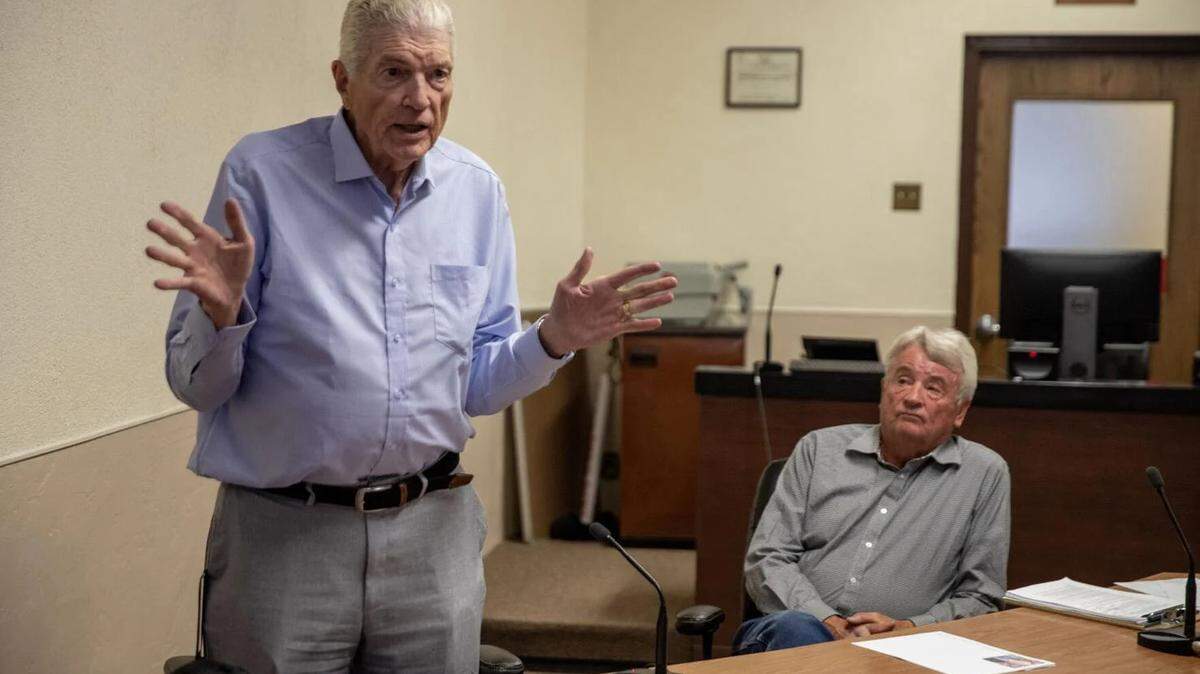
Adamson pleaded guilty in 2008 to withholding payroll taxes from the employees of six nursing home facilities he owned in California and not paying them to the federal government — both evading taxes and leaving employees without credit for the Social Security and Medicare contributions Adamson had taken out of their checks, according to his plea agreement.
“... My company had filed 1099 reports indicating payroll paid, deduction for workers’ compensation withheld, and zero dollars paid into the fund,” Adamson said in his email to the Statesman. “I could not pay the taxes at the time, and I chose not to file for bankruptcy. That was a mistake. I thought that, under the circumstances, the feds would work with me. I was mistaken! I plead guilty and I paid the price.”
He was 57 at the time of his plea, which included the acknowledgment that his conduct was willful — that is, that he knew he had a legal duty and he voluntarily breached that duty. His plea bargain required him to pay over $7 million in restitution, and he was sentenced to 27 months in federal prison. A sentencing document indicates he entered prison on May 13, 2009, and the federal inmate locator indicates he was no longer in prison as of April 27, 2011.
Six years after he was charged, as a part of the same case, a federal court found that he had engaged in a fraudulent transfer, through a marital contract, to try to keep the federal government from collecting his assets to pay off the restitution. The court invalidated the contract to allow the government to continue collecting his assets as restitution.
Adamson is also a former lawyer. He agreed to resign from the Idaho State Bar Association in lieu of being disbarred in 2010, according to filings provided by the association.
It would be rather unusual for banks, large investors or others with access to billions in capital to give a company with a project manager with that financial and ethical record access to the credit or investment that would be required to finance a massive project like this one. In his email, Adamson emphasized that he is an employee, not a principal, with Sawtooth. The company’s CEO is B. Roy Prescott, a local rancher, former legislative candidate and former Jerome County commissioner.
Concerning history
This proposal has already been raising eyebrows in industry media focused on nuclear energy.
Dan Yurman is a nuclear energy veteran who worked for decades at Idaho National Laboratory and now runs a blog called Neutron Bytes that’s well read in the industry. In his post about the Sawtooth project, he identified a number of problems and some clear red flags.
The site in Jerome, a desert that’s been converted into irrigated crop land, lacks much of the heavy road infrastructure required to transport the enormous components of a reactor, and easy access to large amounts of water, generally necessary to cool most kinds of nuclear reactors, Yurman pointed out.
Yurman’s concerns were high enough that he raised the examples of two recent proposed nuclear developments in the West that did not result in the construction of reactors:
- Alternate Energy Holdings Inc. promised a nuclear reactor in Payette County in the 2010s, but it turned out that was an investment fraud scheme, for which Senior Vice President of Administration Jennifer Ransom was sentenced to 30 months in federal prison and CEO Don Gillispie fled from prosecution.
- And last year a developer presented plans to build a massive nuclear plant near Butte, Montana, but local media discovered a host of untrue claims made by the developer, including that the reactor was approved by the Nuclear Regulatory Commission. Since then, silence.
I asked Adamson if Sawtooth had any experience building or operating reactors. He replied that the company did not, but that no company had yet installed SMRs in the U.S.
“The entire concept is based upon the fact that different parts of the fabrication of the entire nuclear reactor is built by DIFFERENT companies and then the pieces are brought to one location and assembled,” Adamson wrote in his email. “Remember SMALL Modular Reactors. Once assembled they will be transported by truck to the reactor locations and ultimately placed into power production. NO SMR reactors will be built at the final site of power production. They will ALL be created elsewhere and delivered to the final location.”
In a phone interview, Yurman said this understanding of the reactor installation process was “fabulously incorrect” and appeared to confuse small modular reactors with so-called microreactors. These are reactors that produce relatively small amounts of power and are small enough to be transported by truck. The on-site construction and assembly process involved with SMRs is extensive, and though SMRs are much smaller than traditional nuclear reactors, there is no way to transport them in an assembled state, Yurman said.
What reactor?
The Carbon-Free Power Project had the enthusiastic backing of local city and county governments, Idaho statewide officials and lawmakers, Idaho National Laboratory, NuScale and a huge group of municipal power companies called UAMPS, plus funding guarantees secured by Idaho’s congressional delegation and a guaranteed building site on U.S. Department of Energy land — and it still fell through.
So I find it rather hard to believe that a brand-new company coming forward with no experience in nuclear energy, with no one lined up to sell and build nuclear reactors, with no rights to connect to the grid secured, with no publicly known financing for a project that would cost billions of dollars, and with a project manager who spent time in federal prison, has any realistic chance of coming through on its promises.
Adamson maintains it will pan out.
“We’re taking the position that it’s absolutely feasible. It’s not going to happen as quickly as we’d like to,” Adamson said, estimating the project would be three or four years down the line.
“The world is changing, and it is the hope of developers of the SMRs that small companies, states, small communities, and individual customers needing power will embrace and decide to look at the technology and adopt it to produce the power that they need,” Adamson said in his email. “These possible utilizers of the technology will not be constrained by your concept or need to have only the nuclear reactor operators of the past develop the ongoing utilization of the power by smaller operators in their communities.”
The world may be changing, but hopefully not this much. In a previous post, Yurman raised a quotation from past NRC Chairman Dale Klein, referred to in the industry as the “no bozos rule.”
“My subject is something that each of the five Commissioners believe in, and have said before — which is this: owning a commercial nuclear reactor is not a business for amateurs,” Yurman quoted Klein as saying. “If the nuclear power business is treated with less than the seriousness it deserves — and people begin to think that anyone can just jump on the nuclear bandwagon — it opens up the very real danger of making the ‘wave’ of the nuclear resurgence look more like a ‘bubble.’ And bubbles have a tendency to pop.”
Sawtooth’s May initial filing with the Idaho Secretary of State’s Office indicates that it reserves the right to issue up to 5 million shares of stock at a minimum price of $1 per share.
That is not stock I would want to buy.
Bryan Clark is an opinion writer with the Idaho Statesman.
This story was originally published July 31, 2025 at 4:00 AM.