Here’s who would be hurt in Idaho by cuts to arts, humanities | Opinion
AI-generated summary reviewed by our newsroom.
- Federal funding cuts halt Idaho arts and humanities grants through 2026 planning.
- Small rural organizations stretch $1,000–$3,000 grants into community programs.
- Loss of NEA and NEH support risks cultural access in underserved rural areas.
Jean Thomas uses her grant from the Idaho Humanities Council to bring in speakers to talk about Welsh immigration at the annual Malad Valley Welsh Festival.
Sarah Skaar, of the Hagerman Valley Historical Society, used a $1,000 grant to research and collect records on 435 men and women who served in the military from the Civil War through current conflicts.
Darlene Nemnich, also of the Hagerman Valley Historical Society, used a $1,000 grant from the Idaho Humanities Council to hire an art historian to research, inventory and display a collection of 600 paintings by local artist Archie Teater.
Russ Tremayne uses a grant from the Idaho Humanities Council to bring speakers to the annual Social Science and Humanities Symposium at the College of Southern Idaho in Twin Falls and to the annual History at the Barn speaker series in Jerome.
Each of these grants is small, typically anywhere from $1,000 to $3,000.
But the recipients, many who are tucked away in rural Idaho, from Malad to Melba, Hagerman to Hayden, leverage those small grants to provide an outsized public service.
“Ultimately, I believe these small grants from the Idaho Humanities Council help people connect with other people, with the stories of where they live, with knowledge of the land where they live and with what gives their life meaning,” Nemnich said.
But these grants are in jeopardy.
In his quest to shrink the federal government, President Donald Trump is seeking to kill the National Endowment for the Arts, which funds the state agency Idaho Commission for the Arts, and the National Endowment for the Humanities, which funds the nonprofit Idaho Humanities Council.
In April, Trump started canceling NEA grants, and arts commissions and organizations all over the country, including Idaho, began receiving notice that their previously approved funding was gone.
The Idaho Commission for the Arts has postponed issuing grants until funds are secure, according to a prepared statement emailed to me from the Idaho Commission for the Arts.
Similarly, the Idaho Humanities Council has canceled all grant rounds for the current fiscal year and is awaiting word as it prepares its budget for 2026.
Arts and humanities groups waiting
That means local arts and humanities groups are waiting to see whether they’ll get any federal funding at all next year, as they try to plan for events, such as the Malad Valley Welsh Festival and History at the Barn.
On Tuesday, the House Interior Appropriations Subcommittee, which is setting next year’s funding for arts and humanities and is chaired by U.S. Rep. Mike Simpson, R-Idaho, approved significant cuts to the National Endowment for the Arts and the National Endowment for the Humanities, recommending a 35% reduction for each agency.
Whether Congress approves funding for arts and humanities, cuts it slightly or kills it altogether remains to be seen. But we’ve already seen Republicans, including Simpson, Rep. Russ Fulcher and Sens. Mike Crapo and Jim Risch, cave under pressure to eliminate funding for public radio and television, most likely to the detriment of their rural Idaho constituents.
It wouldn’t be a stretch to see them likewise buckle under pressure from Trump and allow him to kill funding for arts and humanities.
If it’s any indication of Simpson’s sycophancy for Trump, on Tuesday he proposed renaming the opera house at the Kennedy Center after First Lady Melania Trump.
Idaho organizations
I talked to a half-dozen local arts and humanities organizations in Idaho about the impact these cuts would have on them. Most said they’ll be able to continue, but their programs and events won’t be nearly as good as they would be with the funding.
Thomas said she might be able to get local speakers with a smaller fee or no fee at all, but she probably won’t be able to get national experts to travel to Malad and spend the night without grants. Same with History at the Barn. Tremayne said he is hoping to bring “The Big Burn” author Timothy Egan to the Social Science and Humanities Symposium in February. But without a grant from the Idaho Humanities Council, he’s not sure how he’s going to scrape together the money to bring him.
The Cabin, a literary arts organization in Boise, receives about $50,000 out of its $1 million budget from the National Endowment for the Arts, so the loss is significant but not catastrophic, executive director Kurt Zwolfer told me in a phone interview.
The Cabin is exploring alternative funding strategies, including seeking individual donors, finding new grant opportunities and securing community sponsorships, but Zwolfer pointed out that every other arts organization is out there fighting for those same dollars.
“The competition for those funds is going to be pretty intense if everyone is losing their government funding, and they all have to go to the same other donors and other granting organizations,” Zwolfer said. “That money is going to get tighter, as well.”
Caldwell Fine Arts
Caldwell Fine Arts was informed in May that it was losing the second year of a two-year, $35,000 per year grant from the National Endowment for the Arts.
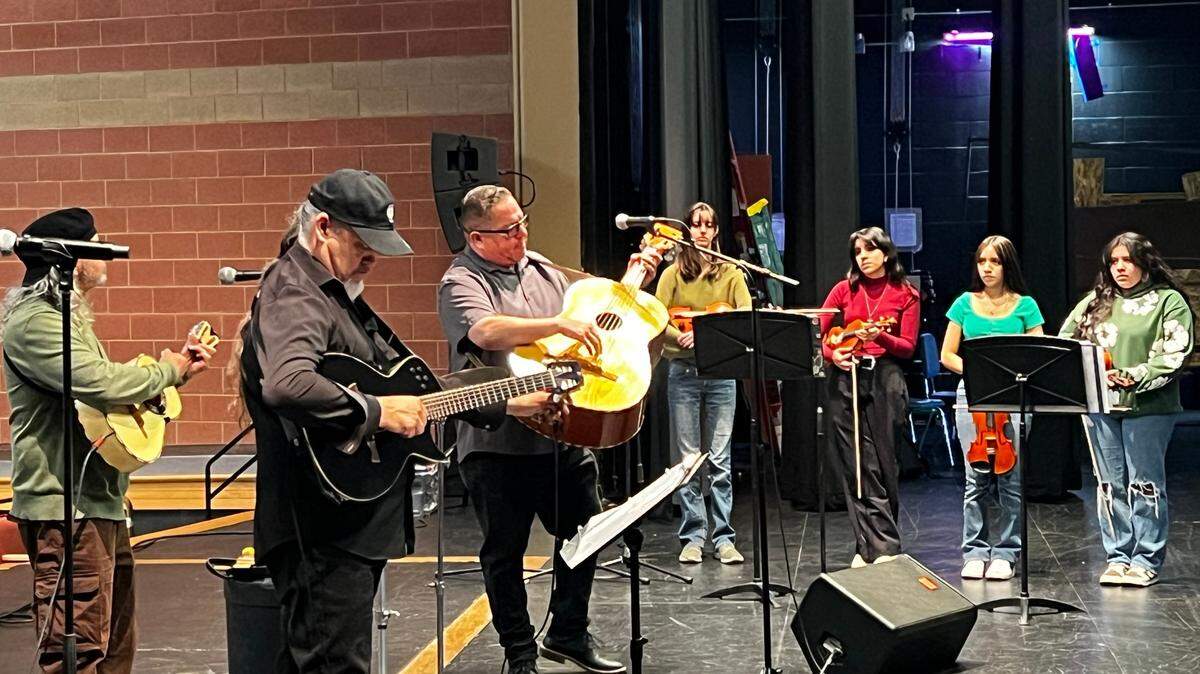
The program served local schools, particularly serving Hispanic and low-income students by bringing musicians, dancers and storytellers into classrooms to expose students to music they might not otherwise have access to.
The funding cut means Caldwell Fine Arts must now scramble to replace the lost $35,000.
The group received a $10,000 anonymous donation, but it’s still a long way to fill the gap. A recent campaign raised just $1,125 raised from 18 donors.
“We need this kind of thing more than ever,” Rebecca Hanson, Caldwell Fine Arts board member, told me in a phone interview. “And I think that the funding from the government has always been, I thought, based on improving things for people in rural communities in particular, who don’t have the means.”
How it works
The National Endowment for the Arts budget is about $200 million, which is 0.00296% of the federal budget. Similarly, the annual budget for the National Endowment for the Humanities is about $200 million.
Approximately half of the Idaho Commission on the Arts’ $2.25 million comes from federal grants.
Over at the Idaho Humanities Council, which is a private, nonprofit organization, the National Endowment for the Humanities is its largest funder.
In April, the Department Of Government Efficiency terminated funding for all state humanities councils. In July, the Idaho Humanities Council’s NEH grant was restored but at a 53% cut, which meant a loss of over $500,000, dropping from around $930,000 to $447,000.
As a result of this loss of funding, all Idaho Humanities Council programs and grants are paused until further notice, IHC executive director David Pettyjohn told me in a phone interview.
The council typically awards 50-60 grants annually, totaling around $180,000. Only about 15 grants have been awarded this year, primarily affecting rural communities, Pettyjohn said.
The council’s staff was also reduced from four to three full-time members, and programs like the speakers bureau were put on hold.
Pettyjohn said that the funding is a minimal investment — less than two cents per Idaho resident monthly — with a potential economic return of up to $6 for every $1 invested.
Looking forward, the IHC is preparing for potential further cuts, with reserves and endowments as a backup, Pettyjohn said.
“We can make a little go a long way here in Idaho,” Pettyjohn said. “We see that in our communities, we do it here at IHC, and we are hopeful for the future because the humanities matter, the humanities are important.”
Good return on investment
The other thing that struck me in talking to the grant recipients was that, through volunteer labor and matching funds from the community, these organizations are able to do a lot with these small $1,000-3,000 grants.
“We can do so much with so little,” Skaar said. “I mean, it’s not a ton of money ... but I think it’s just leverage, particularly when you get to small town America.”
She was able to turn her $1,000 grant into 1,000 hours of research, resulting in stories of 435 men and women who served in the military, production of a catalog of all the biographical information, the purchase of a new military photo viewer showing historical photos of service members, a refresh of the Hager Historical Museum’s military exhibit and a special Military History Event, that included the printing of booklets of service members’ stories.
Undoing the Great Society
The arts and humanities endowments date back to President Lyndon Johnson’s call for a “Great Society” in 1965. That call led to the creation that same year of the National Foundation for the Arts and the Humanities Act, which later morphed into the National Endowment for the Arts and the National Endowment for the Humanities.
“Democracy demands wisdom and vision in its citizens,” the act reads. “It must therefore foster and support a form of education, and access to the arts and the humanities, designed to make people of all backgrounds and wherever located masters of their technology and not its unthinking servants.”
Some — particularly those connected to Project 2025 — argue that funding arts is not the proper role of the federal government and actually distorts the market by rewarding organizations and projects that might not otherwise be supported by the general public.
But the Idahoans I talked to all agreed that the federal cuts to the art and humanities is short-sighted and foolish.
“I want to live in a community where the government does support things that make our community, our city life, life in rural Idaho a richer experience,” Zwolfer said. “When you lose government funding for programs like the arts as well as other nonprofit causes, the places that suffer the most are those rural areas in the state. They lose complete access to that type of programming because they don’t have the resources to maybe go to the community to help them out for that funding gap.”
Tremayne said there’s a reason the government picks up the slack.
“Does the private sector do it? And the answer is, ‘No,’” Tremayne said. “They’ll do it if it’s a profit. They don’t do it if it’s not a profit. Well, we don’t do history for profit. We don’t do humanities for profit. We do it to improve the human condition. And so where the private sector doesn’t do things, the public sector has decided that it should do things like public radio, like public TV and arts and the humanities.”
Thomas put it more directly: “To cut the arts and humanities, frankly, is cutting your right arm off.”
Scott McIntosh is the opinion editor of the Idaho Statesman. You can email him at smcintosh@idahostatesman.com or call him at 208-377-6202. Sign up for the free weekly email newsletter The Idaho Way.