How an Idaho city became first in U.S. to take this major step toward green energy
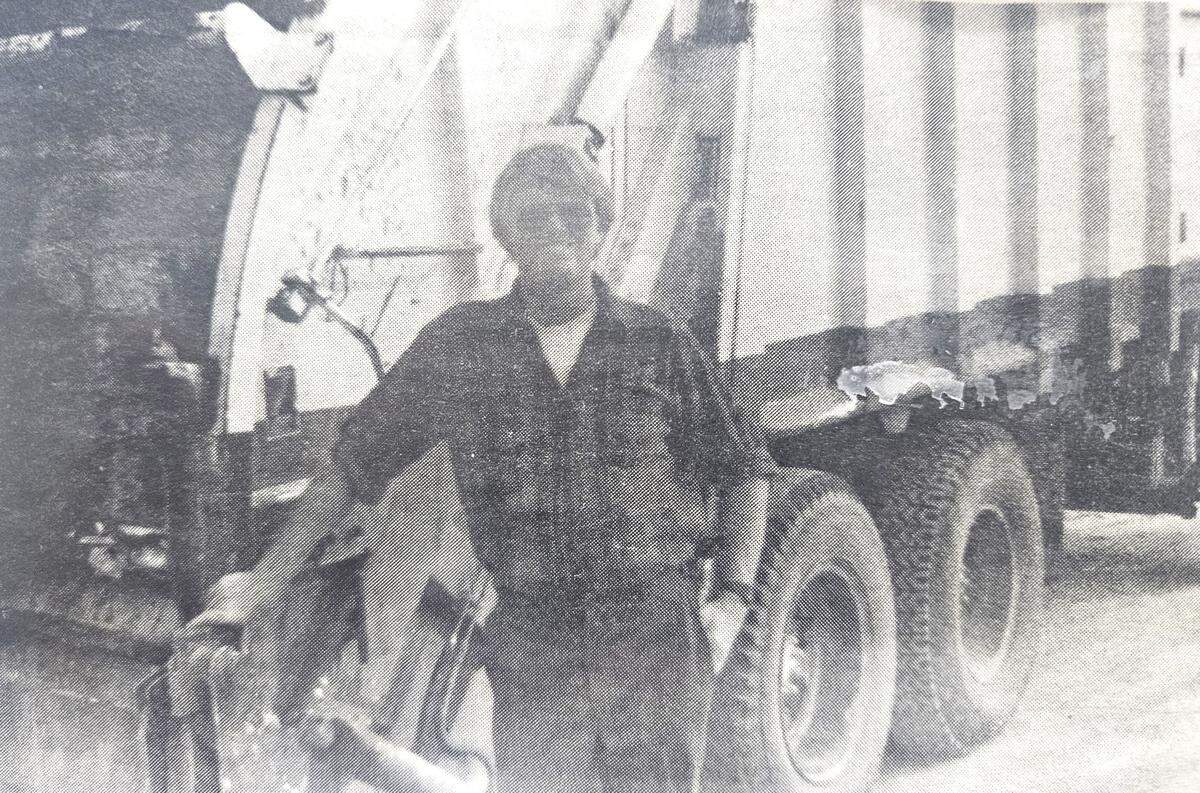
Tim Gordon would often come into my office at the Kuna Melba News and extol the virtues of renewable energy.
The owner of J&M Sanitation, the family-owned trash collection company in Kuna, would preach to anyone who would listen. This was 15 years ago, before clean energy was in vogue.
“The green economy, Scott,” Tim would tell me breathlessly. “The green economy is the future. It’ll create thousands of new jobs, it will reduce our reliance on fossil fuels, it’ll make the environment cleaner and it’ll boost the economy.”
Now, the locally owned company run by his son, Chad Gordon, is putting its money where his mouth is.
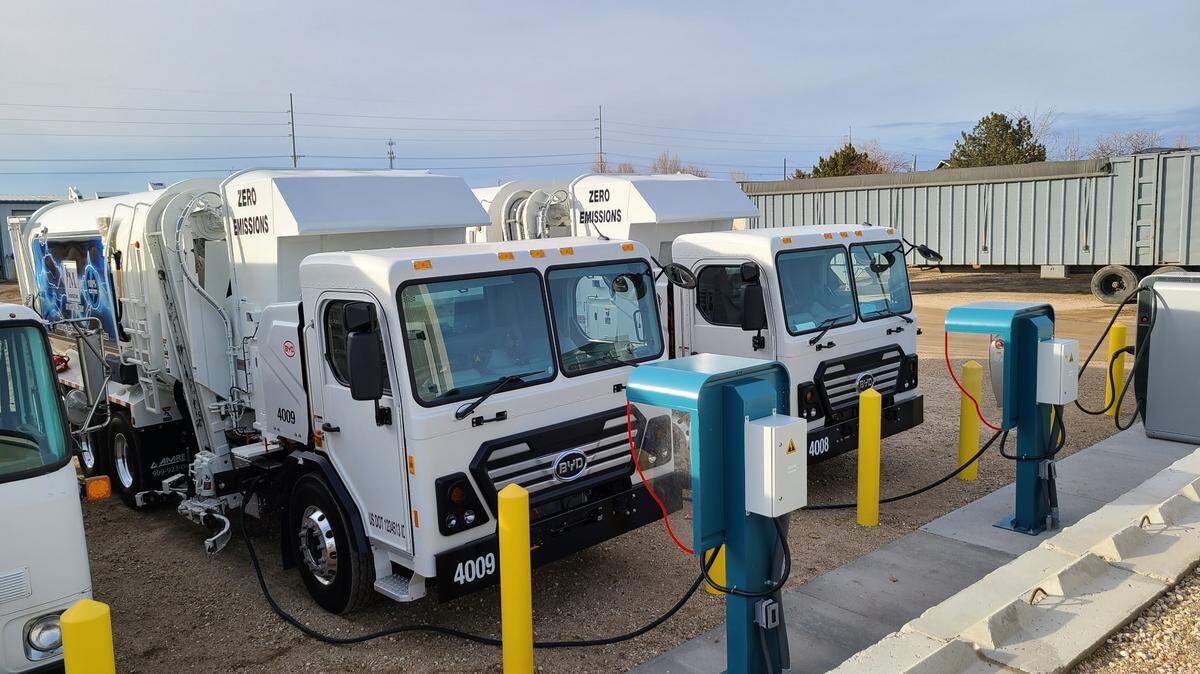
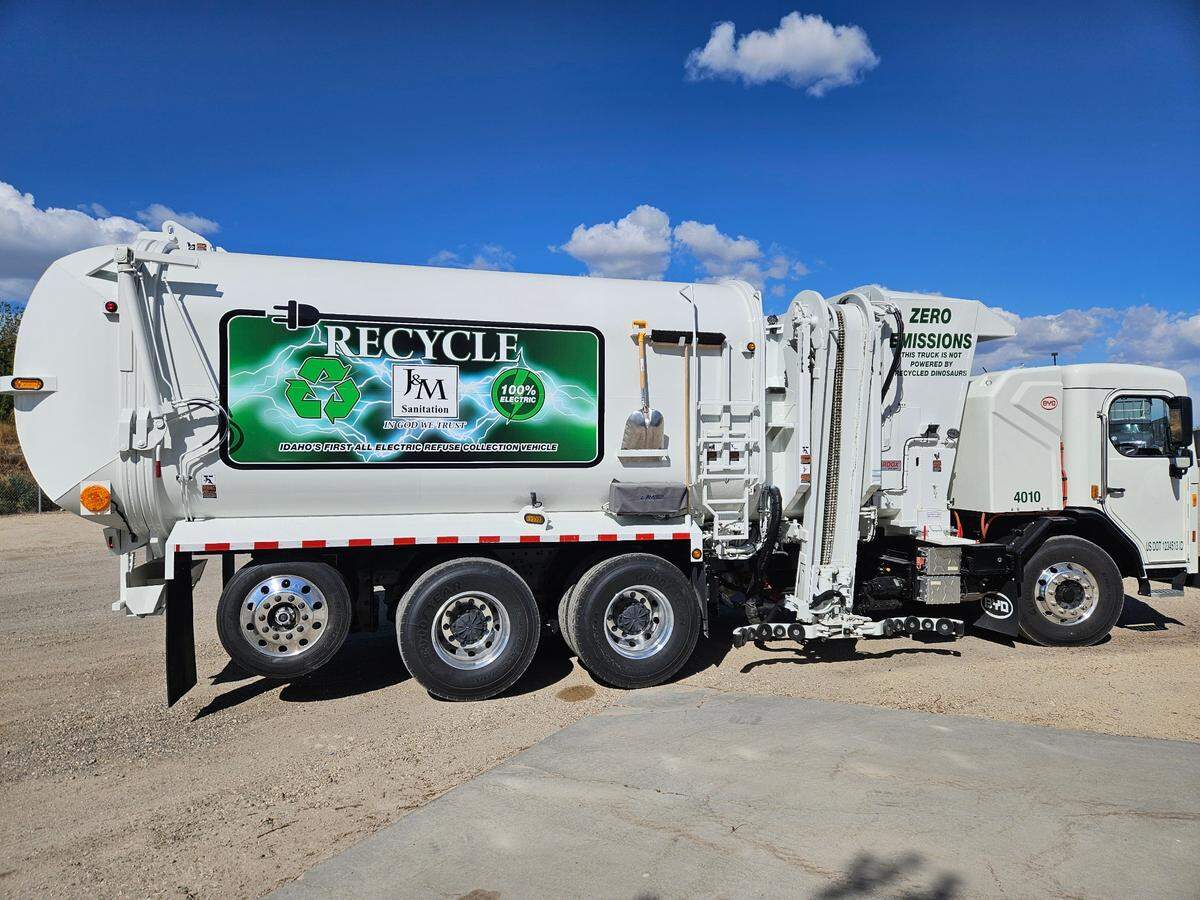
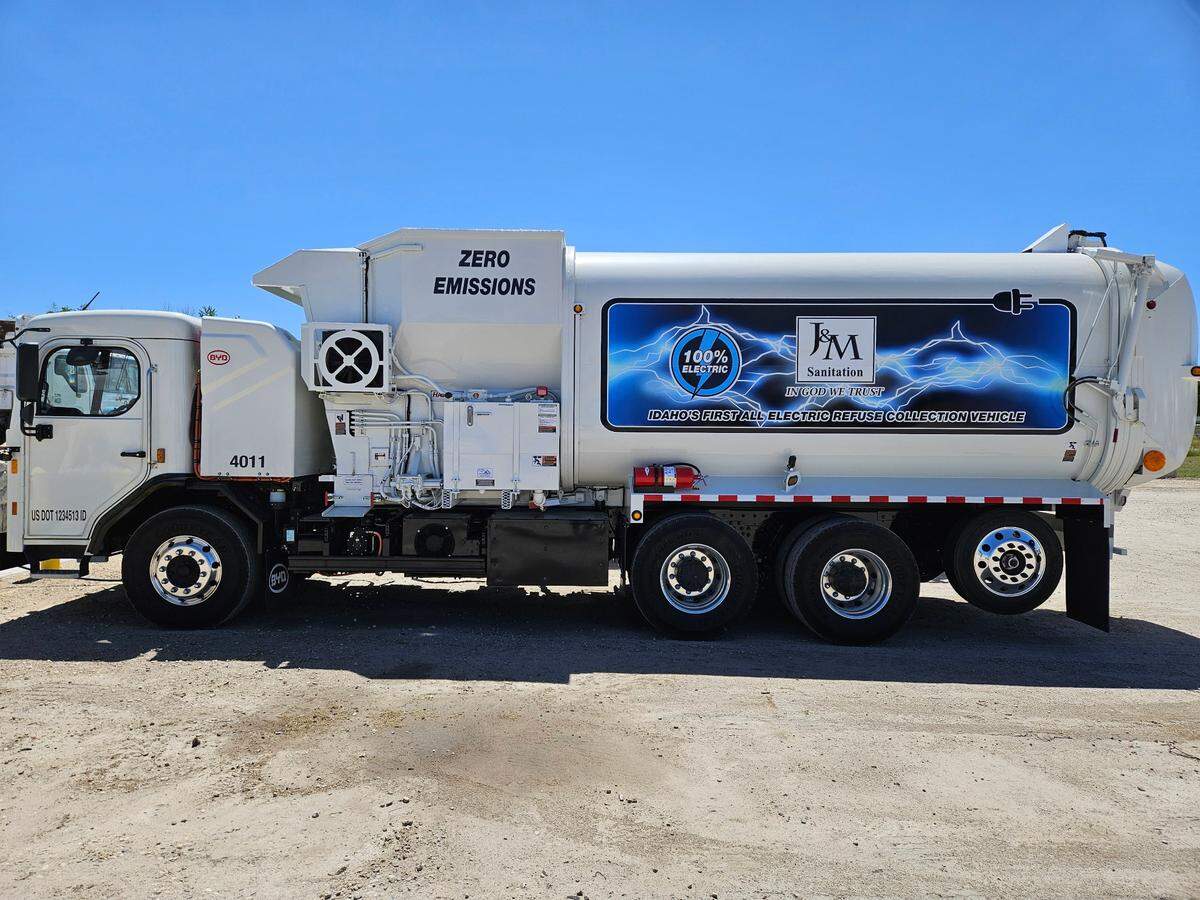
J&M Sanitation just completed the purchase of two electric garbage trucks, and coupled with the two it already owned, all of Kuna’s residential garbage and recycling is now being collected exclusively by electric vehicles.
As far as Chad knows, Kuna is the first city in the country — if not the world — to do so.
J&M serves about 11,000 households in the city of about 30,000, with three residential routes and one residential recycling route.
“Obviously, Dad has been a very big proponent of electric vehicles for a very long time and has been wanting to shift over to these for a while,” Chad, J&M part-owner and general manager, told me in a phone interview. “Now, all of those (residential) routes are covered by 100% electric vehicles. And that’s where we’re the first city — that I’ve been able to find in the world — where our residential trash and recycling is being picked up by 100% electric vehicles.”
Waste Today magazine reported last week that Louisville, Colorado, population 20,560, will become the first city in the country to adopt a fully electric residential waste collection fleet.
But that fleet won’t be replaced until the fall.
So by my math, Kuna beat Louisville by at least a couple of months.
Electrification process
Garbage trucks are particularly well-suited for electrification because of their consistent routes and the ability to recharge overnight. They offer zero emissions, promote cleaner air and are nearly silent, which can save cities on maintenance and fuel costs.
J&M has been working toward the electrification of its refuse collection fleet for the past seven years. The technology for electric garbage trucks hadn’t penciled out until 2021, Chad said.
Two things made it happen: battery life improvements and “dieselgate.”
J&M bought its first two fully electric garbage trucks in March 2021, becoming the first trash collection company in Idaho to have a Class 8 refuse truck, and their two trucks were only the ninth and 10th such trucks in the country.
The trucks had 295 kilowatts of battery capacity, enough to do a collection route on a single charge.
“I didn’t want to go to all this work and buy these trucks and then find out that halfway through the day, they got to park the truck and get in a diesel truck,” Chad said. “That was going to defeat the purpose.”
So the range was there, but then the other problem was the cost: $650,000 for an electric garbage truck, compared with $350,000 for a new diesel truck.
That’s where “dieselgate” came in.
The federal government had settled with Volkswagen, which agreed to pay billions of dollars in fines and reimbursements for misleading the public about its cars’ fuel emissions.
Some of that money went toward state programs to reduce nitrogen oxides.
Class 8 diesel trucks, such as the garbage trucks used by J&M, are some of the biggest producers of NOx.
The Idaho Department of Environmental Quality, which administered the funds, provided a 45% cost reimbursement for transition from diesel to all-electric. So now the electric trucks were within reach.
Plus, J&M received the reimbursement toward the $180,000 it spent installing a charging station for up to 20 trucks at its facility in Kuna. Of that, $80,000 was for one fast-charging station, which can charge a truck fully in about two hours.
Cost savings
Chad admits he was skeptical of the financial benefits at first and was worried that the promises of cost savings wouldn’t come to fruition.
But that changed as soon as they put the new trucks to use.
“Right off the bat, we were like, ‘Wow, these are going to work great,’” Chad said.
The trucks were able to handle a typical route, which consists of 800 homes a day, 36 miles and 1,000-1,400 arm lifts a day, and that includes two or three truckloads and 8-10 hours on less than one charge.
Most of the time, those trucks come back from their routes with 20-30% charge remaining at the end of the day. It takes about 8-9 hours to charge back up to 100%. The fast-charging station, which the company hasn’t had to use much, can do the job in a pinch.
Admittedly, J&M is in an ideal situation. All of its Kuna residential customers are within a 6-mile radius of the shop, and the trucks are able to unload into transfer trailers at the J&M shop, without having to run up to the landfill after each load.
The drivers love the trucks, too.
The air conditioning works much better than the diesel trucks because there’s no hot engine heating up the cab. Plus, some of the drivers would wear ear protection because of the noise of the diesel trucks. Not so with a silent electric vehicle.
J&M uses side loaders, meaning the driver stays in the cab, pulls up next to a garbage or recycling bin, and uses a joystick to operate a mechanical hand that grabs a can and dumps it into the truck — all from the comfort and quiet of the cab.
If anything, Chad said, customers complain that they can’t hear the truck coming, so they can’t drag their bins to the curb at the last minute anymore.
Other benefits: no more oil changes, no oil filters to replace and virtually no maintenance on the new trucks compared with the diesel trucks.
The trucks have regenerative compression brakes, meaning the truck will slow down when the driver steps off the accelerator, using the truck’s inertia to slow the truck and pump electricity back into the battery. That saves not only on brake life, but also adds to the truck’s range on a charge.
He said in the three years they’ve had the electric trucks, they haven’t had to change the brakes yet. Meanwhile, with diesel trucks, they were changing the brakes every six months because of all the stopping required.
Saving on fuel
In terms of fuel, because Idaho electricity is so cheap, it costs about $25 per day to fuel an electric truck, compared with about $180-190 a day for a diesel truck.
“(Diesel) fuel is so unpredictable that from day to day, you don’t know what it’s going to be,” Chad Gordon said. “So for budgetary purposes, it’s really, really difficult to look at a year and say, ‘Hey, what’s my fuel bill going to look like,’ versus with electric, they set the prices once a year. So I can budget out really easy, and say, here’s what my cost is going to be to fuel that truck.”
Plus, it’s helped with employee retention, he said, because the drivers are a lot more comfortable all day long, and they’re not having to listen to all that noise or sit in the vibration or breathe the diesel fumes.
“There’s a lot of real positives to it, at the end of the day,” he said. “If we’re just looking at costs, yes, they cost double the price, but in the long run, they’ll pay for themselves pretty quickly.”
With the overwhelming success of the first two trucks in the fleet, J&M forged ahead this year to buy two more. By now, the battery life has improved even more, to 405 killowatts, or about 50-60 miles on a single charge.
That meant they could replace the diesel trucks that were used for longer, outlying routes and the recycling route, which involves longer distances and higher speeds in some points.
The new trucks went into operation about a month ago.
The company has never had a truck run out of juice on a route. The lowest they’ve ever seen was about 12% battery life, and that’s only been once or twice, Chad said.
Trucks come with an eight-year warranty on the batteries, five years on the rest of the chassis parts and two years on all other cab parts.
They haven’t had to replace the batteries and they don’t expect to for at least eight years.
And replacing a battery is a lot cheaper than replacing a diesel engine — not to mention a lot faster.
“We’ve had just great luck with them,” Chad said. “So far, they’re coming back with anywhere between 20 and 40% (charge) at the end of the day, and they’re probably doing closer to 50 to 60 miles, versus the other two trucks are doing about 36 miles.”
DEQ subsidized three of the four trucks. J&M paid for the fourth truck outright, without subsidies.
J&M still uses diesel trucks for its county routes, the city of Melba and for commercial front loaders, and uses diesel semi-trucks to haul trash out to the landfill.
But as the technology gets better and better, the vision is to convert those trucks to electric, as well.
Plus, Chad said, J&M is looking into installing solar panels on site with the possibility of becoming completely self-sufficient.
Chad said he expects a third round of funding from DEQ next year, and J&M may apply to purchase a new electric commercial front loader.
“So really it’s overall cost-effective to continue down this path,” he said.
He’d also like to partner with landfills or transfer stations to install fast-charge charging stations there, so that their drivers can take the mandated lunch break and charge their vehicles at the same time.
“I think we’re going to see Idaho be one of the leaders in all this technology, and hopefully setting an example for the rest of the United States,” Chad said.
The future of electric
The application for this technology is a perfect fit for collecting trash.
But it also has some other obvious applications: school buses, food and beverage distribution, or fire trucks.
The Boise School District recently was awarded $2.8 million in grants from the Environmental Protection Agency’s Clean School Bus Program to buy up to eight electric school buses to add to its fleet.
The district anticipates having the new vehicles on the road for the 2026-27 school year, barring any production delays.
“I think there’s a lot of guys that are scared of the technology and the cost,” Chad said. “And it is new. It is something we took a pretty good leap of faith there in the beginning to do this, but in my opinion, it’s paid off tenfold, and it’s proving that this technology can be used.”
Rachele Klein, business development director for Republic Services in Idaho, said J&M has been “a local EV leader from the start.”
Tim Gordon got things kicked off.
“He’s very passionate about it,” Chad said. “Sometimes he drives me nuts with it, but I really do love the vision, and it’s probably a vision that I myself may not have had if it wasn’t for him to kind of push, and so he’s really the catalyst that got this whole thing started.”
Republic Services, a national company that provides refuse and recycling services to several municipalities in the Treasure Valley, is making significant strides in converting its fleet to electric vehicles.
Republic is one of the largest operators of vocational fleets in the United States, with over 17,000 trucks, and the company expects electric vehicles to represent half of its new truck purchases by 2028.
Locally, Republic is expecting its 10th Class 8 refuse/recycling electric vehicle in Boise this week, according to Klein, and Republic completed its electric vehicle build-out to charge 32 trucks at the end of July, so even more trucks are expected to be added locally soon.
Louisville, Colorado, the city that looks like it’s going to come in second place for full electrification behind Kuna, is serviced by Republic.
“It’s really been awesome to work through this process and see his excitement come to fruition through all this,” Chad said. “And also prove to people, ‘Hey, this is a technology that it works and works really, really good in the right situations.’”