Sick of Idaho’s winter dragging on? Here’s why you should be thankful | Opinion
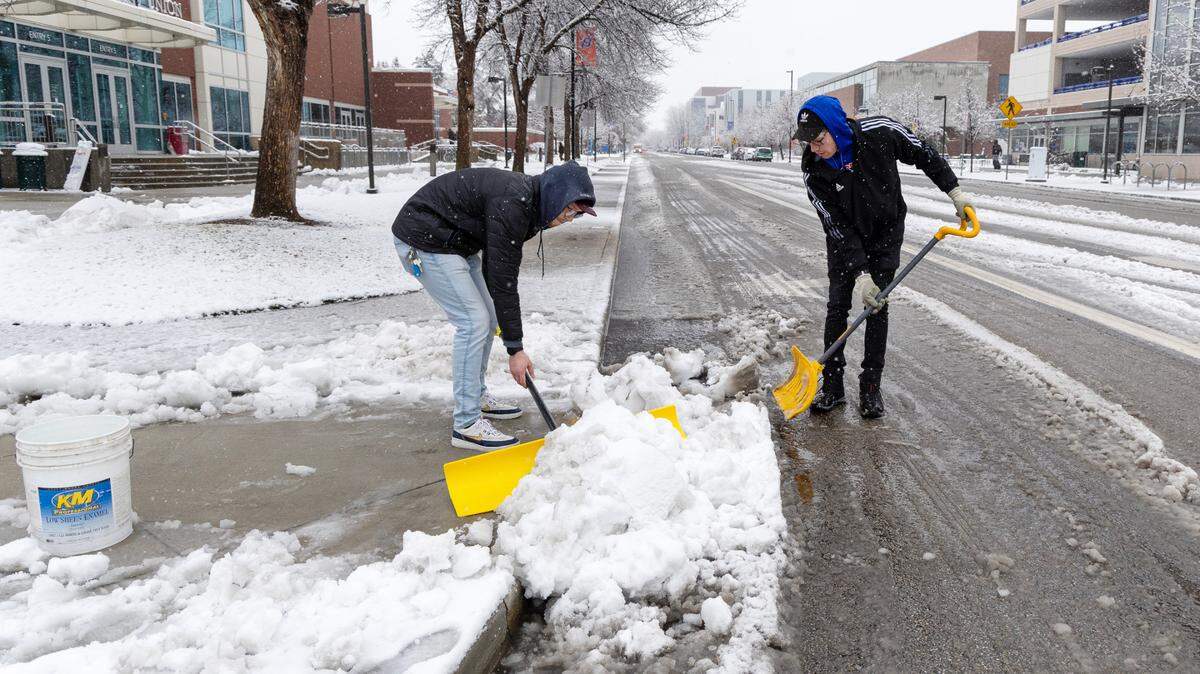
I still have friends back in New York, who have posted about recent snowstorms they’ve been getting. Of course, snowstorms in March in Rochester, New York, are not uncommon. I have been chuckling to myself, thinking I’m glad I’m not still back there.
I was chuckling until Thursday morning, when Boise came close to setting a 105-year-old record for snowfall on March 30. As Shaun Goodwin of the Idaho Statesman reported, As of 10 a.m. on Thursday, Boise had picked up 2.8 inches of snow as of 10 a.m. Thursday, close to the March 30, 1905 record of 3.2 inches, National Weather Service Meteorologist Stefanie Henry said.
Now I’m the one posting on social media about getting snow so late in the season.
But I’m not complaining.
First, this has been one of the best seasons if not the best season in recent memory for skiing at Bogus Basin, which has gotten more than a foot of new snow just this week. My wife and I estimate we’ve been up the hill nearly 20 times this season. Each week, we think it will be our last, and each week there’s a new layer of snow, and back up we go each weekend.
But there’s an even more important reason to welcome the snow: We’re probably going to have a fantastic water year in Idaho.
“Overall, all around the state, we’re in really good shape,” David Hoekema, hydrologist with the Idaho Department of Water Resources, told me in a phone interview. “One thing that this cool weather has done is delayed the irrigation season and it’s delayed runoff…. And so now with pretty spectacular snow across the southern part of the state and this cool weather, it’s fully going to bring us out of drought.”
The U.S. Drought Monitor this week officially pulled southern Idaho out of the drought category.
Snowpack in the Boise basin as of Thursday was 129% of the median, according to the Natural Resources Conservation Service. Precipitation totals for March are currently at 205% of normal, according to the Northwest River Forecast Center.
Hoekema said this likely won’t be a record-breaking year, like 2017, which many recall as the year of “Snowmageddon,” but will be a top 20% snow year.
But Hoekema chuckles at the thought.
“Although, we might be in 2017 (type situation) here in another week or two if this keeps up,” he said. “But we are moving toward the realm of flood control being a much more serious issue and topic of much greater concern now.”
In fact, the U.S. Army Corps of Engineers and the Bureau of Reclamation are going to be increasing Boise River flows as a flood control measure starting next week.
Starting Monday, water flows will increase by 500 cubic feet per second each day through the week and the following Monday, Ryan Hedrick, reservoir operations manager for the Bureau of Reclamation, told me in a phone interview.
The Boise River will be flowing at about 3,000 cfs, which is pretty fast and dangerous, Hedrick said. By comparison, the Boise River flows at about half that, 1,300-1,500 cfs during the summer floating season.
The goal of the water releases from Lucky Peak Dam is to reduce the risk of flooding later in the spring.
As of Thursday, the three reservoirs in the Boise River system — Arrowrock, Anderson and Lucky Peak — held about 610,000 acre-feet of water, or 64% of capacity.
That means a full supply of irrigation water is anticipated this summer.
That’s a good thing. Idaho doesn’t have a multi-year water storage system. We get what we get each year and use it until it runs out, more or less, ideally with a little storage left over each year.
A historically dry spring in 2021, not seen since 1924, “drained the reservoirs across the state,” Hoekema said.
Things weren’t looking so good last year, until we had a very wet spring, which helped us get through last season.
In the Boise Basin, there is a plan to increase storage by enlarging Anderson Ranch Reservoir by raising the height of the dam by 6 feet, but that is a year or more off. It would add about 29,000 acre-feet of water, which is a drop in the bucket, adding only 7% to Anderson Ranch’s capacity, and just 3% of total capacity of the three reservoirs combined.
So having good water years like this is vital.
“Huge sigh of relief,” Hoekema said. “And it didn’t really come until really starting in February, where we could really say, ‘We’re pulling it off. We’re leaving the drought behind.’”
This story was originally published March 31, 2023 at 4:00 AM.