
Ada commissioners shirk fiscal responsibility by defunding successful homeless program
Ada County commissioners put politics over hard evidence when they defunded a homelessness program that’s proved to save money.
Commissioners also shirked their statutory responsibility when they eliminated the county’s $312,000 share of supportive service funding for New Path Community Housing, an apartment building for those who are chronically homeless.

Boise City Council members picked up the tab, likely saving county taxpayers millions.
The commission, now dominated by Republicans Rod Beck and Ryan Davidson — Democrat Kendra Kenyon is the third — have looked askance at New Path, a “housing first” model to provide housing and supportive services for people who are chronically homeless.
New Path, understandably, offends the conservative sensibilities of Davidson and Beck (and Kenyon has gone along with them). Admittedly, this is a pretty liberal program: The government is providing subsidized housing and supportive services for New Path residents. You could easily qualify this as “socialism.” I don’t know how Davidson or Beck could show their faces at a Republican Central Committee meeting and say they approved hundreds of thousands of taxpayer dollars for a program that’s perceived as helping people who can’t just pull themselves up by their bootstraps.
But here’s the problem for the commissioners: Funding New Path makes fiscal sense, a hallmark of conservatism. It saves the county money.
And the commissioners have proof — hard data proving that New Path saves money.
The Idaho Policy Institute at Boise State University has been studying New Path and its cost savings since it opened its doors in 2018. Its most recent report found that over New Path’s first two years, there was a 60% reduction in costs, equaling a savings/cost avoidance of over $2.6 million.
Cost savings come from such things as police responses, jail services, ambulance calls for service, emergency room visits and hospitalizations.
These aren’t just broad estimates, either. This is real data based on the real people living at New Path. Researchers looked at the history of residents and documented the services they used before they came to New Path and then looked at the services they used after they moved in.
The drop is dramatic.
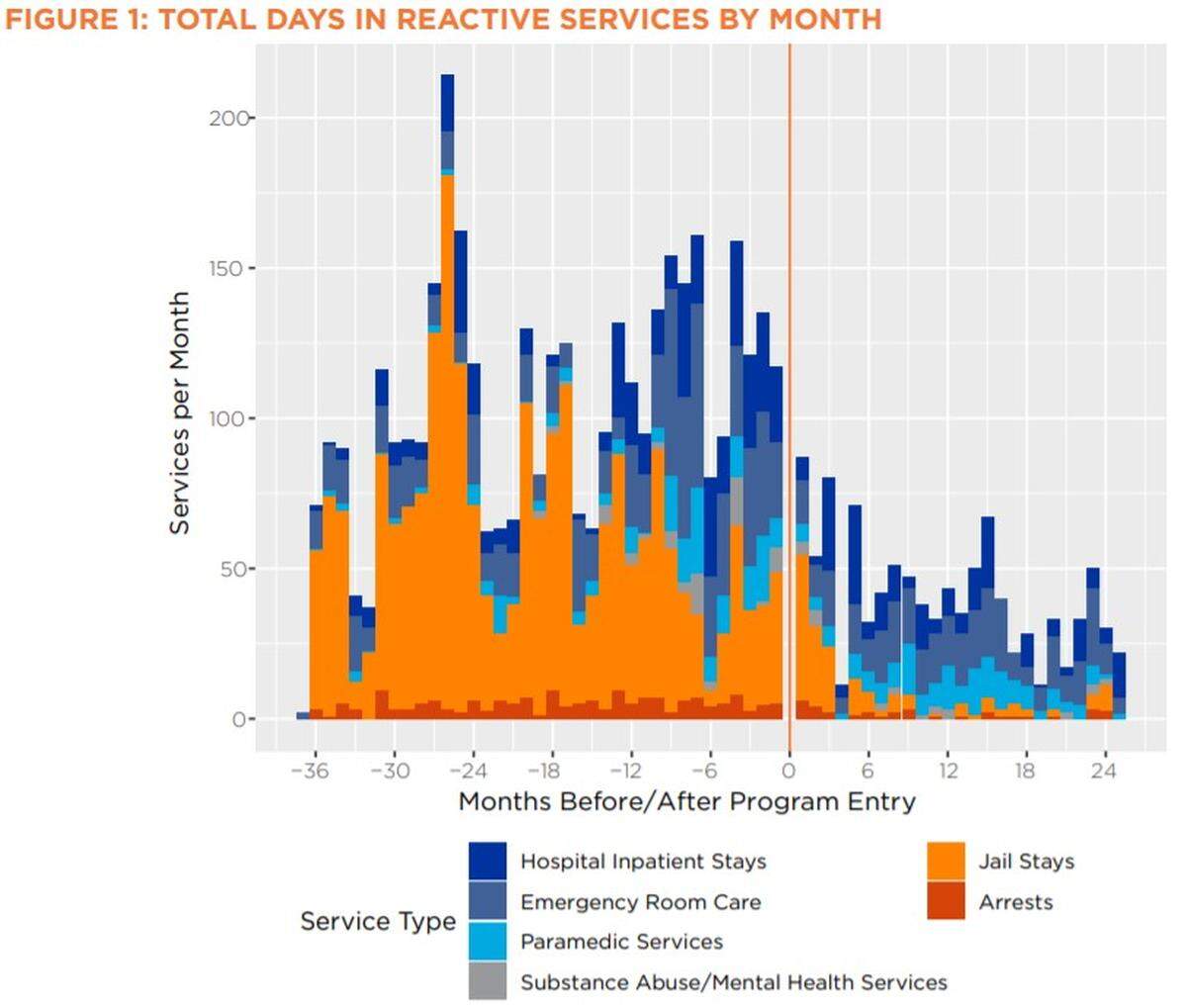
This reduction in the use of services not only saved $2.6 million, but it also improved the lives of these 40 people dramatically. Less interaction with police, fewer trips to the emergency room, fewer hospitalizations. No question it benefits the lives and well-being of residents.
“New Path is unequivocally a success story,” Casey Mattoon, Our Path Home manager for the city of Boise, said in a phone interview. “It provides bar none the most positive impacts and outcomes for the residents and the community at large of any type of response program that we could be running for people experiencing chronic homelessness.”
Political decision
Funds to run New Path operations, such as building maintenance and utilities, come from money that is already coming into the community to target homelessness and would be used for housing programs anyway, Mattoon said. Using these vouchers to cover rental assistance at New Path is where Our Path Home has found they have the biggest impact in terms of positive outcomes for residents and the community.
The other critical piece of New Path’s funding that’s in question is the “supportive services,” such as case managers, peer support specialists, nurse case workers, substance abuse counselors and mental recovery staffers. Terry Reilly Health Services, contracted to offer those services at New Path, requested $575,000 for 2021-22, an increase of $63,000 from the previous year.
Ada County had been scheduled to contribute $312,000, and St. Luke’s and Saint Alphonsus hospitals were scheduled to contribute $100,000 each. After the requested increase for this fiscal year, the hospitals agreed to up their shares to $120,000 each, and the city of Boise agreed to pay the county’s share, now at $335,000.
Ada County still agreed to provide Terry Reilly with $200,000 for services, just not at New Path. County commissioners haven’t defined a program to replace New Path, which makes it clear that this decision is purely anti-New Path and not pro-something better.
In which case, the decision to defund New Path is based on pure politics and spits in the face of hard evidence that shows New Path works.
“The commissioners have made this decision (to defund New Path) based on their personal feelings about the ‘housing first’ philosophy versus the actual outcomes of the program,” Stephanie Day, executive director of CATCH, an Idaho nonprofit organization that works with government agencies, local businesses and other charitable organizations to house people experiencing homelessness, said in a phone interview. “So the program itself has saved us over $2.6 million. The quality of life of the tenants that live there has dramatically increased, and the cost of things like interaction with the police and hospital systems has gone down for all of the folks that live there.”
Condition of tenancy
Day noted that part of what appears to be the commissioners’ objections to New Path is that New Path doesn’t force residents to participate in support services and treatment as a condition of tenancy.
She likened that kind of attitude to a mask mandate or a vaccine mandate.
“That doesn’t work for everyone,” Day said. “There’s a part of the human spirit that does not like to be told what to do. If you can help reason with someone and help them understand what the benefits of something are and get them to a point where they want to do it, it’s a lot more successful than telling them that they have to.”
Further, kicking someone out of housing because they won’t participate in services just puts them on the street, where they’ll cost more in terms of police, jail, ambulance and hospital use.
Day notes that not everyone who is homeless is the same. Each has their own needs and their own challenges.
“There are different types of interventions for different levels of need,” Day said. “And New Path is designed for the highest level-need folks that we have in the community — so the folks that have the most severe physical health issues and substance use challenges and mental health issues.”
She estimated that 70% of New Path residents participate in some form of services, whether it be mental health or addiction services, and she estimates that another 15% function at a high enough level that they don’t need services.
“And then you’ll always have a few folks that just are struggling so much that maybe this isn’t going to be a successful placement and they’ll move on,” she said.
But that’s no reason to defund the program. To the contrary, the success that New Path has had shows that it should be expanded.
In fact, a 2016 study of Ada County found 100 individuals experiencing chronic homelessness were associated with over $5.3 million annually in costs to the Ada County community. New Path is just getting started and helping 40 people, averaging a cost avoidance of $1.3 million per year. So the numbers are penciling out.
“We have so much unmet need for permanent supportive housing in our community,” Mattoon said. “So we need to be building right now, not backing away at all — that is the opposite that we should be doing.”
Last week, Our Path Home released a five-year plan to build five new projects like New Path to house 250 people. That’s the right direction.
Unfortunately, they’ll likely have to do it without help from the Ada County commissioners.
County’s statutory responsibility
But here’s an important thing to consider: Counties — not cities — are the government agencies responsible for providing indigent care.
It even says it right in the original contract between Ada County and Terry Reilly Health Services. That contract, by the way, was signed in 2017 by Republican commissioners Jim Tibbs and Rick Visser (Dave Case was absent).
“Many of the services provided to chronically homeless individuals through the Project (New Path) would be services otherwise provided pursuant to statutes providing Hospitals for the Indigent Sick, for Hospitalization of the Mentally Ill, and for Ambulance Districts, which statutes require counties to provide emergency medical and mental health services and indigent medical care,” according to the contract.
Back then, the commissioners recognized that it was their responsibility to address the situation, and they recognized it was a matter of “pay now or pay more later.”
Now, however, Boise city taxpayers are picking up the tax tab that should be borne by all Ada County taxpayers.
Taxpayers in Eagle, Meridian, Kuna and everyplace in between should send a thank you note to the Boise City Council for saving them money.
Not only should that $335,000 be paid out of the county budget, but if New Path just disappeared, the county would be on the hook for a lot more than that, through court, jail and ambulance costs and more. Remember, Beck and Davidson ran on a platform of saving tax dollars.
“The data shows it’s a great investment,” Mattoon said. “It’s impressive local results. There are almost $2.7 million in cost savings and about 60% reduction in service utilization just in its first two years for residents.”
We talk a lot as a community about Boise not becoming another Seattle or Portland, and one of the things we point to are tent cities, homeless encampments in city parks and along sidewalks.
If we want Boise to avoid that, New Path is the way to go.
“We’re in a really unique period in time right now, where we may not be beyond the point of no return,” Day said Tuesday during a City Club of Boise forum on homelessness. “We may — if we really lean into this and come together to try to attack this challenge that we’re having right now — we may be able to keep from becoming a Portland or Seattle.”
To their credit, Saint Alphonsus and St. Luke’s put their money where their mouth is and increased their share of the cost to $120,000 each — recognizing that it’s a program that works.
“Saint Alphonsus Health System continues to support the mission of New Path Community Housing as it addresses a pressing community need,” Saint Al’s wrote in a prepared statement. “Our Community Health Needs Assessment identified safe, affordable housing and homelessness as the most significant health need in our community.”
It’s too bad Ada County commissioners don’t recognize what a good investment New Path is.
“It’s the supportive services that actually enable our health care system to better address the health of those most at risk in our community,” Mattoon said. “I’m just thankful that Boise, St. Luke’s and Saint Al’s are allowing demonstrated results to drive their investments instead of what I would say is political posturing.”
BEHIND THE STORY
MOREWhat is this column all about?
This column shares the personal opinions of Idaho Statesman communities editor Scott McIntosh on current issues in the Treasure Valley, in Idaho and nationally. It represents one person’s opinion and is intended to spur a conversation and solicit others’ opinions. It is intended to be part of an ongoing civil discussion with the ultimate goal of providing solutions to community problems and making this a better place to live, work and play.
Want more opinions each week?
Subscribe to The Idaho Way weekly email newsletter, a collection of editorials, columns, guest opinions and letters to the editor from the Opinion section of the Idaho Statesman each week. You can sign up for The Idaho Way here.
Want your say?
Readers are encouraged to express their thoughts by submitting a letter to the editor. Click on “Submit a letter or opinion” at idahostatesman.com/opinion.