
Tuition freeze, state budget cuts a double whammy to Idaho higher education
Last week’s announcement that Idaho is freezing college and university tuition for in-state undergraduate students at Idaho’s four-year institutions is good news for students.
But the decision to forgo that revenue comes at a time when the University of Idaho is already facing a $14 million shortfall that could climb to $22 million over the next couple of years.
In addition, Idaho Gov. Brad Little has ordered colleges and universities to cut spending by 1% this budget year and 2% the following year in the wake of weakening state revenues.
And when it comes to higher education, Idaho is relying more and more on tuition to pay the bills.
In 1980, state funding covered 88% of the state’s higher education budget, and tuition revenue paid 7% of that cost. Today, state funding covers 51% of costs, and tuition revenue pays 47%.
Further, state higher education funding is down 6% when adjusted for inflation, compared to where it was at the beginning of the last recession in 2008, according to Debbie Critchfield, president of the state Board of Education, in a guest opinion published by the Idaho Statesman.
“When we have discussions about funding for higher education in Idaho, we must start with the fact that funding has not yet recovered to pre-recession levels,” Critchfield wrote. “While restoration of operational funding has been underway for K-12, the same is not true for higher education.”
Keep in mind this is what the president of the state Board of Education wrote as guest opinion when announcing the tuition freeze, not exactly a screaming endorsement of the direction we’re headed.
State general fund spending on higher education peaked in 2009 at about $285 million but dropped during the recession to as low as $210 million in 2012 before rising again to $306 million this fiscal year.
Critchfield pointed out that state appropriations for higher education was almost 17% of the state budget in 1980. Today, it is less than 8% of the state budget.
Total tuition dollars, meanwhile, have increased every year, even straight through the recession, more than doubling from $129 million in 2009 to $281 million this fiscal year.
Cuts on the legislative horizon
But cuts seem to be inevitably on the horizon.
In a possible harbinger for the legislative session, Idaho Rep. Wendy Horman, R-Idaho Falls, this week retweeted a column by the president of Kaplan University Partners about the decline in interest in a college education among young adults.
The thrust of the column was that amid rising costs of higher education, young adults are less interested in higher education, and there’s a growing perception that college graduates are less prepared for the workforce.
“Great summary of the reasons (Idaho Legislature) will be having conversations in our upcoming session about the cost of college and how Idaho is preparing students to enter the workforce,” wrote Horman, who is also vice chairwoman of the House Appropriations Committee and sits on the Joint Finance-Appropriations Committee.
Idaho still has low tuition
Even with an increase in the state’s reliance on tuition dollars to fund higher education, Idaho has the eighth-lowest in-state tuition in the country, higher than only Wyoming, Florida, Utah, Montana, North Carolina, New Mexico and Nevada, according to The College Board.
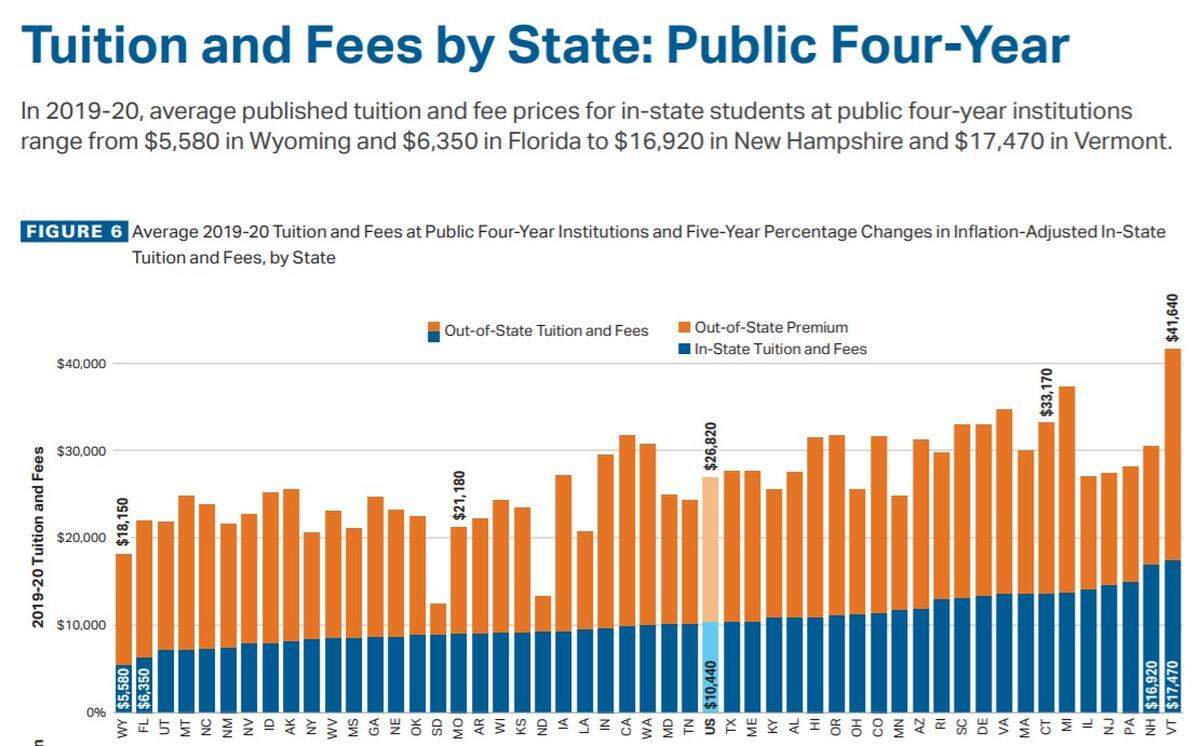
With the freeze, tuition bills next year will be $8,304 at the University of Idaho; $8,068 at Boise State; $7,872 at Idaho State University; and $6,982 at Lewis Clark State College, according to Idaho Education News.
Idaho also ranks 12th-lowest in the country for in-state tuition as a percentage of median household income, at 13.6%, according to an analysis by the Idaho Statesman of College Board data and U.S. Census numbers.
.png "In-state tuition and fees as a percentage of median household income (1).png")
Despite that relative affordability, Idaho’s “go-on” rate is less than 44.6%, which is down from 2016, the wrong direction we want to be headed. It also doesn’t bode well for the state Board of Education’s ambitious goal, set in 2012, that 60% of Idahoans ages 25-34 will have a degree or certificate by 2020.
Cutting costs at Idaho’s four institutions
A 4.53% increase in tuition and fee increases last year translated to about $16 million in new money for the state’s four institutions.
Freezing tuition revenue next year and the likelihood of cutting state revenue most certainly means some hard decisions are going to have to be made.
As part of then-Gov. Butch Otter’s Higher Education Task Force, the state Board of Education last year commissioned a study of consolidation at the state’s institutions, estimating that $38 million could be saved over 10 years by consolidating such functions as information technology, purchasing and human resources.
That’s certainly a good start, but really that’s a drop in the bucket of a $604 million annual budget, which includes $306 million from the general fund, $17 million from endowment funds and $281 million from tuition and fees.
It’s not looking at more drastic consolidation on the education side, such as combining some duplicative programs into one location and shedding degrees and programming long ago determined to be unproductive and cost-inefficient.
We support efforts to make higher education spending more efficient, systemwide collaboration among all of our higher education institutions, including our community colleges, and eliminating duplicative or cost-inefficient programs in an effort to bring down the cost of higher education in Idaho.
Ultimately, any changes should bring about better educational outcomes.
What we don’t want to see happen is cutting for the sake of cutting without a smart plan forward.
What we do not understand is why it is necessary to attack the two primary revenue sources our universities and colleges employ to support our students, faculty and staff, and to do so with no apparent plan for how these cuts fit into Idaho’s commitment to workforce development our employers require. This seems to be a double whammy that Idaho’s colleges and universities do not need at this moment. There’s still time for the Governor’s office to adjust these twin attacks on higher education by giving the board authority to consider specific tuition increases for campuses that can show how the budget cuts would negatively affect the quality of the education our students receive.