Did a Boise air quality monitor read ‘very unhealthy’? Why is Idaho air so bad right now?
Boise residents are accustomed to waking up on a summer morning to see the Boise foothills covered in smoke and an air quality advisory popping up on their phone alerts.
But it’s a far less common sight to see an air quality advisory pop up in the middle of January, with several inches of snow on the ground and no wildfires to report.
It wasn’t just a minor air quality advisory issued this past Friday, but an orange air quality advisory, which indicates the air is unhealthy for sensitive groups. Yet, for most of the Treasure Valley on Thursday, monitors indicated air quality in the red category, which is unhealthy for all groups.
One monitor in the Boise area even recorded a reading in the purple section for several hours on Thursday, which is deemed very unhealthy for everyone.
So why is the air quality so bad in Boise right now, and why are monitor readings exceeding the severity of advisories issued by the Idaho Department of Environmental Quality?
How is air quality measured?
The Idaho Department of Environmental Quality measures air quality for the Gem State. The department runs a real-time map on its website that updates the air quality every 15 minutes at 24 locations in Idaho, including four locations throughout the Treasure Valley.
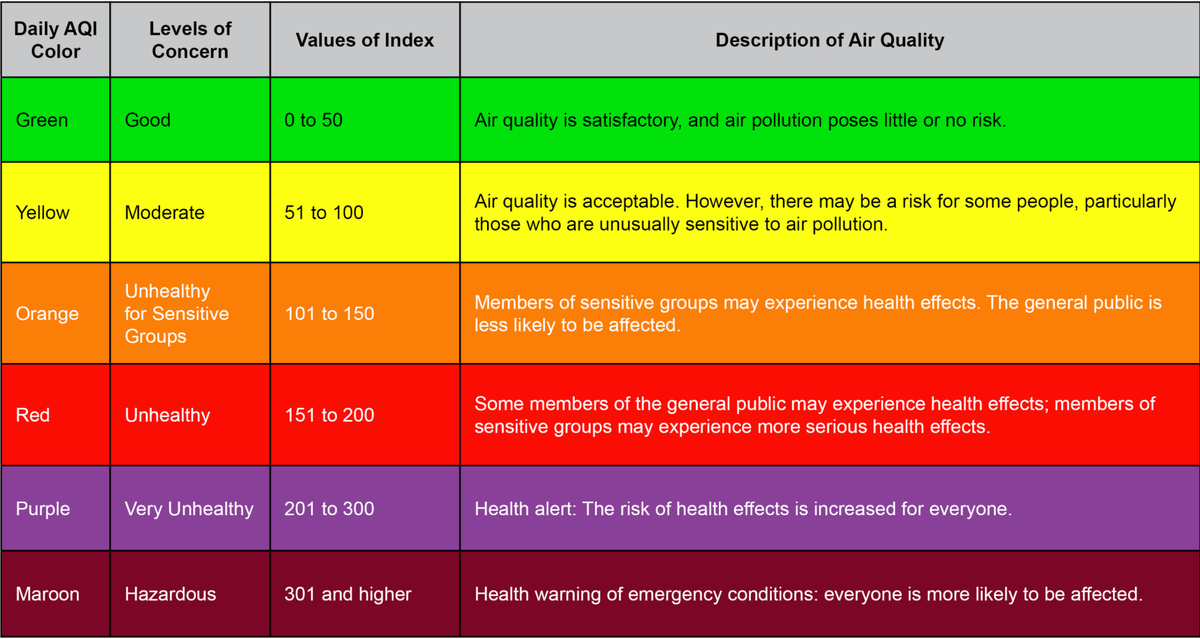
The index calculates the number of pollutants in the air, considering how large the pollutant molecules are and the severity of the pollutant, and produces a number between zero and 500.
Good air quality, which would fall under the green level of concern, is between zero and 50. The index then slowly increases through six levels up to maroon, a hazardous air quality, with the index above 301.
Why is the air quality in Boise bad right now?
The most common reason for poor air quality in Boise is smoke from wildfires within the Gem State and from afar.
But pollution is another common reason for air quality. Ozone, a gas compound made up of three oxygen atoms that is poisonous to humans, is released from cars and other manufacturing endeavors and can get trapped in the Treasure Valley.
“What we’re experiencing now is just kind of a winter inversion; everything’s just locked in,” Michael Toole, regional airshed coordinator for DEQ, told the Idaho Statesman on Friday. “We just haven’t had — this is going to sound weird — but we haven’t had a strong enough storm system to come in and kind of blow everything out.”
The wind and warmer temperatures often associated with storms help clear out pollution. But despite snowstorms dropping 3.5 inches of snow since Monday, low wind speeds and temperatures as low as 3 degrees did little to clear out the inversion.
The DEQ issued a red level red advisory on Friday afternoon heading into the weekend, with little improvement expected until next week.
“It looks like right now that the forecast for the entire weekend can be either in the upper orange or the red; we’re hoping that the next storm system coming through might help,” Toole said. “It looks like there’ll be some increased winds, which is kind of what we need.”
Why is the air quality worse than forecast?
DEQ issued an initial air quality advisory on Thursday at the yellow level, but many Boise-area monitor readings crept into the orange and red categories.
That was followed on Friday morning by an advisory in the orange category, but by Friday afternoon, much of the Treasure Valley was reading in the red category.
Toole said that DEQ was expecting cooler temperatures and hoped that a forecast of freezing rain on Wednesday would grab some of the pollution particulates out of the atmosphere. But the Wednesday storm had less moisture than anticipated; despite a slight reprieve, air quality index numbers shot back up soon after.
Advisories issued by DEQ are for a 24-hour span, meaning sometimes those in charge of issuing advisories have to predict what weather is coming up.
“There are times where, say, we forecast to yellow, and it’s pretty high, but we know something’s coming, or we’re expecting relief,” Toole said. “And we’re like, ‘God, we kind of missed on this one.’ But we can ride it out for a short period, and it’s going to clear out.
“What happened yesterday,” he continued, “is although the levels were going up, there was, based on the information that we had at that time, we thought it might improve slightly overnight, and it just didn’t.”
Why did one monitor record very unhealthy air?
On Thursday at around 2 p.m., one monitor in the Boise area had a reading of 222 for several hours, which is in the very unhealthy purple category.
Toole said DEQ performed a site visit to the monitor to see why it recorded such poor air quality but could not find a solution.
“We checked all the settings, and the monitor is just running fine,” Toole said. “So it was just a strange anomaly, almost like a really localized impact. But we weren’t sure exactly why it jumped so high just at that one monitor for that short period of time.”
A common reason an air monitor shows an incredibly high reading for a localized region is if something is burning nearby and the smoke is blowing directly into the monitor.
“We’ve had monitors located in certain areas where somebody was cooking on a barbecue,” Toole said. “And the barbecue (smoke) just happened to be going right in that direction and impacted that monitor significantly.”
Dust from construction sites kicked up by the wind is another common reason a localized reading is exceptionally high.
“We don’t know the specific reason why it did it (on Thursday),” Toole said. “But again, the monitor was checked, and everything’s running fine. And there were no local impacts that we could determine.”