Did you know 2023 was Earth’s hottest-ever year? Here’s how hot it got in Boise last year
It’s official: 2023 was officially the hottest year in recorded history, according to data dating back to 1850.
The European Union’s Copernicus Climate Change Service released its 2023 report on Tuesday, which states that worldwide temperatures were 1.48 degrees Celsius — 2.66 degrees Fahrenheit — higher than pre-industrial levels from 1850 to 1900. The previous hottest year was 2016 when global temperatures were 1.31 degrees Celsius over pre-industrial levels.
While 1.48 degrees Celsius doesn’t sound like a big jump, that’s right on the cusp of the 1.5 degrees Celsius that scientists who were part of the 2015 Paris Climate Accords wanted to stay within to avoid the worst impacts of climate change.
And unfortunately, that record is likely to be broken again in 2024. Copernicus expects global temperatures to exceed 1.5 degrees Celsius above pre-industrial levels for the first time this coming year.
The data can be a little harder to believe in Boise during early January when snow coats the foothills and sidewalks, and several more inches are forecast to come.
So, where does Boise fit into the bigger picture?
Did Boise endure a hotter-than-normal year?
A significant contributing factor to 2023 claiming the title of Earth’s hottest year is that each month from June to December was warmer than the corresponding month for any other year.
Boise played a large role in that during the summer months. The Gem State was one of several states in the western U.S. to be trapped under a “heat dome” in July and September. Temperatures in Boise soared to 105 degrees on multiple occasions, and July was officially the hottest month in Earth’s history.
But despite the intense summer heat, 2023 wasn’t the hottest year in Boise’s history.
The average temperature in Boise for 2023 was 54.6 degrees Fahrenheit, which is 3.2 degrees hotter than the historical average of 51.4 degrees, National Weather Service meteorologist Dave Groenert told the Idaho Statesman.
That’s good enough for Boise’s sixth-hottest year on record, tied with 1874 and 1869. The hottest year on record for Boise was 1934, when temperatures averaged 55.8 degrees.
Although highlighting years from the 19th and 20th centuries indicates Boise has always been this hot, they are more likely anomalies than norms. Of the 15 hottest years in Boise’s history, 11 have occurred in the 21st century.
Last year likely would have ranked higher for Boise, too, if not for an abnormally cold start to the year. Just three months saw below-average temperatures in Boise: February, March and April.
March was especially cold, with the average temperature 6.1 degrees below normal for the month. The Pacific Northwest was one of the few places on Earth to have a colder-than-average March, while the rest of the world recorded its second-warmest March.
What does the near future hold for Boise?
Looking out of the window right now in Boise, it’s hard to believe things will warm up anytime soon. The Weather Service forecasts potentially 10.4 inches of snow in the City of Trees by the end of the weekend, and the forecast high temperature on Sunday is 32 degrees.
But the Climate Prediction Center, an arm of the National Oceanic and Atmospheric Administration, forecasts that much of the Pacific Northwest will have a 50-60% chance of above-average temperatures between January and March.
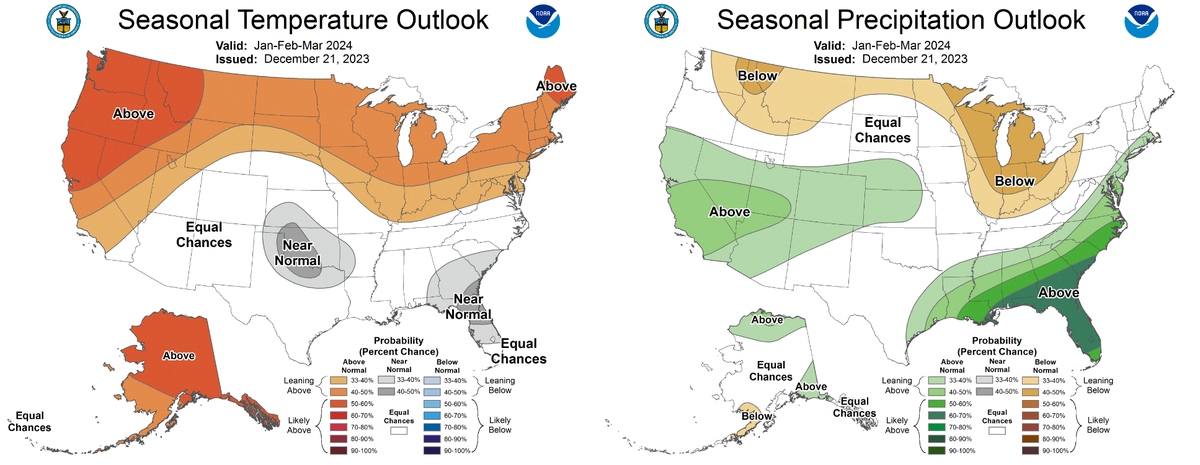
That doesn’t mean you can pull out the t-shirts and shorts by March — the average temperature in March for Boise is still only 45.2 degrees, but Boise could be creeping toward the 50-degree mark sooner than usual.