Farmers’ Almanac predicting an ‘unusually snowy’ winter in Idaho. Here’s the full forecast
With summer quickly giving way to fall, the Farmers’ Almanac published its long-range winter forecast for the United States in August.
After a particularly grueling month in which Boise recorded its sixth-hottest ever July — including eight days that hit at least 100 degrees — the thought of being able to walk outside without melting sounds inviting.
Farmers’ Almanac publishes its winter outlook with somewhat uncanny accuracy every year, using a secret formula known only by a single person under the pseudonym Caleb Weatherbee. The longtime weather forecasting website and publication claims that 80-85% of its forecasts are accurate.
Farmers’ Almanac’s 2022/23 winter weather forecast had an extremely high accuracy rate for whether a region would deviate from its regular winter precipitation but only a 39% accuracy rate on the average temperature. The organization noted that unusual weather patterns resulted in the low accuracy of its temperature forecast.
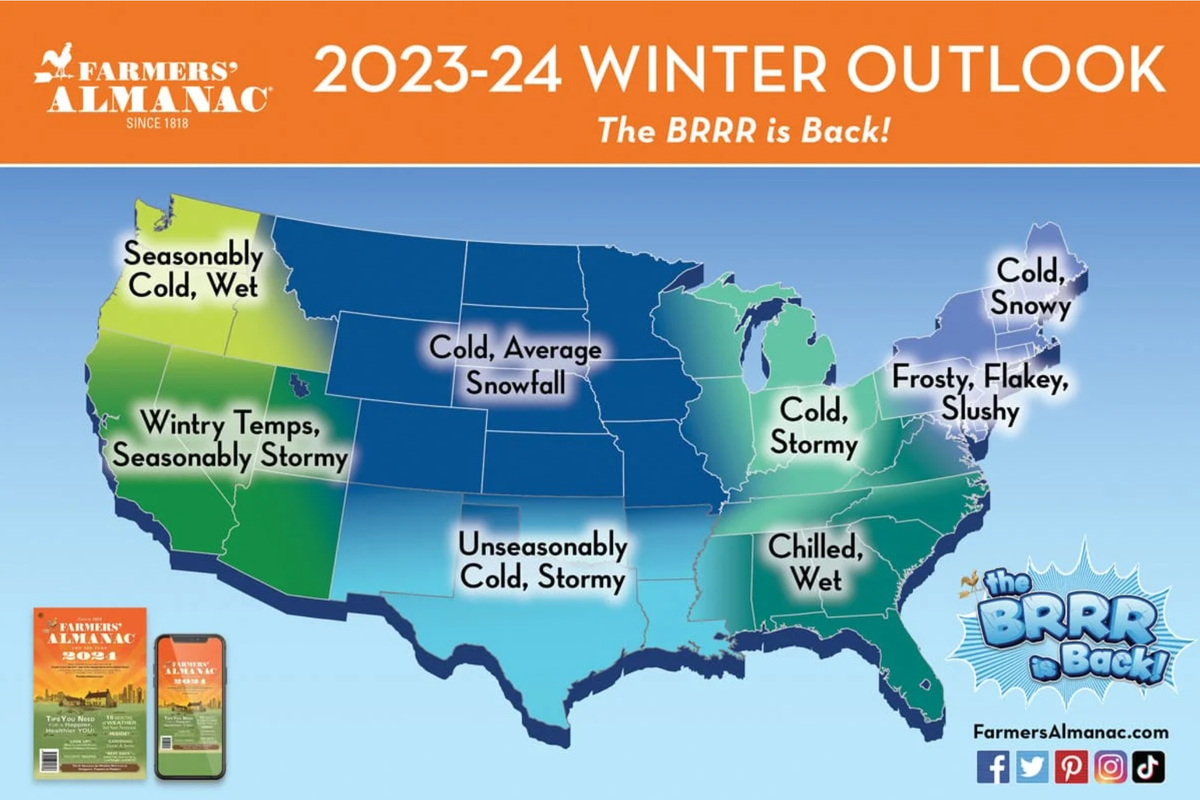
For the 2023/24 winter outlook, Idaho is grouped in the Pacific Northwest region with Washington and Oregon. Thanks to a particularly strong El Niño, Farmers’ Almanac predicts it’ll be an “unusually snowy and wet winter” for the Pacific Northwest.
For December through February, Boise typically averages 3.93 inches of precipitation — 1 inch of precipitation is equal to about 13 inches of snowfall, according to the National Severe Storms Laboratory. Snowfall in Boise averages around 20 inches per year.
Temperature-wise, the Farmers’ Almanac says that the Pacific Northwest will be “seasonably cold,” with particular attention toward a pair of storms in the second week of January and the first week of February that could be “stormy, snowy and wet.”
The average winter high temperature in Boise is 38 to 45 degrees, while the average low is 24 to 28.
Nationwide winter weather outlook
One of the more significant winter storms of the season is expected later in the season when blizzards could sweep over the north central states — such as Minnesota and Wisconsin — in the first week of March, according to the almanac.
The East Coast will also likely see more snow than last year. Those living along the Interstate 95 corridor between Washington, D.C., and Boston should see plenty of precipitation from sleet and snowstorms this winter.
Winter will release its icy grip in late March, but not without a fight. Farmers’ Almanac experts say there will be temperature swings throughout the month before stormy weather across the country in late March takes us into spring.
This story was originally published August 5, 2023 at 4:00 AM.