Here comes the sun: Boise is nearing spring, here’s how much light we gain daily in March

Just when it started to feel like it was getting lighter every morning in Boise, Daylight Saving Time pushed the clocks forward an hour, bringing darkness back to our daybreak routines.
On the flip side, it now means sunlight is sticking around an hour later in the day, giving us all more time to enjoy the outdoors after a long day of work.
On an even better note, we’re gaining more minutes of sunlight every day. The spring equinox is on March 20, signaling the start of astronomical spring and the day when the sun rises and sets directly along the equator.
As the sun appears to rise from south of the equator to north of it in the Northern Hemisphere throughout March, we begin to see more daylight as we inch closer to summer.
March is the month with the most drastic increase in daylight, according to Jay Breidenbach with the National Weather Service in Boise.
But just how fast are we gaining sunlight?
March: The most dramatic month of spring
March witnesses the fastest increase in daylight of any month as we approach and move past the spring equinox on March 20.
As the sun appears to cross the equator northward, it rises slightly more quickly in the morning and takes slightly longer to set each day as the axial tilt points the Northern Hemisphere toward the sun’s rays.
“The Earth’s axis is always pointed in the same direction,” Breidenbach said. “But as it goes around the sun, the hemisphere facing the sun is in summer, and the one pointed away is in wintertime.”
The transition is fastest during March because about 10 days before and after the equinox, the tilt causes the sunlight that hits a region to increase more rapidly than in the middle of summer or dead of winter. The sun is positioned at either extreme of the spectrum during the summer and winter solstices, when the days are either longest or shortest, respectively, and therefore the change in daylight isn’t as drastic.
How much daylight do we gain per day?
On March 1 in Boise, the sun rose at 7:21 a.m. and set at 6:33 p.m. for 11 hours and 11 minutes of daylight.
On March 31, the sun will rise at 7:28 a.m. and set at 8:10 p.m., totaling 12 hours and 41 minutes of daylight — a 90-minute difference in just one month. The sun rises later in the day, despite being later in the month, because of Daylight Saving Time bringing the clocks forward an hour.
On average, Boise gains about 3 minutes of daylight daily in March. In June, when the summer solstice occurs, the difference in daylight from the start of the month to the end is approximately 11 minutes.
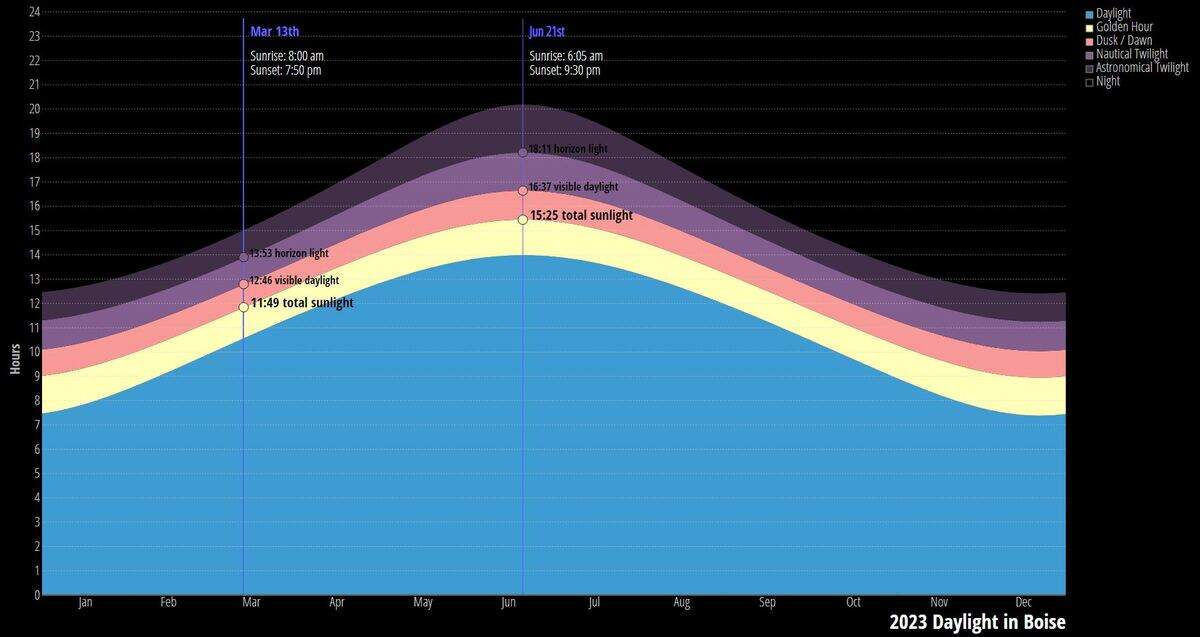
The dramatic increase in daylight coincides with a quick increase in temperature, Breidenbach said.
“Typically, there’s a little bit of a seasonal lag,” Breidenbach said, explaining that April will see a more significant temperature increase than March. The average high temperature in Boise at the start of April is 59 degrees and shoots up to 67 degrees by the end of the month.
The same phenomenon regarding daylight and temperature can be flipped for October each year, shortly after the autumnal equinox: The days get shorter more quickly, and the temperature decreases most dramatically during October.
This story was originally published March 13, 2023 at 1:56 PM.