Officials leave it to stores to navigate gray areas of mask orders. This is the result
The area around Cecil D. Andrus Park in downtown Boise swirled with Black Lives Matter protesters, counter protesters and police on the evening of July 21. The night was mostly peaceful, but sirens and chants emanating from the park could be heard one block south inside Dharma Sushi & Thai — a restaurant at which a different political confrontation was developing.
When an unmasked woman attempted to enter Dharma and was turned away by employees, a tense confrontation ensued. She and an unmasked man accompanying her told police that the restaurant had discriminated against them. According to a video taken by the patron, after the two were refused service, the man showed an official-looking mask exemption card to the police — a card that authorities say is fake.
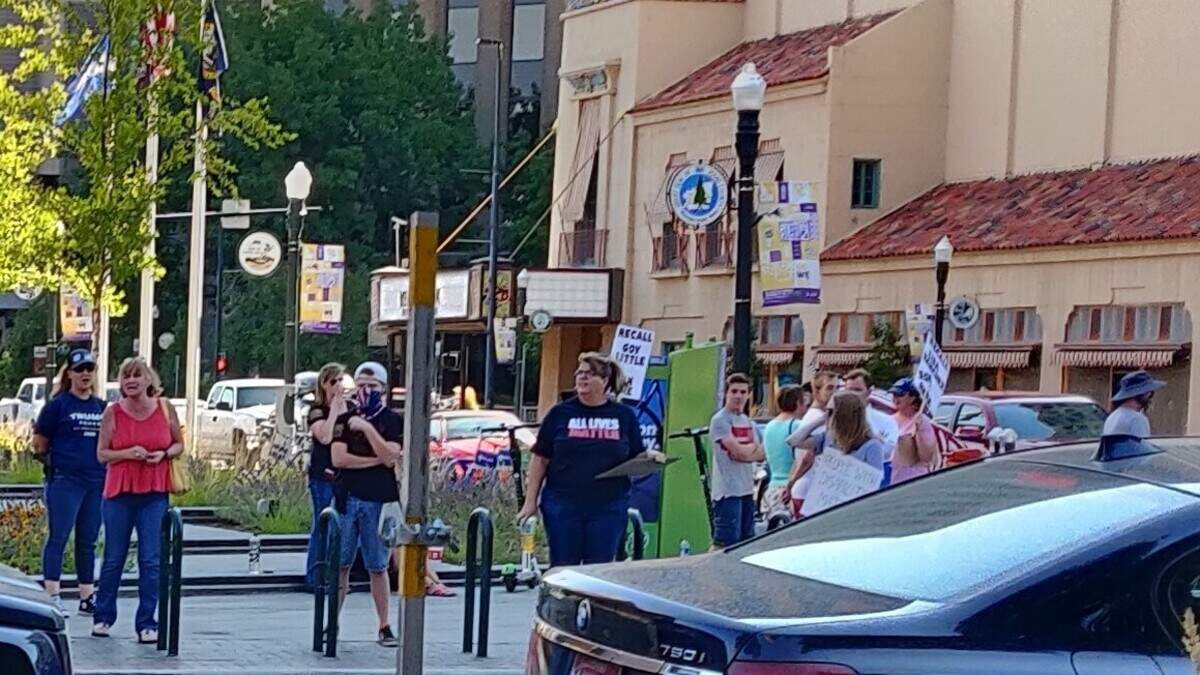
The following Sunday, an anti-Dharma protest— a group of 12 to 15 people, some clad in Trump shirts, others in shirts that said “All Lives Matter,” and some holding “Recall Gov. Little” signs — stood across the street from customers who had congregated to support Dharma. And since the patron’s video of the initial confrontation was posted online, the restaurant has received a string of negative reviews, messages and emails, some of them racist, said the owner, who asked not to be identified to avoid further online harassment and threats.
Official face-covering orders in Boise and Ada County are in effect for retail and other business establishments to fight the coronavirus, but businesses like Dharma have been left on their own to negotiate the gray areas between law and enforcement.
Masks have proved effective in limiting the spread of COVID-19, and many businesses have instituted their own mask-mandatory policies. But when confronted with customers who want to enter stores unmasked, both official orders and store policies go only as far as stores are willing and able to enforce them.
In Boise and Ada County, violation of either the Central District Health Department’s countywide order or the mayor’s earlier, but still in effect, citywide order is a misdemeanor punishable by up to six months in a county jail or a $1,000 fine. But the health department, elected leaders and police departments have chosen to rely on education, rather than enforcement.
“CDH does not regulate the mandate and we rely heavily on the community and business owners to make choices that will have positive health impacts at the business level. Certainly we hope people feel empowered to make correct decisions based on the current standards established,” Central District Health spokesperson Brandon Atkins wrote in an email to the Statesman.
For Treasure Valley chains, a gulf between policies and enforcement
Treasure Valley retailers such as Albertsons, WinCo Foods, Fred Meyer, and Grover’s Pay & Pack Electric and Plumbing Supply have instituted mask mandates in all stores, even those in areas under no mask order. But some unmasked customers continue to enter stores, customers and employees report.
Chains with such requirements are allowing entrance to customers who claim they have a medical condition that prevents them from wearing a mask.
Under Ada County’s mask order, people with such conditions are not required to provide documentation demonstrating they “cannot tolerate a face covering.” But it’s unclear what, if any, measures stores could or should take to assess if customers’ claims are legitimate. Store employees typically don’t ask if a maskless customer qualifies for an exemption.
The Idaho Youth Ranch, a chain of thrift stores with multiple locations in the Treasure Valley, has opted not to require masks in areas where local ordinances do not mandate them. The Youth Ranch has interpreted the Ada County mask order to suggest that once a customer claims a medical exemption, the customer cannot be questioned further, said Richard Cline, vice president for social enterprise.
“We are not allowed and certainly not able to evaluate the veracity of a claimed medical exemption,” Cline wrote in an email to the Statesman.
In locations where there’s no local mask mandate, Cline said, about half the customers do not wear masks.
WinCo’s stance is similar. In a July 22 Facebook statement, WinCo wrote that the company “cannot question an exemption, nor can we ask for medical proof once someone has stated they meet an exemption.” WinCo’s policy originally covered just stores in areas with mask mandates but was revised July 24 to cover all stores.
But these interpretations of the Ada County mask order may be misguided. When maskless customers enter a store claiming to have medical mask exemptions, Atkins wrote, it is within employers’ rights to question customers further.
“If someone is willfully demonstrating refusal to wear the mask and simply citing the medical exemption as a reason to bypass the order, business owners may opt to question the validity of the refusal without having to force someone to show documentation,” Atkins wrote.
Businesses can also prohibit maskless customers from entering stores, regardless of whether customers have legitimate mask exemptions. Under Americans with Disabilities Act regulations, businesses and retailers have the right to refuse entrance to customers whose disabilities prevent them from wearing masks, as long as they provide reasonable accommodations to ensure that customers can access the businesses’ goods or services another way. Offering curbside pickup and delivery services constitutes reasonable accommodation, according to ADA guidelines.
Some Treasure Valley retailers are scared of prompting an aggressive reaction from customers who refuse to wear masks. After several violent confrontations around the country in recent weeks between unmasked customers and store employees, chains have proved hesitant to force masks on customers.
Kathy Holland, a spokesperson for Albertsons, said that if a customer refuses to wear a mask and also refuses to leave the store, the company permits the customer to continue shopping “in order to avoid conflicts that would put the store director or other employees and customers at risk.”
When Brenda Sene, a United Methodist minister from Kuna, picked up curbside groceries from an Albertsons store on July 21, she observed many customers entering the store unmasked. Sene then went to Ridley’s Family Market, where she also saw very few people wearing masks.
“I have church members who are sick, and some of them seriously ill, ” Sene said in a phone interview. “And someday, I want to be able to meet with them again.”
Sene posted on both companies Facebook pages asking them about their policies, and found Albertsons to be particularly responsive. The company later instituted its company-wide mask mandate. Sene has since tried to limit her grocery runs and does not plan on returning to Ridley’s or other businesses that admit unmasked customers. Ridley’s did not respond to requests for comment.
“I’m so frustrated that people have not taken it more seriously so that our numbers are increasing,” she said. “I have claustrophobia. It’s not pleasant for me to wear a mask. But I am not going to potentially affect someone else because I’m uncomfortable.”
An employee at Boot Barn said that the Boise store at 8525 W. Franklin Road, despite falling under Mayor Lauren McLean’s mask order, does not require masks because it’s not a statewide mandate. The employee estimated that roughly 30% of customers do not wear masks. Boot Barn did not respond to requests for comment.
An employee at Red Robin in Boise at 267 N. Milwaukee St., said the restaurant continued to seat unmasked customers as of August 2, despite Boise’s mask order. Many customers do not wear masks in the restaurant, the employee said. Boise’s and Ada County’s orders allow patrons not to wear masks in restaurants as long as they maintain social distancing with people not in their households.
‘We’re not playing mask police’
When customers enter Shu’s Idaho Running Co. at 1758 W. State St, in Boise and ask if they should put on a mask, salesperson Kai Collingwood says he tells them, “It’s your choice, but we can’t enforce it. We do encourage it.”
Collingwood estimates roughly 30% of customers enter the store unmasked.
Next door at Summit Wellness, a store selling CBD and hemp products, co-owner Kevin Pabst takes a similar approach. In Pabst’s experience, many customers who try to enter Summit Wellness unmasked do so attempting to instigate trouble. As a small business owner, he said, he does not feel he has the “clout” to make people wear masks.
“People who aren’t wearing a mask, it’s almost as if they feel ready to argue about it,” he said. “We’re not playing mask police.”
Caught between local mask mandates and the demands of unmasked customers, small businesses across the Treasure Valley are grappling with how to protect employees while staying open. While Shu’s Idaho and Summit Wellness have allowed unmasked customers inside, others, like Dharma, have refused entrance to unmasked customers — and lost business because of it.
The owner of Dharma was upset that the restaurant’s mask-mandatory policy had been taken as a political statement.
“Dharma has never been political,” the owner said. “We’re just in the business of selling food. Even if masks only help prevent spread by 10% , I’m going to err on the side of caution. ... I would never be able to live with myself if somebody got sick. I would feel personally responsible for that.”
Mike Rogers, who owns a jewelry studio at 280 N. 8th St. in downtown Boise, said he was yelled at after telling an unmasked couple to put on disposable masks, which he keeps for customers at the front of his store.
“They came in all aggressive and loud,” he said. “She started yelling at me that she had a medical condition, and I was like, look, I don’t care. I’d be happy to talk to you outside. They just stomped out, saying they would just go somewhere else.”
No tickets, arrests or citations have been issued for mask violations by the Boise or Meridian police since the pandemic began. Between April 25 and August 3, the Boise Police Department received 21 calls reporting mask violations.
In Nampa, police spokesperson Gary Marang said the department has not received any mask-related complaints. Marang thinks that is because there’s no official mask order in Nampa or surrounding Canyon County. By his estimate, roughly half the customers he sees in Nampa restaurants and grocery stores are not wearing masks.
While some business owners are reluctant to enforce mask policies because they think it will hurt their bottom line, it’s possible that the reverse is true.
David Blaydon, president of Grover’s Pay & Pack Electric and Plumbing Supply, which has locations in Boise, Nampa and Twin Falls, said the decision to institute — and enforce — a strict company-wide mask mandatory policy has paid off.
“Do we upset people by it? Yes, there’s a few who get upset, but it’s a very small number,” he said. “We get actually more people who are happy that we’re doing what we do to make them feel safe.”
—
☆☆☆
STATESMAN EXTRA
The mask order: Q&A for Ada County stores, customers
Brandon Atkins, spokesperson for the Central District Health Department, responded to the Statesman’s questions about its mask order for Ada County in an Aug. 7 email.
Q: The Ada County mask order states that residents do not have to provide medical documentation to verify a medical mask exemption. Many businesses have taken this to mean that after a customer claims they have a medical mask exemption, they cannot question them further. Is this a correct interpretation of the order? Does CDH worry that customers who want to enter stores unmasked may be able to do so by simply claiming a medical exemption?
Atkins: While the order does not require someone claiming a medical exemption to provide documentation for not wearing a mask, it is certainly within the right of the business to protect all customers to their establishment, including finding a suitable way to address an unmasked customer while protecting other clients. This can definitely include questions that will best serve the needs of the unmasked customer while respectfully addressing risks posed to others by this individual.
Businesses have the right to refuse service to anyone violating public health standards currently in place, and certainly if someone is willfully demonstrating refusal to wear the mask and simply citing the medical exemption as a reason to bypass the order, business owners are may opt to question the validity of the refusal, without having to force someone to show documentation.
Q: How is CDH ensuring mask orders are being followed in businesses, and particularly in food establishments (grocery stores, restaurants, etc)?
Atkins: CDH does not regulate the mandate, and we rely heavily on the community and business owners to make choices that will have positive health impacts at the business level. Certainly we hope people feel empowered to make correct decisions based on the current standards established.
Q: Are there any inspectors working to survey food establishments to ensure mask orders/other COVID safety measures are being followed?
Atkins: Our environmental health inspectors are not surveying food establishments for mandate compliance. The inspectors only visit the locations for yearly certification, and all food establishments are required to have a plan in place that has been reviewed by CDH for operating with current best practices for COVID-19 identified.
Q: If so, how many inspectors are there, how are they surveying food establishments, and how many food establishments have been inspected? What guidance have they been given in terms of what to look for?
Atkins: Food inspectors will answer questions posed by businesses that allow them to operate under best practices. These questions routinely happen for all aspects of food service operations. Environmental Health inspectors with CDH reiterate the importance of requiring face coverings for employees and staff while providing effective social distancing measures for all in the establishment. Other criteria can be found on the CDH, state and CDC websites for operations and best practices for food establishment operations.
Q: Have any food establishments failed inspection? What happens if a food establishment does not pass an inspection?
Atkins: I am not privy to all the establishment inspection details, so I cannot comment on establishments failing their inspections. I can assure you there historically have been establishments that fail to meet current best practices during their inspections. Our team of environmental health specialists work with the establishments, taking an educational approach to remedy any deficiencies in operational practices when noted in an inspection and, if establishments are unable or unwilling to comply within the criteria for safe operational guidelines, they may be restricted from operating under failure to meet general inspection guidelines. COVID-19 and the mask mandate are not used in this inspection criteria but are considered best current practices as outlined in the public health order and through state and federal agencies.
This story was originally published August 11, 2020 at 4:00 AM.