
Decades-old Idaho campaign finance laws remain on the books. Why reforms failed
AI-generated summary reviewed by our newsroom.
- The Idaho Legislature failed to advance campaign finance reforms before adjournment.
- Proposed changes included clearer reporting rules and higher contribution limits.
- Senate Bill 1422 passed a committee, but did not receive a full Senate vote this session.
For back-to-back years, proposed updates to the state’s campaign finance laws that proponents say are long overdue failed to advance in the Idaho Legislature, maintaining current rules for the approaching elections.
In the closing weeks of the session, Republican Secretary of State Phil McGrane helped pitch a set of campaign finance reforms that he’s sought for nearly a decade, dating to his time as a deputy in the Ada County Clerk’s Office. He began his tenure in the Secretary of State’s Office, which oversee elections, in 2023.
The changes McGrane recommends include better defined donation and expenditure reporting requirements for candidates and political action committees, or PACs, and more uniform fines for violations. Not all disclosure violations are created equal, he told the Idaho Statesman, so he has proposed a minimum fine of $50, plus 5% of the amount of money tied to what a campaign failed to disclose in a timely manner to improve enforcement.
“I can tell you I’m very tied in with the public on this,” McGrane said in an interview. “The idea of campaign finance reform — widely supported, more transparency, more visibility, I think just more clarity.”
In addition, he has proposed increases to candidate campaign contribution limits. Legislative district, judicial and local races would become $1,500 per election, up from $1,000. Statewide races, including for governor, lieutenant governor and attorney general, would rise to $6,000 per election, an increase from $5,000.
The planned overhaul, which also would move all state campaign finance laws into one area of statute, was presented as Senate Bill 1422, sponsored by Senate Assistant Majority Leader Mark Harris, R-Soda Springs. It was the second attempt during this year’s session to bring forth the new campaign rules, which would have taken effect ahead of November’s general election.
The revised version of the bill passed the Senate State Affairs Committee, on which Harris serves, but failed to earn a vote in the Republican-dominated Senate in the session’s waning days. The same occurred for a prior McGrane-backed effort in 2025.
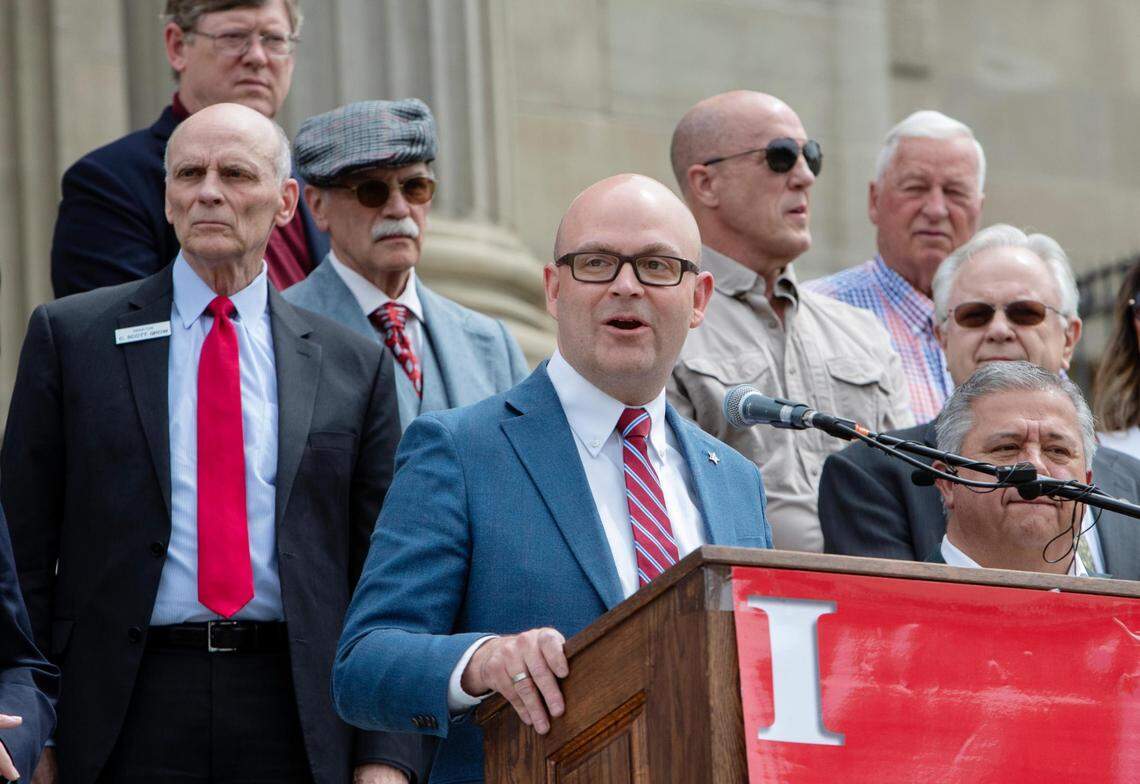
Timing has become the biggest obstacle for the legislation, Harris said. Even so, it has the support of both House Speaker Mike Moyle, R-Star, and the Senate Pro Tem Kelly Anthon, R-Declo, he said, despite not gaining greater traction. Moyle and Anthon each sponsored versions of the bill last year.
“We need to run it at the beginning. It’s a big bill,” Harris said in a phone interview. “It’s one of those bills that needs some time for members to look at, to digest. There’s a lot in it.”
‘The politics of the building’
Harris acknowledged that the bill lacked a path forward in the House, including with first receiving committee approval for a floor vote, before lawmakers adjourned for the year. If it advanced out of the Senate, the bill most likely would next head for consideration in the House State Affairs Committee.
Rep. Brent Crane, R-Nampa, chairs that committee and told the Statesman that he agrees updates are needed for Idaho’s campaign finance rules, which date to the 1970s. He was even an original co-sponsor of an initial version of McGrane’s bill last year.
But Crane questioned the secretary of state’s level of commitment to passing the bill this year, because he said McGrane did not personally bring it to him for review. As a result, Crane said he never took the time to read the legislation.
“He’s got some significant problems with his bill. He didn’t even talk to me about campaign finance,” Crane told the Statesman by phone. “The first place you start when you’re serious about a bill is the germane committee chairman.”
Crane referenced campaign changes that took hold this year through other pieces of legislation. House Bill 810 clarified that legislative candidates must be registered to vote in the district they represent at least a year prior to running for the seat, and House Bill 930 added requirements to avoid commingling of a candidate’s campaign and personal funds in a single checking account.
Gov. Brad Little signed both bills into law.
The latter inclusion also was part of McGrane’s bill. But Crane took issue with the scope of the more comprehensive campaign finance bill, which he labeled essentially an “omnibus bill,” and also that it aimed to raise campaign contribution limits, which haven’t increased in Idaho since the 1990s.
“I haven’t had a single problem, and legislators have not been coming to my desk, ‘Oh, man, we can barely survive, it’s not enough money,’ ” Crane said. “If it ain’t broke, don’t fix it. And I can tell you, nothing’s broke with people raising money.”
Inflation mixed with the cost of modern campaigns together justify raising the contribution limits, Harris said. The secretary of state also remains dedicated to campaign finance reform, he added.
McGrane approached the Senate State Affairs Committee chair with the bill ahead of its presentation, but he said it hadn’t gotten far enough in the process yet to bring it to Crane. There’s also some personal history between himself and Crane, McGrane acknowledged, but he hoped that wouldn’t get in the way of what he believes is good policy for the state.
“I think on a certain level, we all agree,” McGrane said. “Then you add in just all the politics of the building.”
Rewriting Idaho’s campaign finance laws continues to be one of McGrane’s top priorities, he said. McGrane is running for a second term as secretary of state in November. Should he win, he expects to try the bill again in 2027, and Harris said he would once more intend to be its sponsor.
“Next year will be my 10th year trying at this, so maybe that’s the golden ticket,” McGrane said. “We will be bringing it back next session.”
This story was originally published April 13, 2026 at 1:19 PM.
