
Idaho’s new ‘starter home’ bill promises cheaper houses. Not everyone agrees
AI-generated summary reviewed by our newsroom.
- House narrowly passed SB 1352; bill now heads to the governor.
- Bill sets 1,500 sq ft minimum lot size, shrinks setbacks, eases rules.
- Critics warn preemption helps developers, may not cut prices or stop rentals.
Idaho lawmakers narrowly agreed to send a bill aimed at lowering prices for first-time homebuyers to the governor’s desk on Thursday, continuing a late comeback for housing reform this legislative session.
The House of Representatives voted 36-34 to pass a twice-amended version of Senate Bill 1352, which overrides most local laws that prevent “starter-home subdivisions” — that is, dense, small-lot homes designed to sell for less than typical single-family options. Thursday’s vote teetered on a tie with every vote cast until Rep. Dori Healey, R-Boise, flipped her vote to yes before the final count. Healey could not immediately be reached for comment.
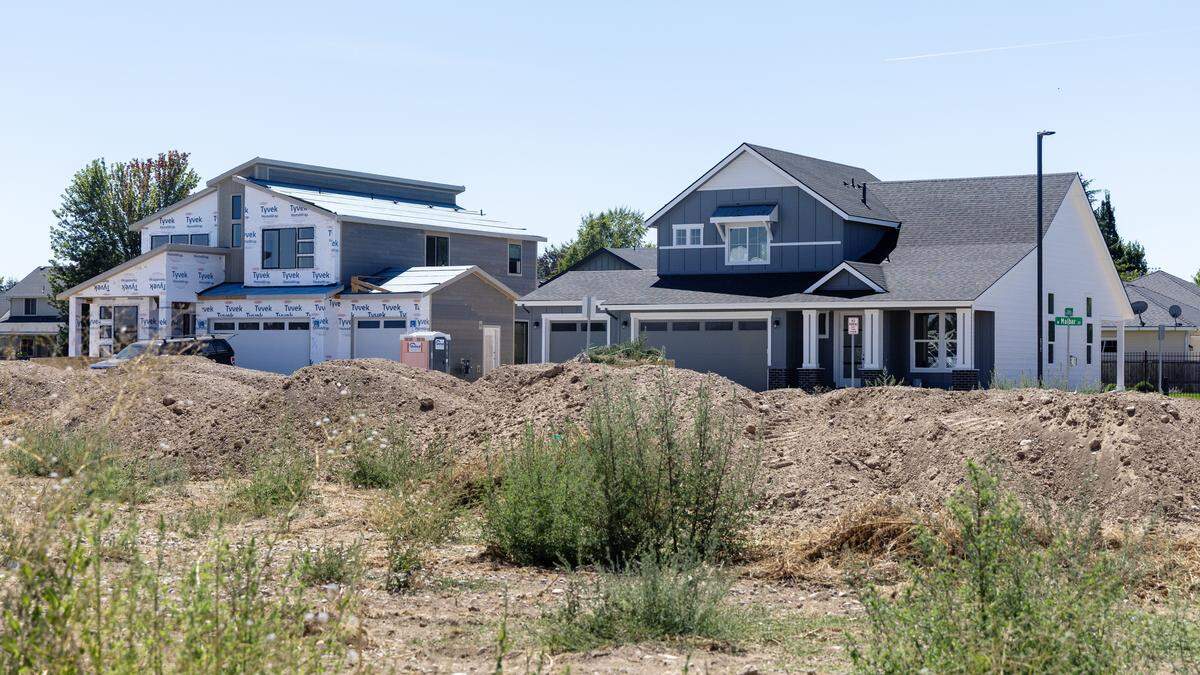
Framed as deregulation, the bill sets a statewide minimum lot size of 1,500 square feet while also shrinking setbacks and eliminating dimensional requirements that could stand in the way of building multiple compact homes on at least four acres of land. If signed, municipalities retain some say, with provisions allowing cities to stop plans that present deleterious environmental impacts, health and safety risks, or undue burden on infrastructure like sewer or water.
The idea is to build more, smaller homes, and let the market take care of the price. Reduce the lot size, cut the square footage, and a house should cost less, supporters said. That would flip two trends — growing footprints and skyrocketing prices — in one piece of legislation.
Sen. Ben Toews, R-Coeur d’Alene, says that will help young, working Idahoans buy houses sooner. Right now, they’re priced out, Toews said. The median list price for a house in Idaho has more than doubled in the past 10 years, according to data from the Federal Reserve Bank of St. Louis, reaching $565,000 in January. That’s roughly double what you would have paid in March 2017.
“First-time homebuyers are becoming an endangered species,” he said during a March 19 debate on the bill.
“Idaho is on the leading edge of our country’s protracted housing crisis,” he added. “The reality is, we’re forcing young, working Idahoans to spend their prime wealth-building years trapped in a cycle of skyrocketing rent, pricing them out of the American dream.”
Boise Rep: Cities had their chance to fix zoning
The bill now goes to Gov. Brad Little, a stark reversal of fortune for a proposal that looked dead in committee last month.
But ideas to spur Idaho’s stagnant housing stock — namely through deregulation or preemption of local land use — are gaining steam as the session drags on. Bills loosening regulations on accessory-dwelling units — smaller, secondary homes attached or adjacent to a primary residence — and factory-built manufactured homes also fell flat this winter before finding a second wind en route to the governor’s desk.
All three were championed by Coeur d’Alene Republicans Toews and Rep. Jordan Redman, who sponsored the the “starter home” bill in the House. Toews and Redman were part of the Legislature’s 2025 Interim Committee on Land Use and Housing, which over the past year embarked on a “comprehensive review” of local land-use laws to gauge their impact on housing prices and availability, according to the resolution that created the committee.
To do it, members scoured comprehensive plans and zoning codes “to identify opportunities to reduce regulatory building costs and waiting times, and provide greater flexibility in housing development.”
The committee sparked a suite of bills aimed at juicing the supply side of Idaho’s housing market — a deregulatory approach targeting zoning laws that has lately found rare bipartisan support at the Capitol, if not in city halls across the state.
Rep. Megan Egbert, D-Boise, joined the interim committee with low expectations, in terms of both work and outcomes. But as she toured the state for possible solutions, she was surprised by the consensus she felt with Republican lawmakers
“Zoning laws in the United States were created to divide us — they always have been, whether it’s by ethnicity, by race or by class,” Egbert told the House on Thursday.
“There’s power in unity,” she added, “especially if it’s around something that has been so divisive for so long.”
With that in mind, Egbert didn’t share her colleagues’ discomfort with pre-empting local laws.
“They had 130 years to demonstrate that their city is a place where anyone can start a home,” she said. “And if they haven’t done it yet, they aren’t going to.”
Idaho cities leery of state control
Support, while bipartisan, wasn’t universal. Some lawmakers worried the change wouldn’t actually help Idahoans purchase homes. Others chafed at pre-empting local rules.
Rep. Josh Wheeler, R-Ammon, worried about both.
“This is a pre-emption step that is too far for me,” he said. “We’re planning and zoning from the Statehouse at this point.”
Wheeler didn’t think the bill solved the problem it set out to, since it did nothing to control who bought the units, or even that they went up for sale, rather than rent.
Sen. Brian Lenney, R-Nampa, seized on the same complaint days earlier in the Senate.
He called the density boost a “pack ‘em and stack ‘em model” that helps developers, not buyers. Lenney opposed earlier versions of the bill, too. He grew up in Southern California, which he said failed to manage rapid growth. “That whole model of cramming as many people into whatever space you have is what broke California and caused so many people to leave,” he said during a debate on a previous version of the bill earlier this month.
This round, he called the small-lot plan “corporate welfare wrapped in a help-young-families uniform.”
“We’re here passing a bill they crafted while they count their money,” he said of developers.
Lenney also advocated for controlling the demand side of the market, addressing the housing crunch by restricting who could buy homes by banning large institutions from purchasing them as investments. (A draft on that idea popped up Friday, though it is unlikely to advance this session.)
In the House, Redman said that he imagined the small-lot subdivisions slotting into open lots in existing neighborhoods, arguing that they’d “fit right into communities.” True or not, many fellow lawmakers thought that was for those communities to decide.
Before the Senate vote, Sen. Kevin Cook, R-Idaho Falls, got a text from his mayor.
“If you want to be on planning and zoning,” it read, “then come home.”