3 Republican candidates want to be Idaho’s next superintendent. What we know about them
Three Republican candidates are vying to serve as Idaho’s next superintendent of public instruction, the state’s top education official, as schools deal with lasting impacts from the COVID-19 pandemic, funding issues and fights over curriculum.
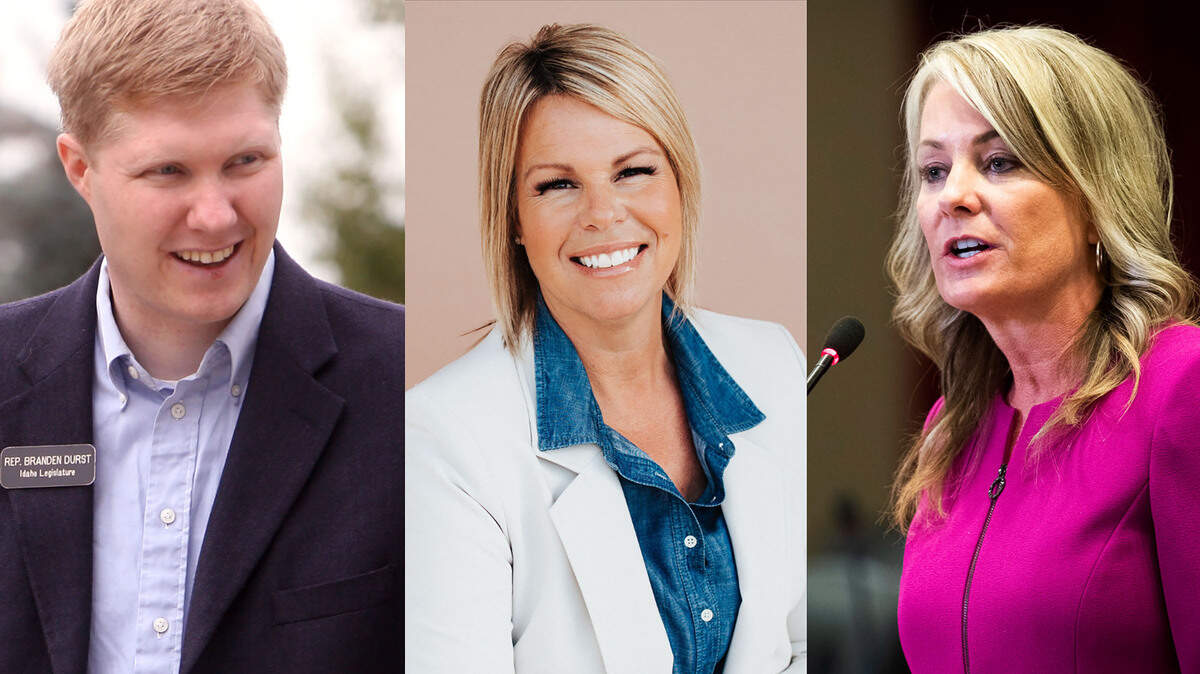
The candidates include incumbent Superintendent Sherri Ybarra, former Board of Education President Debbie Critchfield and former legislator Branden Durst. They will face off in the GOP primary on May 17.
The three candidates in their platforms differ in their views, but all included similar key points in their platforms — helping schools move forward from the pandemic, listening to and engaging parents, improving literacy rates and ensuring critical race theory isn’t being taught in K-12 schools.
Ybarra touts experience as a teacher
Before Ybarra was first elected to the position in 2014, she worked in schools as a teacher, principal and federal programs director. Her background as an educator has been a major factor in what drives her decisions as the superintendent, she said.
“I am the only educator in the race, and I want to continue the momentum of all the great things that my team and I work hard every day on,” she told the Idaho Statesman. “I’ve been an effective advocate for what our schools need.”
During her time in office, Idaho rose from 31st in student achievement in 2016 to its most recent 17th ranking last year, according to a study from Education Week.
Those rankings take into account the percentage of students in fourth and eighth grades who are proficient in reading and math and achievement changes over time. It’s one of three factors Education Week uses for a state’s report card. Idaho most recently ranked 40th overall in the study, a gradual increase from its 48th rank in 2016.
Critchfield said her years of experience on the State Board of Education, most recently as president, and her decades of experience in the education realm give her the knowledge and background for the role. She previously worked as a spokesperson for a school district, a trustee and GED instructor. She didn’t come to the decision lightly to run for the position, she said.
“I came to it based on my experience and my belief that the skills that I can bring to the state are what we need not only right now, but five years down the line and 10 years down the line,” Critchfield said.
She wants to see inspired leadership, she said, and be a leader who collaborates and creates relationships.
“I show up, listen, identify what the problem is and go and advocate for those things,” she said. “My approach is to be one of the first people in the room.”
For Durst, he said he was driven to run because of what he saw as a lack of action or advocacy for parents by the state’s educational leaders.
“I was really prompted to run by seeing a real need for a parent advocate in the state superintendency and as a member of the State Board of Education,” he said.
Durst was elected to the Idaho House in 2006 and to the Idaho Senate in 2012. He resigned in 2013 after KTVB reported that he was splitting his time between Idaho and Washington.
A Washington court last month issued a protection order against Durst after a doctor reported an injured child to Child Protective Services, according to Idaho Reports. Durst wasn’t charged, while his wife faces a misdemeanor charge of injury to a child. Durst declined to comment on the order.
Superintendent candidates lay out priorities
Durst said he had three key objectives — and the first is to eliminate common core standards in Idaho. Common core is a set of standards in math and English language arts that outline what students should know by the end of each grade.
His next two priorities are to stop critical race theory from being taught in schools and to provide school choice for parents.
“That is something as state superintendent, I intend to expend a considerable amount of political capital on to make sure that every parent has the right to send their child to their school of choice,” he said.
Critchfield said she is running on a vision to make sure students are able to access all opportunities available in the state when they graduate and that they have confidence in their education.
“As I’ve traveled around the state as a candidate recently and with my experience at the state level, our districts are looking for a leader, they’re looking for a partner, they want an advocate to help them be successful,” she said. “And I hear that as a missing ingredient over the last couple of years.”
Some of her priorities include improving literacy and supporting the state’s earliest learners, providing more work-based learning for students in high school, supporting educators through professional development and mentoring, making sure students have college and career opportunities after graduating across the state and adding a personal finance class for students.
She added that she’d make sure she helped to address issues with school facilities. Schools are aging, she said, and there needs to be someone in leadership to help struggling districts.
Ybarra said she wants to ensure every child is reading at grade level by the end of third grade, and students are ready for career and college when they graduate. She said she wants to improve teacher retention and recruitment and get more parents engaged. She supports increasing school choice and learning opportunities for students and establishing optional full-day kindergarten, she said.
She added that schools are now grappling with staffing shortages, and some are leaving the field for better salaries. If elected for another term, she said she would continue to advocate for more pay for teachers and support staff, and work to make sure teachers have more incentives to stay in rural districts.
Her goal, she said, is to make Idaho a top-10 state in education.
An ‘existential threat’ to public education
The Idaho Education Association said it doesn’t endorse candidates in state races until next month, but the group’s members plan to endorse the best advocate for public education.
“Someone who knows (and) understands that better salaries, benefits and working conditions for educators are important to the recruitment and retention of these dedicated, hard-working professionals,” spokesperson Mike Journee said in an email. “The superintendent must not be shy about making hard decisions that benefit students and public schools.”
Journee added that the superintendent needs to understand that school vouchers, and “taking public money from public schools to benefit private or parochial schools,” is a “red line that cannot be crossed.”
Rod Gramer, from Idaho Business for Education, said education should be a key issue for all the candidates running, not only in the superintendent race. The superintendent, he said, should also be a person who inspires educators, the public and legislators to fulfill the mandate in the Idaho Constitution for a uniform, free and thorough system of public education.
Gramer also said a key issue facing public education is the issue of school vouchers or educational savings accounts. He called it an “existential threat” to public education.
“Why would we want to fund another education system, meaning a private or religious system, when we’re not even funding the public education system we have right now adequately?” he said.
Other issues he pointed to included early education and support for full-day kindergarten, in addition to closing what he called the “opportunity gap” for low-income students and students of color. Facilities were also a key issue, he said, with many schools across the state now in poor condition.
Gramer said the candidate should also know that education doesn’t stop when kids graduate from high school. The superintendent of public instruction has a seat on the Board of Education, so higher education issues, and pathways for students after graduating high school, should also play a role, he said.
While Ybarra has been in the seat for seven years, Critchfield so far has the lead on funding. Critchfield has raised well over $200,000 for her campaign, according to the Idaho secretary of state’s office. Ybarra announced her run for reelection last month and has reported $23,000.
Handling of COVID-19 pandemic
Schools and lawmakers have worried about the state’s handling of education during COVID-19, with learning losses stemming from the pandemic and students’ mental health struggles.
Ybarra pointed to the work during her time in office of securing and dispersing pandemic relief funds to schools. She said schools faced many challenges during the pandemic — including implementing mitigation protocols such as distancing and masking — but Idaho didn’t experience as much learning loss as expected because of the emphasis on in-person learning.
The state did see some drops in its standardized tests scores when compared with those before the pandemic, something officials expected would happen.
But her opponents see areas for improvement.
Durst said the superintendent and State Board of Education failed Idaho parents and students during the pandemic. If in the position, he would have taken more steps to prohibit mask mandates in schools and made it clear to schools they must provide in-person instruction, he said.
He pointed to two schools next to each other that he saw during the pandemic: one that required masks, distancing and other mitigation protocols and one that didn’t.
“It really reminded me of the movie, ‘The Boy in the Striped Pyjamas,’ ” he said. The Holocaust movie, based off a novel, portrays a Nazi commander’s son who befriends a Jewish child behind the fence of an internment camp. “Because on one side, we had freedom, on the other side, we had bondage.”
Going forward, he said, to address some of the mental health challenges, school counselors could help provide more mental health services to students, and some of their current responsibilities could be given to others.
Critchfield said there were missed opportunities during the pandemic. At a time when many federal and state requirements in education were waived, she said she thinks the state had a unique opportunity to create a system that better served Idaho students.
“We had freedom from a lot of the traditional requirements that our system had in place … and I can’t think of a better time to say, ‘Well, here are things that we’ve wanted to try or we’ve wanted to do,’ ” she said.
Going forward, she said she expects learning loss won’t be as pronounced as in some other states because most districts prioritized in-person learning.
But she raised concerns about the emotional issues attached to COVID-19. If elected, she said she’d want to support parents and help provide them the tools they need to support their kids. The state can help teachers know how to identify struggling students, and can help counselors to support those students, but ultimately parents need to be involved, she said.
“A parent has to be a part of any type of long-term success in this area,” she said.
Candidates oppose critical race theory
All three candidates said they didn’t support critical race theory being taught in K-12 schools.
Critical race theory, according to the American Bar Association, “critiques how the social construction of race and institutionalized racism perpetuate a racial caste system that relegates people of color to the bottom tiers. …CRT recognizes that racism is not a bygone relic of the past.”
But lawmakers and some officials have raised concerns over the past year about whether the theory was being taught in K-12 schools. Several teachers told the Statesman last year it wasn’t taught in Idaho classrooms.
Ybarra said when she goes into history and social studies classes across the state, most of them are teaching the same concepts and facts. Idaho isn’t one of those “scary examples,” she said, where critical race theory is widespread.
She said she’s also investigated every example and accusation she has received, and they haven’t turned out to be critical race theory. She acknowledged critical race theory has become an “umbrella term” for many concepts.
Critchfield summarized the issue in a few sentences: Parents are concerned that critical race theory is being taught in schools; schools are saying it’s not there; and policymakers don’t know what to do about it.
Critical race theory, she said, is a way to talk about race relations. She said she doesn’t believe it’s an “appropriate way” to discuss history in schools, and added that she’s seen a number of successful responses around the state where district leaders work to open up communication and reestablish trust in their communities.
She added that she hasn’t seen a systemic approach to adding critical race theory into curricula across Idaho.
“We owe it to our students to provide them a full, broad education without adding individual perspectives and opinions,” she said.
Durst said he has heard of examples of critical race theory being taught in several school districts across Idaho. People who say it’s not happening, he said, have become “quite pedantic in what they mean.”
He looks at critical race theory as “racially divisive theories that really find their nexus in Marxist ideologies.” He said he believes there are districts that are “systematically doing it,” and it is more often an issue in larger districts.
“I think what we need to do is, we need to educate our teachers,” he said. “We need to make sure we give teachers plenty of opportunities to understand what’s OK and what’s not OK.”
He said kids should not be taught about concepts such as anti-racism, implicit bias or privilege, but they should be taught about the more difficult parts of history.
“Students need to understand why the Holocaust happened, why slaves were a thing in the 1800s,” he said. “When we start to interject any sort of conversation that divides us based off of what the color of our skin is or … any other characteristic, that’s when it’s problematic.”
Parent engagement a key priority
Making sure parents shape the education their children are receiving has become a major point of tension in Idaho schools. Parents for months have argued school boards weren’t listening to them when it came to decisions on pandemic protocols.
School board candidates who ran on issues of giving parents a choice in the protocols their kids follow won several races in the Treasure Valley last year.
And school board meetings, at times, drew hundreds of people as trustees talked about pandemic protocols.
Now, all three candidates vying for the superintendent role talked about the importance of engaging parents, giving them the tools to drive their children’s education and involving them in processes, including shaping content standards, the curriculum and school policies.
“What you hear from parents about the state of Idaho is, there is a lot of frustration,” Durst said. “They don’t feel like they’re valued. … It’s parents that we should be most concerned about.”
Durst said parents should be involved and leaders of efforts that impact their kids’ education.
He also voiced his support for parent choice in choosing where their students attend school. He dismissed arguments that programs like school vouchers would take away money from public schools, or that rural communities would have fewer options for private schools than urban areas.
“Those arguments are lies,” he said.
Ybarra said she has already been working on increasing parental engagement. Her office is now working on a toolkit for parents of ways they can get involved and resources.
Critchfield too emphasized the importance of listening to parents and strengthening the role they play in their kids’ education.
Editor’s note: This story was updated at 5:48 p.m. March 9 to include additional information on a legal proceeding involving Durst.
This story was originally published March 7, 2022 at 4:00 AM with the headline "3 Republican candidates want to be Idaho’s next superintendent. What we know about them."