What would happen to Idaho Public Television without state funding?
Updated 5:34 p.m. on March 10, 2021, to include comments from House Minority Leader Ilana Rubel.
Idaho Public Television narrowly held onto its state funding Monday as House members considered whether to vote down an appropriation bill over complaints about “partisan” programming — shows that dealt with issues like race and climate change.
After some debate on the floor, the House in a 36-34 vote approved House Bill 283, which would accept Idaho Public Television’s $9.6 million budget total and appropriate $2.7 million from the state general fund.
Critics said the broadcast is unfavorable toward conservative Republicans and provided programming about racism and white privilege. State funding is not used for its content, which is financially supported by private donations and federal grants.
IPTV General Manager Ron Pisaneschi said the tight vote was a surprise to him. Without state funding, rural areas would lose out the most, he said.
“It’s concerning,” Pisaneschi said in a phone interview Tuesday. “I have my work cut out for me in terms of working with members of the Legislature to understand their concerns, and to let them know all the things that we’re doing that they may not know about.”
Friends of Idaho Public Television Inc., as a 501c3 organization, also receives tax-deductible contributions and must follow reporting requirements as outlined by the Internal Revenue Service.
Giddings slams ‘critical race theory’ in children’s programming
Rep. Priscilla Giddings, R-White Bird, in the Joint Finance-Appropriations Committee tried to make a motion to defund Idaho Public Television by removing state general funding. It failed with a 2-16 vote, with only Rep. Ron Nate, R-Rexburg, supporting it.
Giddings on the House floor Monday said she wanted to pull funding for the platform unless Idaho Public Television can “put a control on this content.” She said she no longer allows her children to watch Idaho Public Television “because it is so partisan” — citing examples like “Arthur,” which contained an episode on global warming, and “Daniel Tiger’s Neighborhood,” which discussed race.
Giddings also criticized describing former President Donald Trump’s supporters as “insurgents” in “G-Zero World with Ian Bremmer,” a program that sometimes airs on Idaho Public Television. She told legislators on the floor they should reject the bill and use the funding to bargain over what kind of content is permitted to air.
“So my question is, if you can’t control the content, then maybe I need to try to get rid of this platform that taxpayer money is using to support the content,” Giddings said on the House floor Monday. “I think we do have a way forward, but I think we need to put our foot down right now, and say, ‘Please make it stop.’”
Nate on the House floor also criticized PBS Kids for showing an episode of “Clifford the Big Red Dog” that portrayed a lesbian couple and programming that encouraged white parents to talk about race and privilege.
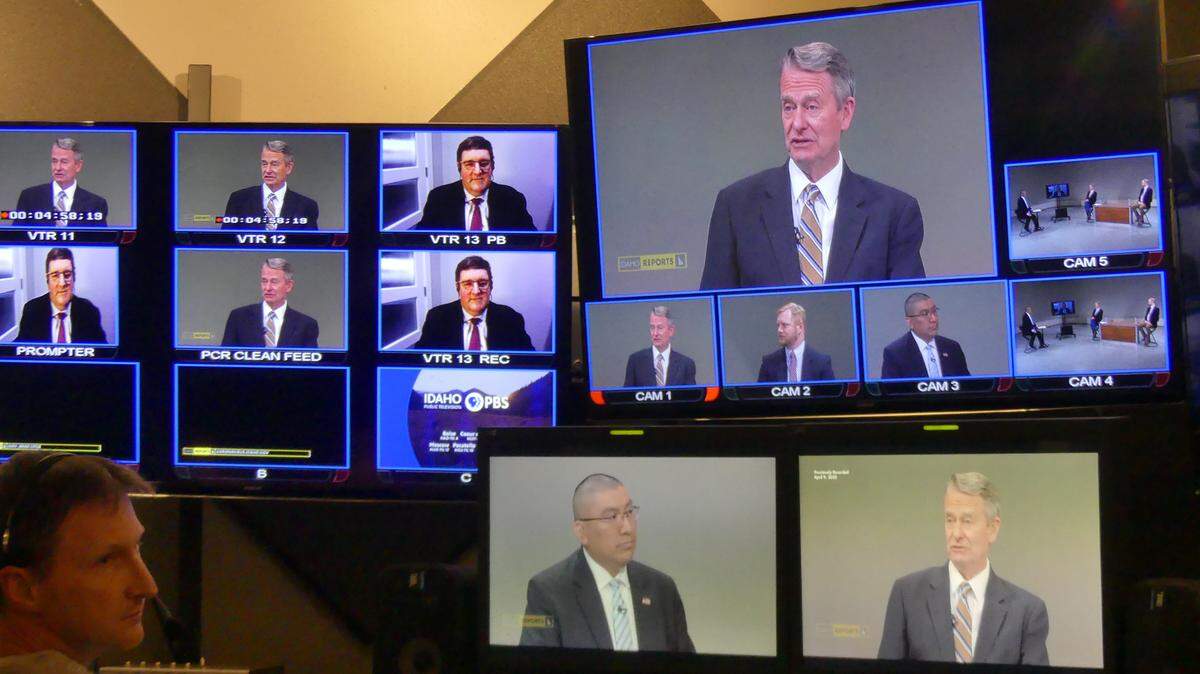
Rep. Dorothy Moon, R-Stanley, also advocated for defunding IPTV, chastising Idaho Reports for what she considered “a bias against conservative Republicans.”
“I just don’t think that we should be giving money to be used against us on public TV,” Moon said on the House floor Monday. Moon didn’t respond to a request for comment Tuesday.
In an emailed question about whether Giddings was concerned about making funds contingent on elected officials’ ability to control IPTV’s content, Giddings wrote, “Idaho Pubic Television news coverage is extremely partisan and does not fairly cover the differing opinions inside the Idaho Legislature.”
In follow-up questions, Giddings didn’t directly respond to a question about what she would consider an appropriate discussion about race. She reiterated her opposition to a PBS Kids show that encourages white parents to talk about privilege.
“Critical race theory argues that racism exists in every aspect of life and those who don’t agree are racists,” Giddings wrote in an email. “This approach does not help address racial issues. It only further exacerbates division.”
House Minority Leader Ilana Rubel, D-Boise, said “social justice” this session has become a dirty word. She said it’s become increasingly more difficult to provide essential services by passing budgets — she pointed to other appropriation bills that have been denied in the House, such as the attorney general’s budget and $6 million in federal grants for early childhood education.
“Things that I think most people would expect the state to do are now far from a forgone conclusion,” Rubel said over the phone Wednesday. “We don’t have enough Democrats in there to save these budgets, …to continue to salvage basic government services in the face of a Republican war on them.”
IPTV broadcasts 43,800 hours of programming a year, according to IPTV. Pisaneschi said “it’s pretty easy to selectively take a handful of things and imply that that is the essence of what an organization does.”
He provided examples of a variety of ways the broadcast has tried to adjust and help parents during the pandemic — such as devoting a channel to direct instruction with Idaho teachers for parents who now stay at home.
He also pointed to an annual nationwide survey that lists PBS as “the most trusted institution” for 18 years in a row and PBS Kids as the top educational media brand for children.
“I think it’s safe to say the children’s programming is well loved by people in Idaho,” Pisaneschi said. “Our approach is to provide the programs that our viewers have come to expect. It’s not for everybody, but everybody has a choice. They don’t have to watch it.”
Impact on rural viewers in Idaho
Trent Clark, a member of IPTV’s advisory board, moved to Soda Springs from Washington, D.C., in the 1990s for a job. He brought with him his wife, a professionally trained opera singer, to the town with a population under 3,000.
They enjoy the occasional opera performance in Lava Hot Springs, Clark said. But with Idaho Public Television, they stayed connected to performances at the John F. Kennedy Center for the Performing Arts in D.C.
“I’m married to an opera singer. I’m not sure I would be allowed to live in a community that has zero access to opera,” Clark said over the phone Wednesday. “What we were missing in terms of cultural and educational opportunities ... we now stream them into our home.”
He said he also watches Detroit Symphony Orchestra and PBS NewsHour, which he considers “one of the best unfiltered news sources.”
Clark also pointed to programs that help young rural viewers become interested in the STEM fields. When he worked at Bayer, he said the company would support programs like NOVA, hoping some of those viewers can eventually get recruited for jobs at Bayer.
Pisaneschi said the majority of the state appropriation the broadcast receives goes to the costs of transmitting the statewide network. Without state funding, Pisaneschi said the broadcast would likely eventually shrink to be offered only to the Treasure Valley or the Boise area — a population that would be able to sustain the cost of transmission.
“The state dollars are the great equalizer,” Pisaneschi said over the phone Tuesday. “They make sure that people in Ririe get the same content and services as the people who live in Boise.”
Public television has been under heavy scrutiny under former President Donald Trump’s administration. For every year during his term, Trump tried to defund the Corporation for Public Broadcasting, which helps fund public stations PBS and NPR. In 2019, PBS CEO Paula Kerger told POLITICO that cuts to public TV could create media deserts throughout the U.S.
The bill was assigned to the Senate Finance Committee and will need Senate approval.
Rep. Caroline Nilsson Troy, R-Genesee, who sponsored the bill, said the fact that Idaho Public Television has half a million viewers a week in a state with a population of 1.8 million is “astonishing.”
“Quite frankly, I don’t know another way that we spend our dollars, other than our roads, that impact every single body in Idaho,” Troy said. “That programming is meaningful. ... Our Idahoans are voting by turning on the TV and turning it on to public television.”
This story was originally published March 10, 2021 at 11:55 AM.