COVID-19 exposes deep divisions for Idaho GOP as lawmakers come to Boise for special session
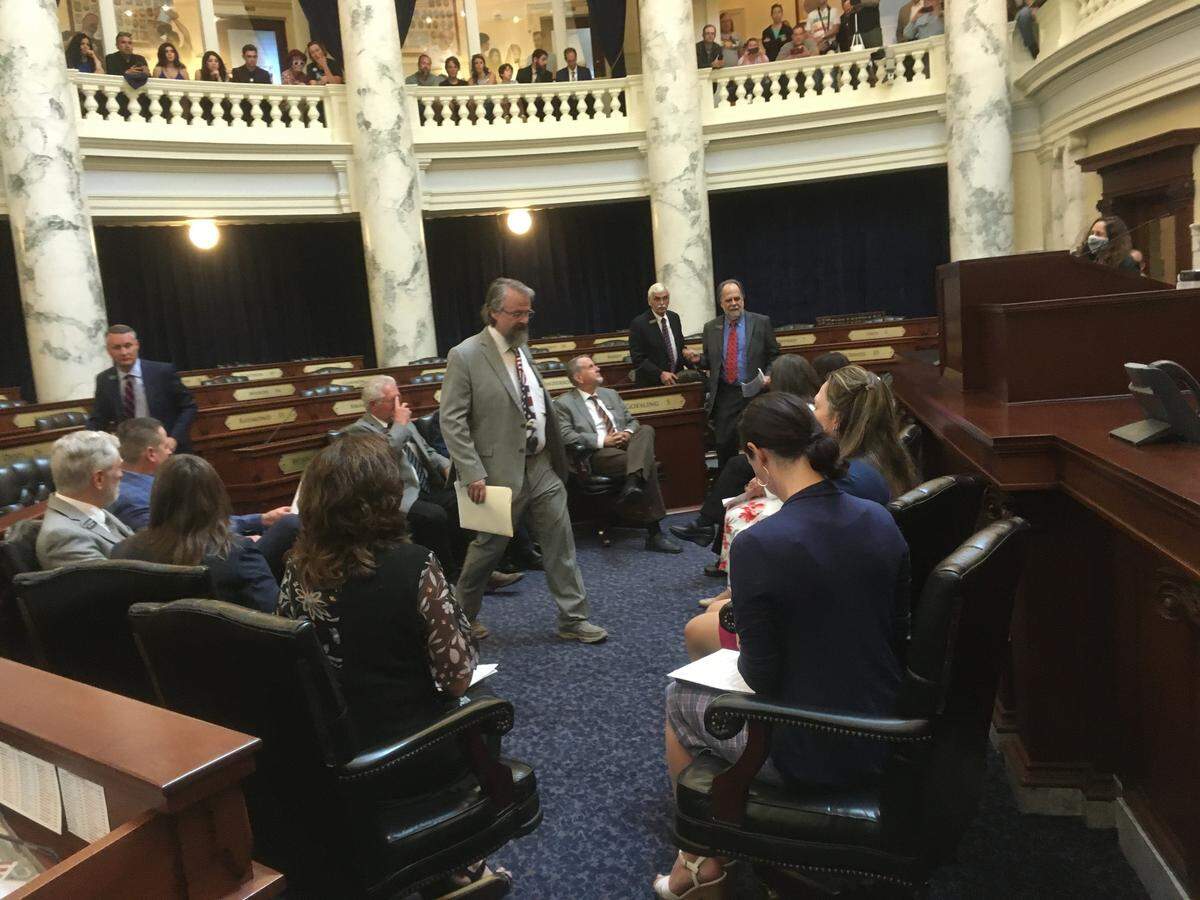
This week, state lawmakers will return to the capitol for a special legislative session that could set the stage to reshape the future of politics in Idaho.
The special session, one of only four in the last 20 years, is meant to address issues prompted by coronavirus as Idaho nears its sixth month dealing with the pandemic.
COVID-19, the disease caused by coronavirus, is putting pressure on some of Idaho’s longtime political processes and creating new tensions — or possibly widening existing fractures — in the state’s powerful Republican Party.
Since COVID-19 arrived in Idaho, stay-home orders and other pandemic precautions ordered by Republican Gov. Brad Little appear to have sown disagreement, with some fringe party members protesting Little’s measures and longtime party leaders taking action to potentially limit gubernatorial authority in the future.
And while some politicians say the pushback is not a criticism of Little, it’s not clear what the tension will mean as Idaho moves toward the general election in November and navigates through high numbers of COVID-19 cases.
Tensions not likely to temper
For months, members of the governor’s party have expressed frustration at their lack of inclusion in the his COVID-19 response, with some state legislators going so far as to convene at the capitol in June and accuse Little of unconstitutional emergency orders.
Later in June, Idaho House and Senate leadership announced the Legislature would create working groups to address coronavirus concerns — some of which will be addressed in the special session. According to the governor’s proclamation issued Aug. 19, legislators will be limited in the session to discussing absentee ballots and in-person polling issues for the upcoming election, as well as temporary civil liability relief during the pandemic.
But the special session likely won’t alleviate much of the frustrations legislators have felt in recent months. One such frustration is the fact that, in Idaho, the governor is the only individual who can call the Legislature into session. One of the working groups formed by legislative leaders would explore a constitutional amendment to allow the Legislature to call itself back into session. In many other states, that’s accomplished by a request from two-thirds of legislators to reconvene.
Majority Caucus Chairwoman Rep. Megan Blanksma, R-Hammett, said in a phone interview that she’s heard proposals that would be similar to other states’ two-thirds rule.
“Members (of the Legislature) are feeling a lot of pressure and a lot of desire to help their constituents,” said Blanksma. “We don’t have a lot of tools available to us, but we do have the ability to put these joint committees together.”
Another working group is discussing limits on emergency declarations.
Speaker of the House Scott Bedke, R-Oakley, said in a phone interview that lawmakers are considering “the ability of the chief executive to continue to roll an emergency declaration and have those just be re-upped.” Bedke said it might make more sense for emergency declarations to trigger a special session or some other Legislature involvement if they exceed a certain scope or duration.
Blanksma and Senate President Pro Team Brent Hill, R-Rexburg, also voiced concerns about the disbursal of the $1.25 billion Idaho received in federal coronavirus stimulus money. (An advisory committee including multiple lawmakers and McGeachin has helped oversee that disbursal.) Yet another working group was created in June to discuss “non-cognizable funds procedures and limits” for similar situations.
“When there’s over a billion dollars being spent ... even if you are in complete agreement with the way the governor’s handling that, you still feel some responsibility, which the Legislature’s always had, as far as appropriating funds,” Hill said. “We have a yearning, I think, as a Legislature to legislate and to appropriate. That’s what we do. So when we’re left out, some people become frustrated.”
Political structures may change
Though lawmakers are limited in what they can discuss during the special session, Hill said the working groups will leave lawmakers poised to make quick changes during the regular session in early 2021.
“We need to have something ready to recommend to the legislators when the Legislature goes into session in January,” he said. “It’s something we need to do our homework on now.”
Hill said there has long been discussion about “having circumstances when the Legislature could call itself into session.” He said Little may even be in support of measures that curb gubernatorial authority.
“It’s not the speaker’s or my intent to try to force something on the governor,” Hill said. “It’s not to go around the governor. There’s a good chance the governor will be in agreement with some of the things we come up with.”
Hill and Bedke also said their working groups weren’t created to hit back at the governor for his coronavirus actions. The pandemic, Bedke said, has exposed weaknesses in some of Idaho’s laws, including who has the power to call a special session.
“We’ve had a bunch of laws on the books for several decades that have never been stress tested,” Bedke said in a phone interview.
Bedke said some of the authority bestowed on the governor is now outdated and doesn’t lend itself to a separation of powers. Blanksma echoed that sentiment.
“Right now we’re in a situation where all branches of government are not being treated equally,” she said. “Some realignment needs to occur.”
What that realignment will look like is still unclear.
“Looking into my crystal ball for January is a little cloudy,” Blanksma said.
For his part, Little has been largely silent on the intraparty tumult. In response to a request for an interview, the governor’s office told the Statesman Little “is not available for an interview on that topic at this time.”
A spokeswoman for the governor’s office, in response to questions about party tensions and what feedback or criticisms the governor is hearing from his fellow Republicans, issued the following statement: “The governor remains in regular conversations with the Legislature about the call of a special session. The governor is focused on making sure our children receive education this fall and businesses can continue to safely operate, and he remains committed to protecting the health and safety of Idahoans during this unprecedented time in Idaho history.”
Little hasn’t gone without praise from fellow Republicans.
“The governor’s been put in the awkward position, in my opinion, of trying to handle these things by himself,” Hill said. “Our governor’s done a real good job of keeping the Legislature informed.”
But not all legislators feel that way. Blanksma said communications have not been where they need to be.
“The general agreement (among caucus members) is that at one point when you’re in midst of an emergency, you need a person to lead,” she said. “But at this point the administration has gone too far without consulting the legislative branch. The thing I think is frustrating to a lot of members is, yes, the governor’s office does inform us of decisions being made, but it’s not the collaborative process that some have been lead to believe.”
It remains to be seen how the party will heal from these spats, some of which may not have surfaced were it not for the pandemic. Party leaders said they don’t anticipate the pandemic tensions will have a lasting effect on political relationships.
“We have in the past had a good working relationship with the executive office,” said Bedke, emphasizing that the Legislature has as much power as the governor’s office. “I think that’s in our future. Equal but separate means exactly that.”
Where has COVID-19 left the Idaho GOP?
Though lawmakers have said they remain happy to work together, it’s clear the pandemic has created some strain in the party.
“During this coronavirus period, the spectacle of the Republicans’ cannibalism has been fascinating to observe,” said David Adler, an Idaho Falls-based longtime political analyst, in a phone interview. “Who would’ve expected that the lieutenant governor would be aggressive toward the governor’s policies and, indeed, publicly critical? Who would’ve expected that 15 to 20 members of the governor’s own party would try to become a rump legislature calling itself into session?”
To Adler, there have been several indicators of Republican infighting, from hostile resolutions at the GOP convention in June that accused Little of “unchecked, unbalanced and unaccountable acts” in his COVID-19 response to Hill and Bedke’s creation of their working groups. Adler said the moves are likely reflecting frustrations not just from lawmakers but from their constituents, as well.
“It reflects the demands of the right wing within their party and complaints and demands of many across the state,” Alder said. “I think it’s both a response to political pressures from private citizens, legislators, and perhaps, in their heart of hearts, real questions over whether the governor should be given such broad authority. And that may lead to efforts to limit the governor’s power.”
Adler said coronavirus was “the spark plug for baseless accusations of usurpation” and accelerated division in a party that already showed fissures between its fringe and more mainstream members.
“We might’ve gotten to this point (otherwise), but it’s been certainly spiked or punctuated by COVID, because it’s laid bare the very stark difference between temperament and politics between those in the moderate wing and those in the far right wing,” he said.
As coronavirus spread remains an issue in Idaho, Adler said Little will face pressure for any decision he makes with respect to the pandemic.
“The way forward for the governor has been to continue to follow the advice of the medical and scientific community, which is what he’s done from the beginning,” Adler said. “And that means he’s going to be on the receiving end of a lot of criticism from his caucus. But if his decision-making and regulations are perceived as reasonable by most Idahoans then he’ll win.
“It’s what Americans, I think, are yearning for right now: Policy-making grounded in science and medical expertise,” he continued. “Anything else smacks of arbitrary decision-making designed to service the political interest of this politician or that politician.”
This story was originally published August 23, 2020 at 4:00 AM.