
Idaho presidential primary early voting starts Monday, Feb. 24, in Ada, Canyon counties
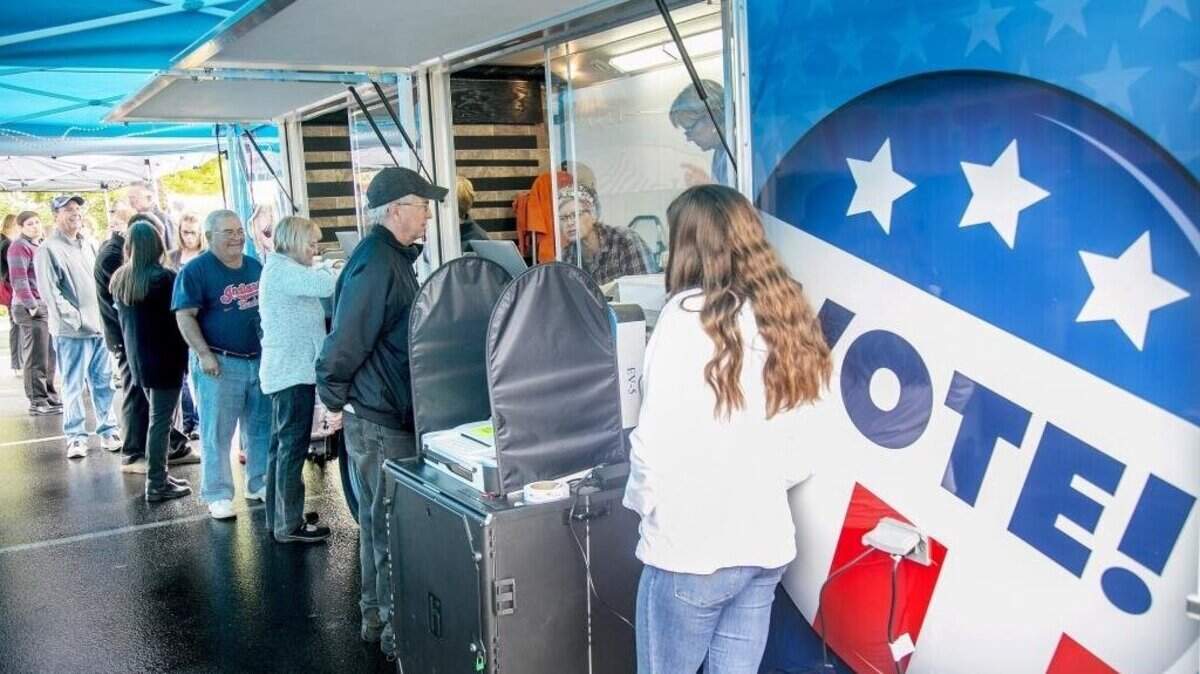
Idaho’s 2020 presidential primary gets underway in Ada and Canyon counties on Monday, Feb. 24, with early voting for the March 10 election.
Any voters residing within Ada or Canyon counties can vote early at locations within their respective county from Feb. 24 through March 6. Voters not registered may register and vote at any of these locations by bringing a photo ID and proof of residence.
In Ada County, voters can cast their presidential primary ballot from 8 a.m. to 5 p.m. weekdays at: Boise City Hall, 150 N. Capitol Blvd; Ada County Elections, 400 Benjamin Lane; or Meridian City Hall, 33 E. Broadway Ave.
The Ada County Elections mobile voting unit will be open 10 a.m. to 5 p.m. weekdays at the following locations:
Feb 24: Bronco Stadium Plaza, Boise State University
Feb. 25: Micron, 8000 S. Federal Way, Boise
Feb. 26: Kuna City Hall, 751 W. 4th St.
Feb. 27-28: Eagle City Hall, 660 E. Civic Lane
March 2: Star Library, 10706 W. State St.
March 3: Garden City Library, 6015 N. Glenwood St.
March 4: Saint Alphonsus, 1055 N. Curtis Road, Boise
March 5: Blue Cross of Idaho, 3000 E. Pine St., Meridian
March 6: Fred Meyer, 1400 Chinden Blvd., Meridian
In Canyon County, early voting takes place 8 a.m. to 5 p.m. weekdays Feb. 24 through March 6 at the Canyon County Elections Office, 1102 E. Chicago St. in Caldwell.
Presidential primary primer
In each state, political parties select their presidential candidates in one of two ways: a caucus, during which voters gather in groups to make the choice, or by primary, a statewide election via private ballot. Then each state party takes its respective nominee to its national convention, where a final candidate is selected for the November general election.
During 2016’s presidential campaign, 11 states, including Idaho, held a caucus instead of a primary for Democratic nominees.
This year, just four states are holding caucuses. Idaho is not among them.
Following its 2016 presidential caucus, the Idaho Democratic Party State Central Committee unanimously decided to switch to a presidential primary election, saying that it is less costly and does not disenfranchise voters.
Idaho’s presidential primary for its Constitution, Democratic and Republican parties is set for March 10.
On the presidential primary ballot in Idaho, the Constitution Party has six presidential candidates, the Democratic Party has 17 and the Republican Party has six, including incumbent President Donald Trump, according to the Idaho Secretary of State’s Office.
The last day for registered voters to request mail-in absentee ballots for the March 10 presidential primary is Feb. 28. Absentee ballot request forms are available at www.idahovotes.gov. You also may request an absentee ballot, in person or in writing, from your county clerk’s office. A written request must list your complete name and address, and the address you want it mailed to. It must be signed by you. Absentee ballots must be returned to county offices by 8 p.m. March 10.
On March 10, polls are open from 8 a.m. to 8 p.m. As with all Idaho elections, all voters will be asked to show photo ID or sign an affidavit attesting to their identification.
Look up where you vote via idahovotes.gov or the Ada or Canyon county election websites. Call Ada County Elections at 208-287-6860 or Canyon County Elections at 208-454-7562 to confirm your polling place.
Closed GOP primary, semi-closed Democratic primary
While a state party can choose to select its presidential nominee via a statewide election, that does not mean all registered voters can vote in that election.
A closed primary means that only people affiliated with a political party can vote in its primary election. During a general election, any registered voter may vote for any party’s candidates.
New voters can affiliate with a party at the time they register. Registered voters who want to affiliate with a party or change party affiliation need to go their county clerk’s office or complete a form and submit it to the clerk for the county in which they are registered.
In Idaho, Republican primaries are closed. Democratic primaries are open, which means any registered voter may participate in its primaries.
For this year’s presidential primary election primary, though, the rules are a bit different.
To pull a Republican ballot, one must affiliate Republican. To pull a Democratic ballot, one must affiliate Democrat or remain unaffiliated. To pull a Constitution ballot, one must affiliate Constitution or remain unaffiliated.
Unlike a state primary, there is no deadline to affiliate or change affiliations in a presidential primary, and it can be be done up to, and on, the day of the election.
Save the date for Idaho’s May 19 state primary
In addition to the March 10 presidential primary, Idaho will hold a state primary on May 19 to elect the state’s Constitution, Democratic and Republican candidates for federal and state offices. The general election is Nov. 3.
Up for election in Idaho this year are three of the state’s four congressional seats and all of the Idaho Legislature’s 105 seats.
The Republican state primary will be closed, the Democratic and Constitution primaries will be open, meaning any registered voter of any party in Idaho will be able to vote.
The deadline for registered voters to change political party affiliation for the May 19 state primary is March 13.
On state primary Election Day, same-day voter registration is allowed and unaffiliated registered voters can affiliate with a political party.
Every candidate for federal and state office must file a statement of candidacy form. The filing period for federal offices, such as U.S. House and Senate races, is now open and closes March 13. The filing period for state offices, such as the state Legislature, takes place March 2 to March 13.
Federal offices up for election in Idaho include one U.S. Senate seat and both U.S. House seats.
Incumbent U.S. Sen. Jim Risch and U.S. Reps. Russ Fulcher and Mike Simpson, all Republicans, have announced they are seeking re-election. Incumbent U.S. Sen. Mike Crapo, a Republican, is up for re-election in 2022.
To date, no Republicans have filed to challenge Risch, Simpson or Fulcher in the May GOP primary. Risch, 76, was elected to the U.S. Senate in 2008; Simpson, 69, was elected to the U.S. House in 1998; and Fulcher, 57, was elected in 2018. Senate terms are six years; House terms are two years.
Three candidates are seeking the Democratic nomination for Risch’s Senate seat, according to Federal Election Commission filings: Paulette Jordan, of Plummer; Travis Oler of Shelley; and Jim Vandermaas, of Eagle. Also running for Risch’s seat, according to the FEC, are Constitution Party candidate Ray Writz, of Coeur d’Alene, and independent candidate Natalie Fleming, of Fruitland. Democratic candidate Nancy Harris, of Boise, withdrew from the race Feb. 13 due to health reasons.
One Democrat has filed to run for Fulcher’s 1st Congressional District seat, which includes the western portion of the Treasure Valley: Rudy Soto, of Nampa. Independent candidate Joseph Evans, of Meridian, also has filed.
One Democrat has filed to challenge Rep. Mike Simpson for the 2nd Congressional District, which includes the eastern portion of the Treasure Valley: Aaron Swisher, of Boise.
In the Legislature, several lawmakers already have announced that they will not be seeking re-election, including four-term Sen. Cherie Buckner-Webb, D-Boise; three-term Sen. Maryanne Jordan, D-Boise; 10-term Sen. Brent Hill, R-Rexburg, who has served as Senate president; seven-term Sen. Bert Brackett, R-Rogerson; and six-term Sen. Dean Mortimer, R-Idaho Falls.
Numerous people have announced plans to run for the Legislature, although they are not officially considered candidates until they file a statement of candidacy form with the Idaho Secretary of State’s Office during the March 2 to March 13 filing period. Once the official filing period closes, the Statesman will publish a list of all legislative candidates who filed to run to avoid any confusion among people who say they are running for office, but then later change their mind and do not officially file.
This story was originally published February 21, 2020 at 12:59 PM.