Real estate, farm groups opposed tax breaks for homeowners. Your taxes rose, not theirs
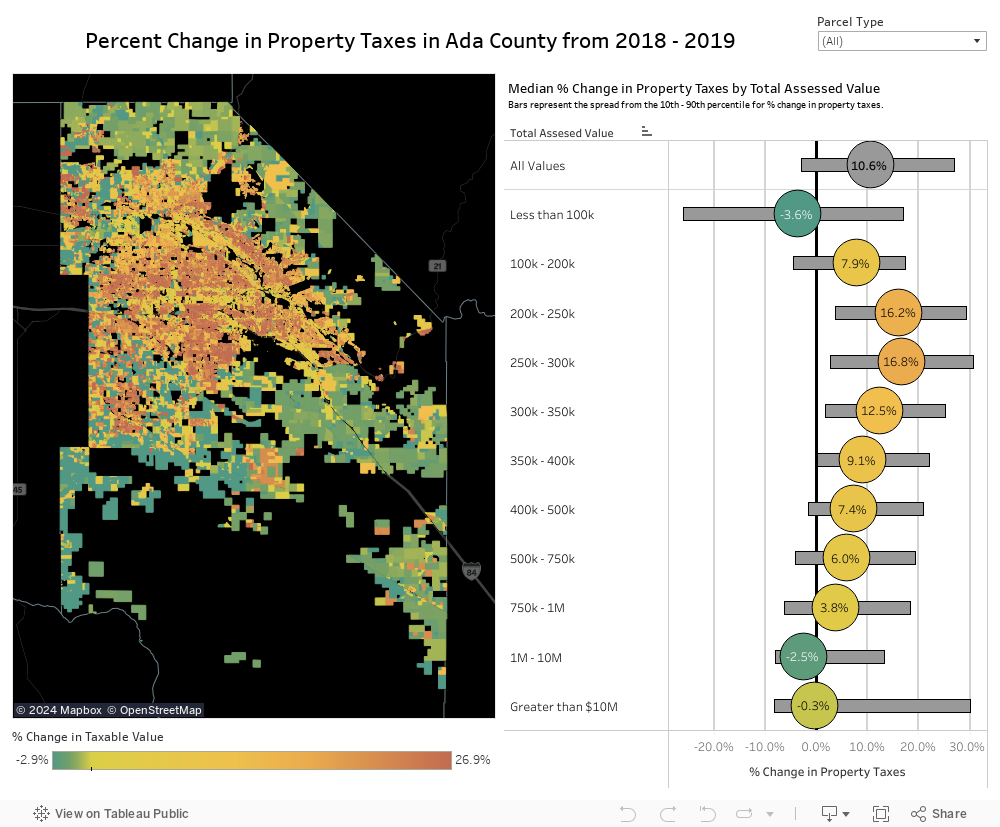
In 2019, a Boise homeowner in the North End paid roughly twice as much in property taxes as in 2010. At the same time, Micron paid 17% more on its headquarters. Albertsons paid 10% more on its headquarters, and AgriBeef just 8% more.
In the last decade, taxes have increased modestly for businesses and farm owners — even falling in 2019 — while homeowners have seen steady increases. And that’s by design.
For years, lobbyists for the real estate and farm industries have fought what they say was an unfairly high property-tax burden on commercial real estate. Their efforts have succeeded in shifting the burden of property taxes from commercial real estate to residential property.
Commercial interests scored their most recent victory in 2016, when the Legislature passed a bill that removed the index on the homeowner’s exemption, which had increased on pace with home values, and capped the exemption at $100,000. But as housing prices increase, that $100,000 is worth less each year.
That bill was sponsored by the Idaho Association of Realtors and the Idaho Farm Bureau.
Property tax freeze
This year, amid an outcry over rising home values, discussion of the homeowner’s exemption has been eclipsed by the Legislature’s focus on reining in local spending. House Majority Leader Mike Moyle’s proposal to freeze property taxes for a year has been supported by the Farm Bureau and the Idaho Association of Commerce and Industry.
Homeowners could see a temporary tax cut. Moyle’s bill would almost certainly lower taxes for commercial and agricultural interests, so long as the value of residential property continues to grow faster than commercial property.
State Sen. Maryanne Jordan, a Boise Democrat, has a bill meant to provide longer-term relief to homeowners by letting counties opt into indexing the homeowner’s exemption. Another bill — sponsored by Sen. Grant Burgoyne, a Boise Democrat, Sen. Kelly Arthur Anthon, a Burley Republican and Sen. Dave Lent, an Idaho Falls Republican — would increase tax benefits for low-income seniors and others through the circuit breaker program.
“The idea we can fix all this by limiting local budgets is not a fair representation of what the problem is,” Jordan said. “A big part of the problem with taxes is the cap on the homeowner’s exemption.”
The chairman of the House Revenues and Taxation Committee has yet to give either bill a hearing. Moyle’s bill, H353, passed the House Revenue and Taxation Committee. The bill is set to go before the full House on Thursday, Feb. 20.
Russ Hendricks, director of governmental affairs for the Idaho Farm Bureau Federation, argues that the real shift in property taxes happened when the homeowner’s exemption was created, because it shifted some of burden from residential to commercial and agricultural landowners.
“Is it fair to the commercial property or the agricultural property or the rental property or the non-owner-occupied property that they pay more taxes than they otherwise would, because the homeowners are paying less tax than they would with the homeowner’s exemption?” he said in an interview.
Homeowners exemption passed by voters, opposed by industry
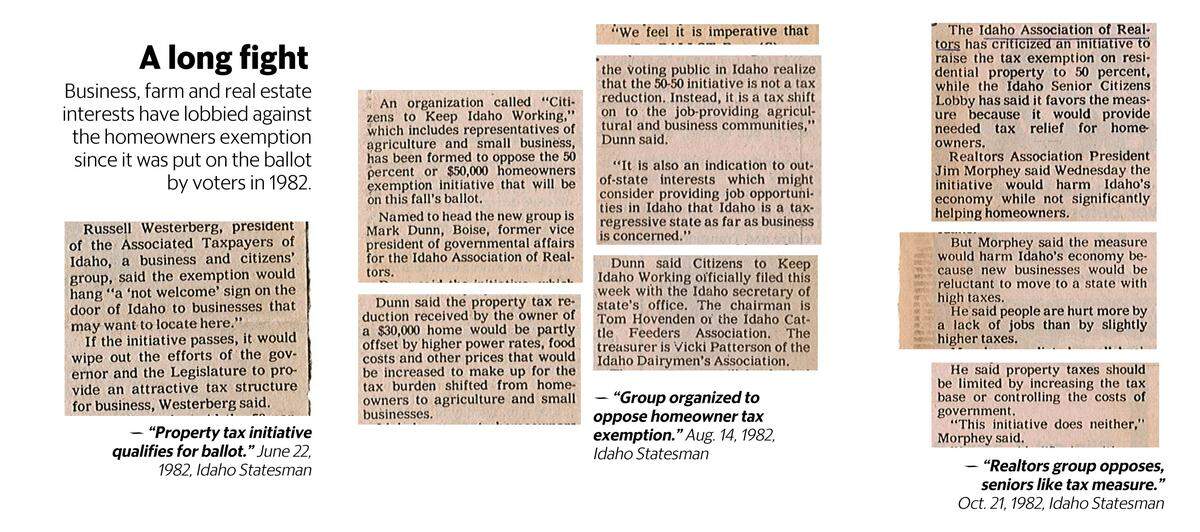
The homeowner’s exemption was first passed by a citizens initiative in 1982, after years of frustration that the burden of property taxes was shifting from other types of property onto homeowners as home prices outpaced other types of property.
That law exempted half of the value of a property, up to $50,000. Supporting the initiative were labor unions, teachers and senior citizens. Opposing it were the Idaho Association of Realtors and the Associated Taxpayers of Idaho, whose board is made up of major business players throughout Idaho.
The next year, the Legislature cut the exemption to $15,000 from $50,000 — but the bill was vetoed by Gov. John Evans.
In 1986, a group of farmers from Bonneville County sued the state over the exemption, arguing it violated the Idaho Constitution by charging different property owners at different rates. The court ruled that the exemption constitutional and said it was successful in “fostering home ownership and equalizing the tax burden between residential and business properties.”
Over the years, the Idaho Association of Realtors and the Farm Bureau supported measures that would chip away at the exemption.
“We want to see Idaho grow, and this hinders growth,” Mark Dunham, then the executive vice president of the Idaho Association of Realtors, told the Statesman in 1987. “We don’t want to hurt residential property owners, but we think all properties should be taxed the same.”
Housing price index
In 2004, with taxes increasing, another initiative movement bubbled up in northern Idaho. In 2006, lawmakers raised the cap to $75,000, which brought the exemption closer to 50% of home values at the time. Lawmakers tied the cap to the Housing Price Index so it would rise or fall with house prices.
In the years leading up to and following the Great Recession, the value of the exemption fluctuated. In 2009, it hit $104,472. In 2013, it dipped to $81,000.
In 2014, the Realtors, the Farm Bureau and the Idaho Association of Commerce and Industry — known as IACI, pronounced “eye-ak-ee” — pushed for legislation to fix the homeowner’s exemption at $90,000. IACI represents major Idaho businesses like HP, Chobani, Simplot and Micron.
The bill passed the House but failed in the Senate.
In 2016, as the homeowner’s exemption was poised once more to exceed $100,000, the industry groups pushed once more to cap it, this time at $100,000.
As before, they argued that a cap would provide more predictability for homeowners. The Realtors called the homeowner’s index “a poorly conceived, poorly executed plan that has hindered economic development and market certainty in Idaho.”
Tax shift to homeowners
Ada County Assessor Bob McQuade predicted in 2016 what capping the value of the exemption would mean: “It will ultimately be a tax shift to the homeowners, as the value erodes,” he told the Spokesman-Review, of Spokane, then.
McQuade’s prediction has come true.
Home prices have risen far faster than commercial properties. In Ada County, the median sales price for a single-family home increased from $237,638 in January 2016 to $363,000 in January 2020, according to the Intermountain Multiple Listing Service.
That’s resulted in taxes increasing more for residential owners than commercial owners, a problem exacerbated by the cap.
Twenty years ago, residential property owners paid 56% of all taxes collected by Ada County and commercial property owners paid 44%. In 2017, residential property owners paid 67%. Today, they pay 72%.
“Market forces have combined with state policies to create this perfect storm,” said Rep. Lauren Necochea, a Boise Democrat and a supporter of Jordan’s bills.
Fairness and fair share
Hendricks says the gap between the residential and commercial share of taxes shouldn’t be used as a measure of the tax system’s fairness.
“There’s no optimal number — nobody’s shooting for some specific portion of the property tax pie,” he said. “It makes absolutely no sense to say that somehow residential property owners are paying more than their fair share.”
Both Hendricks and Alex LaBeau, president of IACI, say that the problem isn’t the disparity between commercial and residential taxpayers.
“The real problem lies in the expansion of local budgets,” LaBeau said in an interview.
Just as industry interests did in 2004, LaBeau is urging the Legislature to pause property taxes “for one year so that we can push them to have an actual sincere conversation about the reality associated with what we believe has been an irresponsible expansion of budgets.”
Hendricks and LaBeau say Moyle’s proposal to freeze property tax budgets for localities will do that.
“This will actually be real property tax relief for all property classes across the board instead of just selected preferred property owners,” Hendricks said.
Still, even if city budgets are frozen this year, property taxes could go up for homeowners if their home values continue to increase faster than commercial property values.
Effects on city services, education
City and county leaders, which depend on property taxes, have lobbied against Moyle’s bill, saying it will affect their ability to provide services that are already strained as a result of rapid growth and shrinking state revenues.
They also say that state doesn’t provide enough funding for education, which has forced local school districts to ask voters to pass supplemental levies, which add to property taxes. For residents of the West Ada School District, a third of the property taxes they pay goes to school levies.
Local leaders support a higher exemption and an expanded circuit breaker.
Seth Grigg, executive director of the Idaho Association of Counties, acknowledges that local budgets affect property taxes. But he said homeowners “should be given consideration as their values are increasing.”
“That index should be brought back, and it should fluctuate with market conditions,” he said.
Max Pond, government affairs director for the Idaho Association of Realtors, did not return phone calls asking for an interview. Instead, he sent an email saying the homeowner’s exemption should not be set on “autopilot.”
“We absolutely believe the Legislature should look at this number (and maybe should happen more often) and have a debate about what is appropriate,” Pond wrote. ‘The Legislature should look at growth in statewide housing prices and consider carefully the impact of any tax shift onto other taxpayers.”
‘Businesses don’t vote, individuals do’
LaBeau said “it’s not surprising” to hear counties advocate for a policy that would leave their budgets intact.
“All they want to do is shift liability from people that can vote to people that can’t — because businesses don’t vote, individuals do,” he said.
And how does he feel about having taken a stance contrary to the will of the voters who passed the homeowner’s exemption in the first place?
“We would say they were wrong,” LaBeau said. “They were misled. And we would say that again today.”
In a phone interview with the Statesman, Moyle said he has another bill drafted that would increase the homeowner’s exemption — but rather than shifting that to other classes of properties, any increase in the homeowner’s exemption would come out of local budgets.
“So the homeowners will get the benefit, but we don’t move the tax to the agricultural, the commercial or the timber group,” Moyle said. “The other side ... is looking at shifting the tax. Shifting the tax is not necessarily what’s best for Idaho — what’s best for Idaho is to solve the problem, not just give it to somebody else.”
Data and visualization by Ada County Clerk’s Office
This story was originally published February 20, 2020 at 4:00 AM.