Idaho woman says family ‘mishandled,’ mistreated at Wilder raid, hints at lawsuit
A licensed Idaho horse trainer who was born and raised in Gooding, Anabel Romero has always been passionate about the animals and horse racing.
On Oct. 19, she and her family were in attendance at La Catedral Arena in Wilder for the last race of the season. No event she’d ever been to had ended like this.
Romero, a Meridian resident, said she and her young children were subjected to violence and aggression by law enforcement during an FBI-led raid in the Canyon County town that also involved ICE agents, who took more than 100 people into custody and arrested them.
She said she now wants to see the government held accountable for officers’ behavior at the raid, where nearly everyone was detained at first.
“We were mishandled,” Romero, 35, told the Idaho Statesman. “My kids, too. They bruised my daughter up. They basically abused her.”
Romero described the scene as chaotic.
“All of a sudden, we heard helicopters, and everybody was running,” she said. “We didn’t know what was going on. Everybody is crying, screaming. And all I can think about is my two nephews with me. They’re like, ‘What do we do?’”
The Wilder raid involved ICE; the Treasure Valley Metro Violent Crime and Gang Task Force, which includes the FBI; and the Canyon County Sheriff’s Office and the Caldwell Police Department, among other law enforcement bodies. A total of 10 agencies were involved, according to an FBI news release.
Romero said people with the law enforcement agencies did not identify themselves or provide information as to why they were there before placing their hands on her.
“They’re trying to grab me, and I’m over here telling them not to touch me,” Romero said. “And then one of them is like, ‘I’m gonna effing blow your head off.’”
.JPG "IMG_1443 (1).JPG")
The Statesman viewed video footage of the incident, which included a law enforcement officer using that language.
Romero said officers shoved her to the ground, kicked her, put a knee on her neck and zip-tied her hands. She said she experienced pain and bruising on her neck and ribs.
“They tied my hands in the back of me, and they grabbed me like a freaking pig,” Romero said.
She said she and others were then made to kneel in an area covered with goathead plants. She said she saw a 13-year-old “dropped to the ground by one of the officers” and a 14-year-old “manhandled.”
Mother said her children were harmed in ICE raid
Most upsetting for Romero was how she said officers treated her children.
That Sunday was a chilly, drizzly day. Romero said she put her children in her truck to keep them warm while she went to look at horse stalls with her nephews. That’s where her children were when officers surrounded the vehicle, according to their mother.
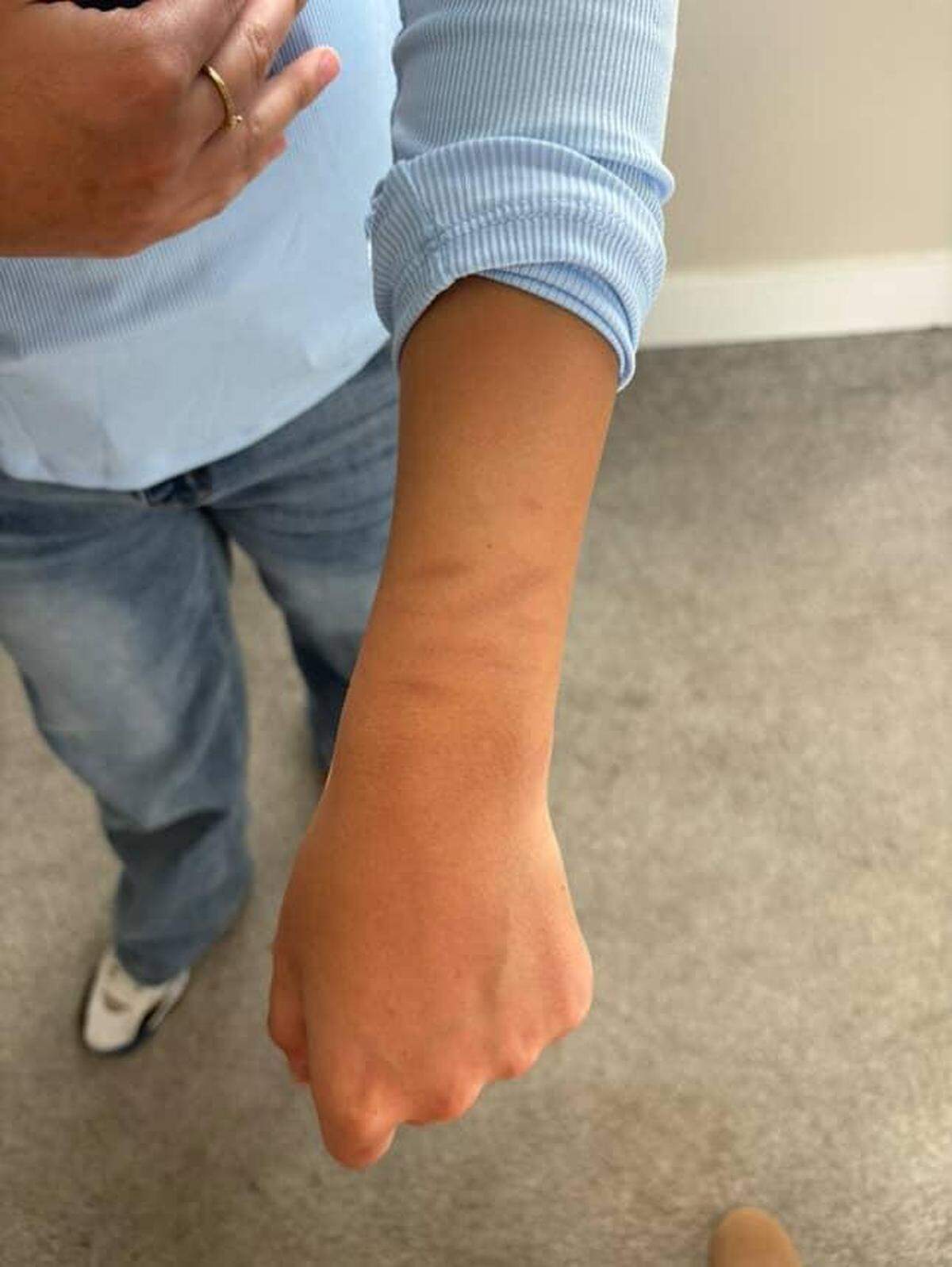
Romero said law enforcement pointed guns at her 14-year-old daughter, 8-year-old daughter and 6-year-old son, ordering them to get out. Law enforcement became physical with 14-year-old SueHey Tello, pulling her from the truck to the ground, Romero said. She documented bruising on the child’s side and wrists, which she said came from being dragged from the truck and zip-tied.
.jpg "1000022878 (2).jpg")
“They had the guns pointed at them,” Romero said. “They grabbed (my daughter,) and they zip-tied her, even though she’s 14 years old. They pointed the guns at my two little ones to get out of the truck.”
The Idaho Statesman asked the FBI, ICE, the Canyon County Sheriff’s Office, the Caldwell Police Department and other agencies why minors were zip-tied, what kind of force law enforcement used and whether any agencies were investigating for potential use-of-force violations. The FBI declined to comment. ICE denied that any children were zip-tied. Canyon County and Caldwell did not respond.
Only the Caldwell Police Department has admitted that its officers zip-tied some people younger than 18.
Former FBI agent said practices were ‘typical’
About 400 people were detained in Wilder that day and 105 were arrested on immigration charges, according to Gov. Brad Little. The rest were eventually released. Romero estimated that ICE detained her family for three to four hours.
Richard Denholm, who was an FBI special agent for over 20 years, said in an earlier interview with the Idaho Statesman that such practices were “typical” of large FBI operations.
“When you go into a place like that, you do have to kind of lock everybody in place,” Denholm said. “You can’t have people wandering off. ... You need to go in with overwhelming force to keep everybody safe so you can get everybody handcuffed and find out what’s going on.”
Denholm said he was not surprised to hear children were among those detained, saying law enforcement was “damned if you do, and damned if you don’t” when it comes to letting people go. He said law enforcement doesn’t know in advance, for instance, whether some other crime — even human trafficking — could be taking place.
“You run into other situations like, ‘OK, so there’s all these kids, which is probably OK, but we also know there’s illegal gambling going on,” Denholm said. “You go in with the mindset of, maybe there’s other stuff going on.”
Romero said her 6-year-old son was afraid the officers would try to zip-tie him, too.
“He was like, ‘Oh, they didn’t handcuff me. I got out. I got away,’” Romero said. “Can you imagine a little kid thinking they need to get away?”
Her 8-year-old daughter, who also was not zip-tied, walked down a line of kneeling, zip-tied people, lifting water bottles to the lips of strangers to help them get a drink.
“My kids have a lot of trust issues now,” Romero said. “They see a police car and they freak out.”
.jpg "1000022877 (2).jpg")
Romero and her children are American citizens, but her brother-in-law, Edmundo Esparza, and 19-year-old nephew, Fidel Cordero, are not. ICE took them to Boise before moving them to the Elmore County Jail, where they continue to be held, she said.
“In Boise, they had them basically with no food or water for the first night,” Romero said. “It was cold, and they just had them in a place where a bunch of ants were.”
ICE responded to the Statesman’s questions about the conditions at its Boise detention facility in an email, saying “all detainees are provided with 3 meals a day, clean water, clothing, bedding, showers, and toiletries.”
Cordero and Esparza, who are from Mexico, plan to post bail, but they won’t have the opportunity until they appear in immigration court, one on Nov. 22 and the other on Nov. 26, according to Romero.
“It is a 50-50 chance, the lawyer told us,” that they will be able to stay in the United States, Romero said. “But I’m just having faith.”
Romero said she is caring for Esparza’s 16-year-old son while his father is jailed, but worries what will happen if Esparza is deported. She said her brother-in-law left Zacatecas to escape violence caused by criminal organizations in that area.
Cordero was brought to the country as a minor, and he provides for his mother financially, Romero said.
Romero said she is part of a group working on a possible lawsuit against law enforcement agencies for the way they handled the Wilder operation.
“I hope it brings awareness more than anything,” Romero said. “Just of how our community is being affected by racism just because of our color, and how there are people using their power more than they should.”
This story was originally published November 14, 2025 at 4:00 AM.