Idaho one of worst states for gender pay gap, says study. Here’s how much less women make
A recent study has ranked Idaho as one of the worst states in the United States to live for women, and gender-based wage gap data from the U.S. Census Bureau shows part of the reason why: low wages.
Using the U.S. Census Bureau data, jobseeker website Lensa conducted their own study and found that Idaho has the sixth-largest pay disparity between men and women in the nation.
The data, compiled in 2019, found that, on average, men in Idaho earned $49,116 per year compared to $36,784 by women. The $12,332 gap amounts to a 25.11% difference, putting the Gem State just ahead of Alabama (25.47%) and behind North Dakota (25%).
Vermont is the best state to live in for women looking to make close to their male counterparts, but men still make 8.98% more than women in the state.
As a result of Idaho’s low standing, the state also falls far below the national average for pay disparity. According to data from The Organisation for Economic Co-operation and Development, the United States averages a gender pay gap of 16.86%; that figure still ranks lowly among OECD members, composed of 38 developed countries worldwide.
The U.S. ranks sixth-lowest among OECD members. Estonia, Japan, Latvia, Israel and South Korea are the only member countries with a larger disparity.
Gender pay gap in the U.S.
The U.S. ranks so lowly among OECD member countries because it has yet to do much to close the gap between men and women over the last two decades.
According to an analysis from the Pew Research Center, as of 2022, women earned about 82% of what men made. In 2002, that figure stood at 80%, indicating little progress in the last two decades.
Furthermore, 50% of U.S. adults said a major reason women earn less than men is that employers treat women differently, according to a 2022 Pew Research Center survey. Additionally, 30% of adults acknowledged that reason as a minor factor.
In the survey, 75% of adults said women are paid less because they make different choices than men about work and family balance, and 69% said they think women tend to work in jobs that pay less.
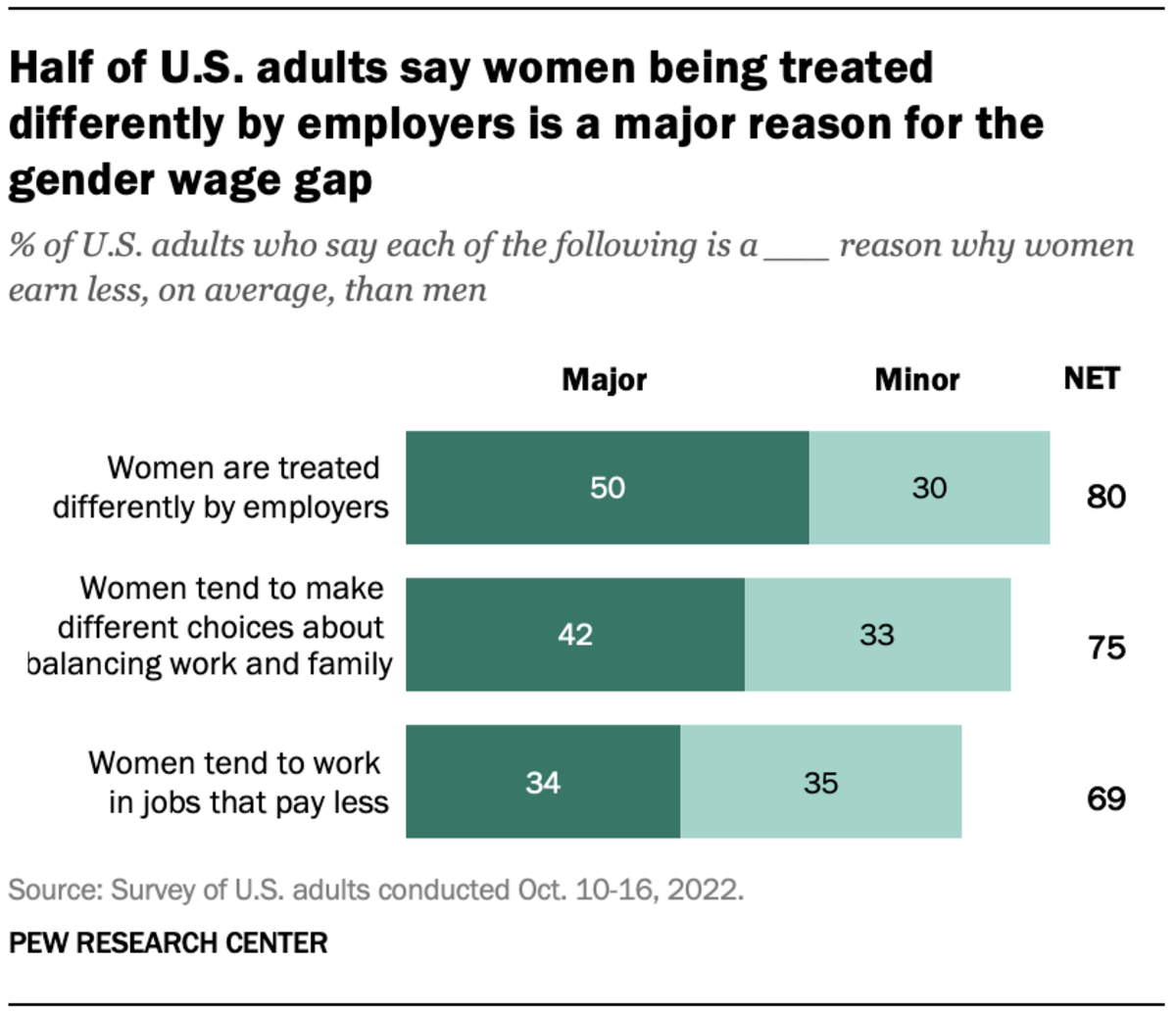
According to data from the U.S. Bureau of Labor Statistics, women accounted for 51.7% of all workers in management and professional occupations in 2020, but the share of women in specific occupations largely varied. For example, 19.4% of software developers, 29.3% of chief executives and 37.4% of lawyers were women.
Conversely, 87.4% of registered nurses, 79.6% of elementary and middle school teachers, and 59.7% of accountants and auditors were women.
UN report says gender equality will take 300 years
The United Nations initially planned to achieve full gender equality by 2030. But a 2022 study has thrown that notion out of the window.
The study, called the Gender Snapshot Report, found that gender disparities are worsening and that, at the current rate, it’ll take 300 years to achieve full gender equality worldwide. Here are some of the current timelines outlined in the report:
Up to 286 years to close legal gaps and eliminate discriminatory laws and practices.
Up to 140 years for women to achieve equal representation in leadership positions.
Up to 40 years for women to achieve equal leadership representation in national parliaments.
To eradicate child marriage by 2030, progress will have to be made 17 times faster than in the past decade.
“Cascading global crises are putting the achievement of the (Sustainable Development Goals) in jeopardy, with the world’s most vulnerable population groups disproportionately impacted, in particular women and girls,” Maria-Francesca Spatolisano, assistant director for the UN Department of Economic and Social Affairs, said in a statement.
Sustainable Development Goals are the 17 goals adopted by UN member states in 2015 to achieve worldwide peace and prosperity by 2030. In addition to gender equality, other goals include creating sustainable cities and communities, conserving ocean life and ensuring affordable and clean energy for all.
“Gender equality is a foundation for achieving all SDGs, and it should be at the heart of building back better,” Spatolisano continued.
U.S. states with significant gender pay gap
Here are the bottom 10 states in the U.S. for gender-based pay disparity according to the Census Bureau, starting with the largest:
Wyoming (36.62%)
Utah (30.23%)
Louisiana (28.72%)
Oklahoma (26.69%)
Alabama (25.47%)
Idaho (25.11%)
North Dakota (25%)
South Dakota (24.82%)
Indiana (24.22%)
West Virginia (23.79%)