‘Our easements are forever’: Land trust, homeowner team to conserve part of Cougar Island
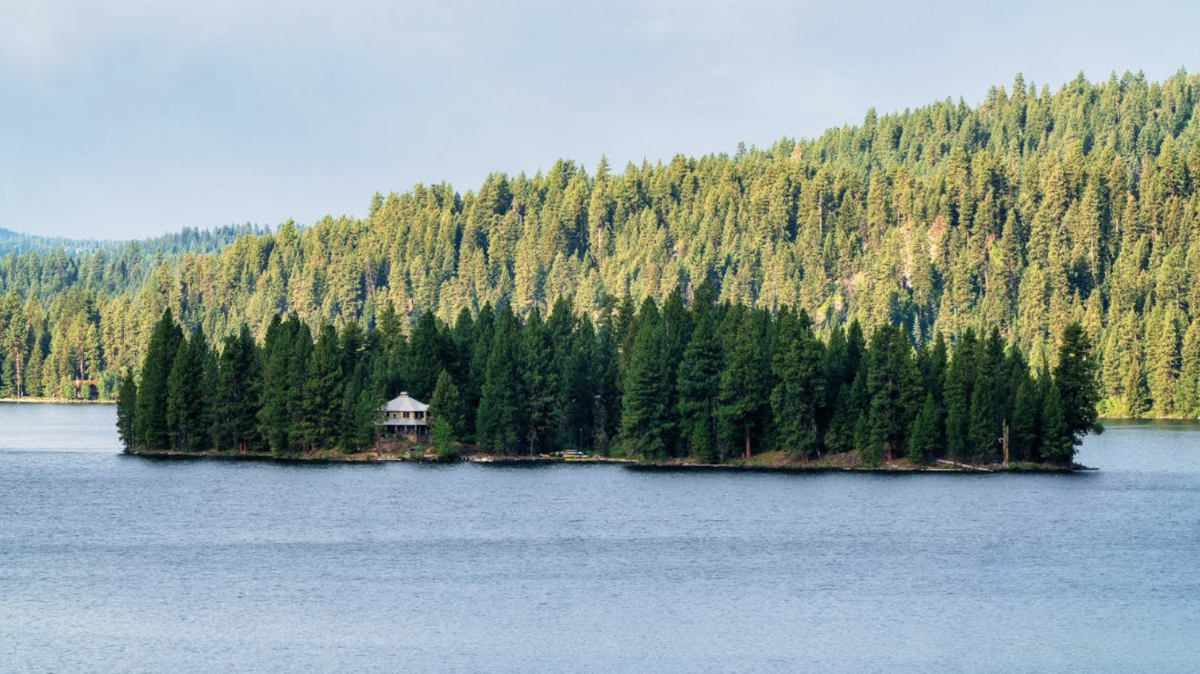
Months after the state auctioned a parcel of endowment land on a rugged Mccall island and the winning bidder put the property on the market, an Idaho land trust announced it has conserved the land “in perpetuity.”
In September, the Idaho Department of Lands held an auction for five parcels comprising Cougar Island, the largest island in Payette Lake. The parcels were longtime Idaho endowment lands — state-owned properties that the Idaho Constitution designated to provide revenue for public schools. That revenue can be earned through rentals, sales, leases or other contracts on the endowment lands.
The auction drew backlash from members of the conservation community who hoped to preserve the island. But on auction day the sole bidder was Jim Laski, who had already owned the solitary home on the island for a decade.
The Payette Land Trust announced this weekend an agreement with Laski that will ensure no additional development occurs on a key part of Cougar Island.
Land trust, land owner worked together before auction
Craig Utter, executive director of the Payette Land Trust, said the nonprofit has gotten to know Laski, a Bellevue attorney, over the last year after news first broke of the state’s auction plans. The land trust and conservation nonprofit United Payette created a task force aimed at conserving the entire island, and the groups invited Laski to join.
“Jim had a stake, and we wanted to be inclusive,” Utter told the Idaho Statesman in a phone interview. “We were really looking to say, ‘How can we conserve it as it is?’ And if we wanted to do that, we had to have a relationship with the homeowner.”
Utter said the state reappraised the Cougar Island parcels last summer, and the parcels’ value jumped from around $6 million total to $10.3 million. No one bid on the other four parcels, but Laski bid on the 2.5 acres of property that would unite the home he already owned and the land it sits on. He paid just over $2 million and closed on the sale last week, Department of Lands spokesperson Sharla Arledge told the Statesman in an email.
The Statesman did not receive a response to an email asking Laski for comment Tuesday morning.
Shortly after winning the auction, Laski briefly listed the 3-bed, 3-bath home for sale for $3.7 million. At the time, real estate agent Sadie Noah told the Statesman there was plenty of early interest. It wasn’t immediately clear when the home was taken off the market. The Statesman reached out to Noah for more information.
The home listing was nerve-wracking for conservationists who had come to know Laski and still hoped to find a way to preserve the island.
“If Jim had sold it to somebody, we don’t know what the ethics of that next owner would be,” Utter told the Statesman. “That’s why we wanted to work with Jim, because his ethics in working with us for the last year let us know we could come to some kind of agreement.”
Laski soon came to the Payette Land Trust, Utter said.
“After he won the bid and was starting to look at, ‘How do I afford this,’ he reached back out to the land trust and asked, ‘Is there a way for us to partner?’” Utter said.
The homeowner and the nonprofit crafted an agreement that took some of the financial burden from Laski while adding an easement on the property’s deed that will conserve it permanently.
“There is this long conversation (with land owners) because you’re making decisions about your property in perpetuity,” Utter said. “Our easements are forever, they always run with the land.”
Easement prevents development by current, future owners
Utter declined to say how much the Payette Land Trust paid to secure the easement but said the nonprofit’s board, donors and Laski were involved in creating the deal.
The agreement bars Laski and any future owner from developing outside of a .75-acre area where structures currently exist, though it allows for development of small outbuildings, such as a shed. The agreement also precludes the owner from renting the home on Airbnb or through other third-party short-term rental sites, or from turning it into a retreat, lodge or restaurant.
Utter said the land trust had concerns about a private landowner building a yurt, short-term rental or other non-residential structure that could potentially skirt a McCall ordinance meant to curb development. The easement protects against that possibility now, too.
The agreement earned accolades from Idaho Conservation League, which also balked at the state’s plan to auction Cougar Island.
“For generations, Idahoans have enjoyed the peaceful tranquility of Cougar Island,” the organization said in a statement to the Statesman. “Protecting the island, its wildlife, and the experiences it holds for past and future generations is vital, which makes ICL excited to see this step in the right direction toward keeping Cougar Island the gem that it is.”
Utter said the agreement isn’t a public access easement. The lakefront access to the island is on Laski’s property, meaning anyone visiting would have to pass through the private property to reach the rest of the island.
“Jim’s front yard is the lakefront,” Utter told the Statesman. “We would never do that with anybody. We wouldn’t ask for public access through the front yard.”
Instead, Utter said, the focus of the easement is preventing development from continuing on the only part of the island with existing infrastructure. In turn, he said, that will likely prevent development on other parts of the island.
Four parcels — about 11.5 acres — of Cougar Island remain in state control. Arledge, the Idaho Department of Lands spokesperson, told the Statesman that “no decision has been made moving forward” concerning the rest of the island.
Utter said he’s eager to speak with the State Board of Land Commissioners, the department’s guiding arm, when its new members are seated early next year. The board includes the Idaho governor, the department director and other state officials including the superintendent of public instruction, the attorney general and the secretary of state.
“They could hold those four lots for another 150 years or they could put them up for auction next year,” Utter said. “We’re a part of that island now going forward, and my hope is that because we’re a part of that, we can have good conversations with the land board and (the department), like we’ve always had.”