Is there a Robert E. Lee Campground in the Boise National Forest? We went to find out
As Confederate monuments began to fall around the country in June, a Boise church made a stunning announcement. Citing community pressure and a desire for repentance, the Cathedral of the Rockies promised to remove a decades-old stained glass window featuring Confederate Gen. Robert E. Lee.
But the stained glass window in the historic church wasn’t the only place a previous generation of Idahoans used to remember and honor the lost cause of the Confederacy. Meridian resident Derick Andrew started a petition to rename a creek and campground named for the Confederate general in the Boise National Forest, near Idaho City.
“Lee died 20 years before Idaho, a territory loyal to the Union and established as part of Lincoln’s war strategy, even became a state,” Andrew wrote in the petition, which now has more than 1,900 signatories. “Memorials should serve to unite communities in shared reverence for our history. Robert E. Lee’s legacy is neither relevant to Idahoans, nor is it worthy of memorializing.”
There was just one problem, forest service officials said. While the Robert E. Lee Creek certainly existed — it branches off the North Fork of the Boise River — they weren’t sure the campground did. The Boise National Forest had no record of an existing Robert E. Lee Campground under their management, officials said, nor one that had been removed like a Southern Poverty Law Center map of Confederate symbols suggested.
“It may have (existed) at one time, but we have not found it on any of our earliest maps,” Boise National Forest spokeswoman Venetia Gempler told the Idaho Statesman on June 12.
A sharp-eyed Idaho Statesman reader disagreed.
“Thank you for your story on the church window honoring Robert E. Lee,” wrote John Eichmann, a veteran of the U.S. Naval Reserve and former city of Boise employee. “I am amazed, though, that no one could tell you about Robert E. Lee Campground. It was located on Robert E. Lee Creek at the confluence with the North Fork of the Boise River, about two miles downriver from Deer Park. It, along with the Deer Park Campground, was abandoned by the Forest Service well over 20 years ago when the Service closed many campgrounds, took out their fire pits and outhouses, and removed most indicators of established campgrounds. I have a map from the 1980s which clearly shows Robert E. Lee Campground.”
There was only one way to settle the discrepancy. Using several old maps provided by Eichmann, we decided to go find the Robert E. Lee Campground ourselves.
The case of the disappearing Robert E. Lee Campground
The Idaho mountains are full of Confederate history. Idaho, barely a territory during the Civil War, saw an influx of Confederate sympathizers after it ended, according to Boise State Public Radio. But Confederate and Union sympathies divided early Idahoans during the Civil War, too. In “Hiking Idaho,” the authors recounted for backcountry explorers of the Central Idaho mountains how the Secesh (Secessionist) River and region was named for the Confederate sympathizers who left the mining town of Warren over their political disagreements. Other towns dotting Idaho’s landscape and history like Richmond, Atlanta, and Dixie reveal their Civil War origins.
Despite the fact that the Forest Service initially said it had no records of the Robert E. Lee Campground, several Forest Service maps showed the campground along the North Fork Boise River Road, or Forest Service Road 327, as late as 1991.
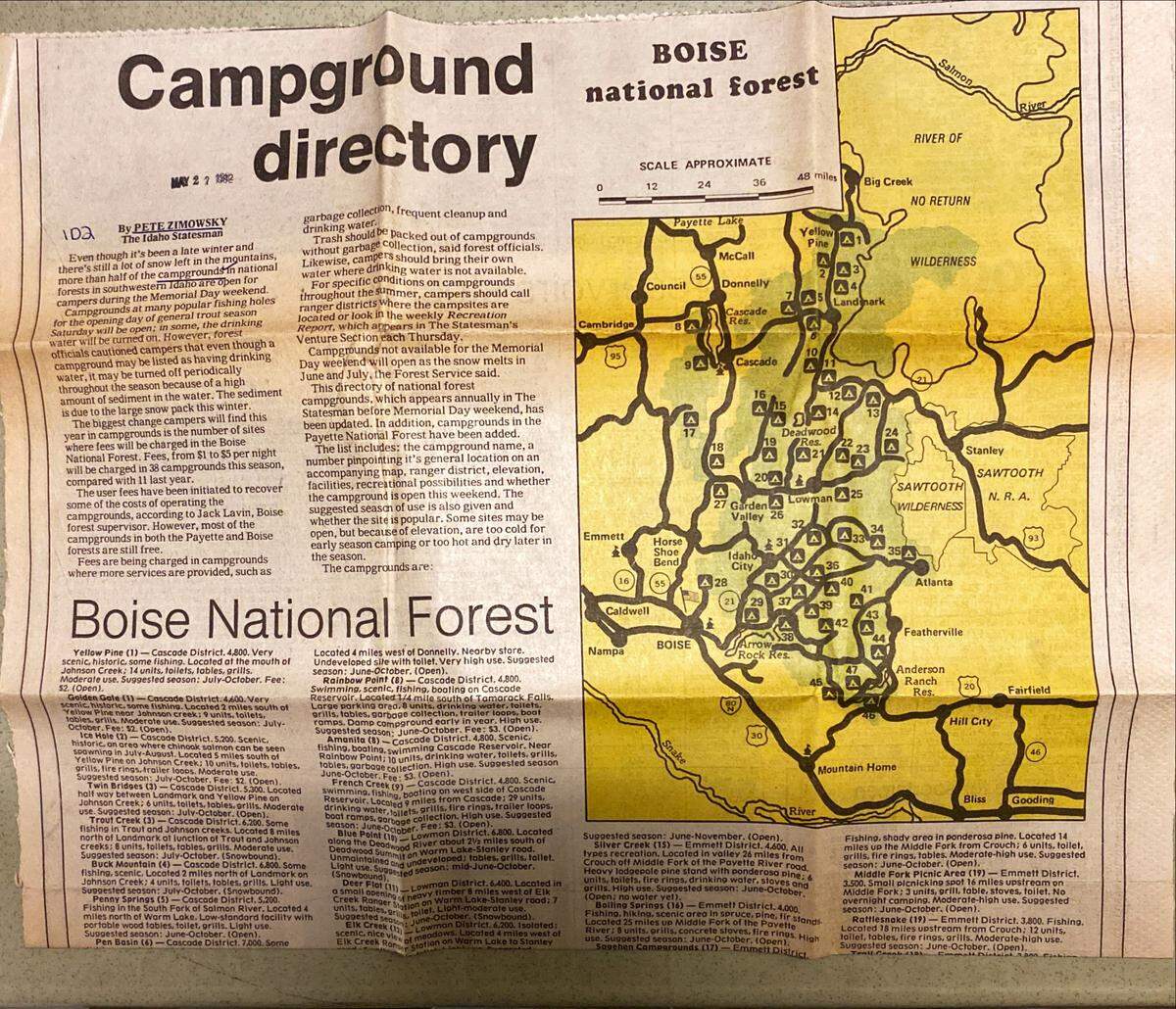
The Statesman also published multiple maps showing the Robert E. Lee campground in camping guides in the early 1980s. Longtime former Statesman outdoors reporter Pete Zimowsky told us he remembered the campground. Zimowsky located a 1987 Boise National Forest map that stated the Robert E. Lee campground had six campsites and an outhouse. A 1982 camping guide in the Statesman also said it had tables and grills and saw “moderate use.”
The campground’s coordinates can still be found online, including on the Forest Service’s online Interactive Visitor Map as “Robert E Lee Dispersed.” It is not marked with a campground icon or description like developed campgrounds are. And until recently, Robert E. Lee campground also appeared on OnX, a hunting GPS app, where it was marked as a developed campground. (OnX changed the name of the site to “dispersed campsite” this summer after we asked what geographic information system data they’d used to find record of the campground.)
“We get our camping points data from many, many sources,” wrote OnX’s access advocacy manager, Lisa Nichols, in an email. “That particular camping area is classified as a dispersed site (which explains why it has no distinguishable infrastructure) and USFS as the type according to the data we have, which we obtained from Idaho Department of Parks and Recreation.”
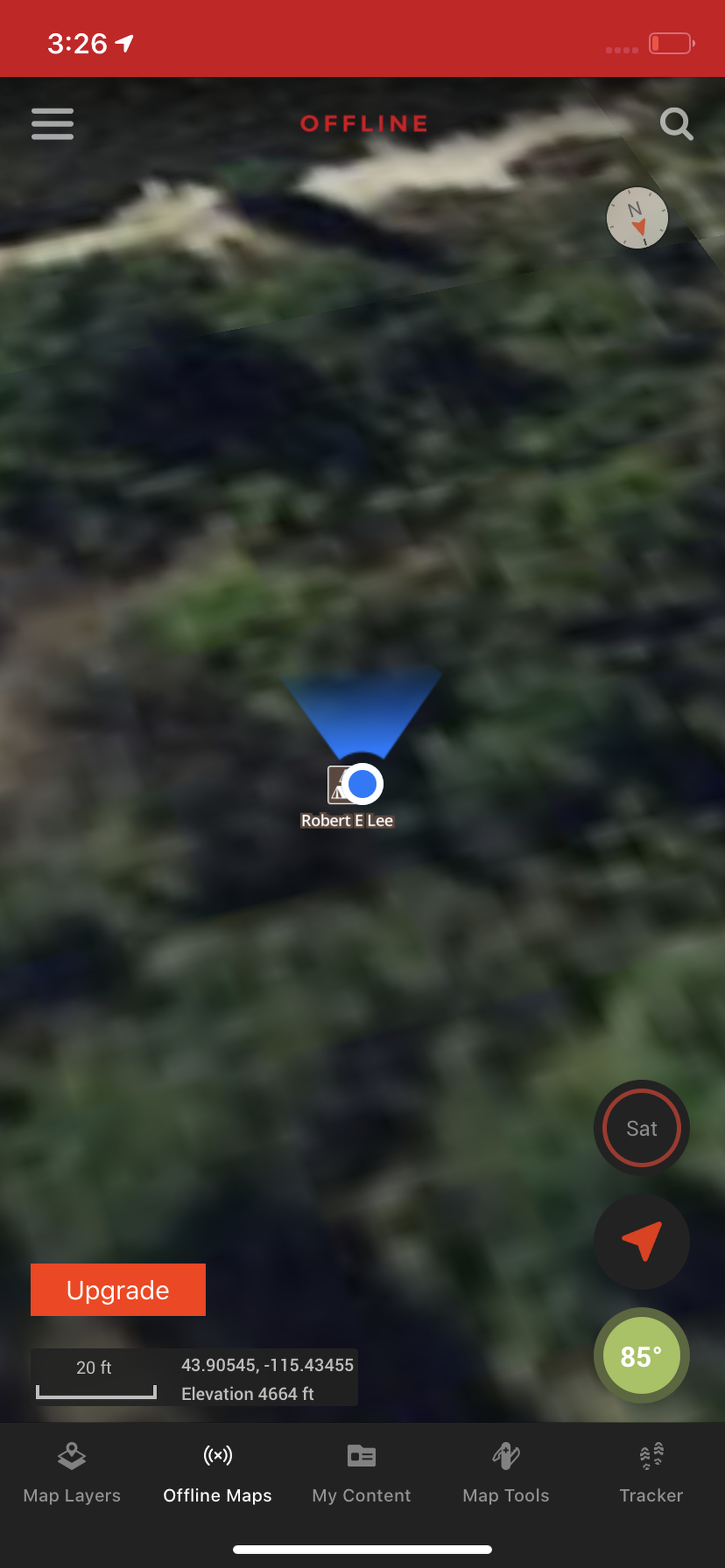
Craig Quintana, spokesman for the Department of Parks and Rec, told us he wasn’t familiar with the Robert E. Lee campground and didn’t believe the state agency would have any reason to have records on it.
Still, the OnX location was spot-on to where the Robert E. Lee campground once was, matching up with Zimowsky’s 1987 map.
“It is located between Deer Park and Four Mile campgrounds,” Zimowsky wrote in an email describing the Robert E. Lee campsite.
But neither of those campgrounds exists anymore either, according to the Boise National Forest’s online directory of campgrounds. A 1988 resource management plan for the forest proposed converting Four Mile campground to a day use site and maintaining Deer Park campground. The plan also called for maintaining Robert E. Lee campground “until future management direction is determined.”
That management plan came around the same time the Forest Service saw budget reductions in the 1980s and ‘90s, forcing employee furloughs, decreased amenities and maintenance backlogs that continue to this day, to the tune of more than $5 billion. Given the campgrounds’ disappearance in the 1990s, it’s entirely possible the sites were a casualty of funding shortfalls. The agency still decommissions roads, campgrounds and day use sites that are no longer needed or have become unsafe.
How we found the campground
The easiest — and most scenic — way to find the Robert E. Lee Campground is to start from Highway 21 and Idaho City. We drove as if we were heading to the Willow Creek Campground, winding through several bumpy forest roads in the Edna Creek area.
Upon arrival, it was clear that Robert E. Lee Campground along the North Fork of the Boise River was no longer an officially managed or maintained campsite. Several fire pits at the site, though clearly used very frequently and very recently, were just rock circles without metal fire rings or grates. There was no sign of the outhouse or tables the 1980s maps said once existed.
What remained was four or five dispersed camping sites that visitors have carved out for themselves over the years. If there was once easy access to the river, it’s grown over since. On the Tuesday we visited, we had clearly just missed a group that had marked their spot with the sign “Camp at your own risk! We are loud!”
Though it was difficult to see with the trees and vegetation blocking any easy path from the campsite, the confluence of the Robert E. Lee Creek started just across the river.
Although the official state of the Robert E. Lee Campground may be in dispute, it certainly exists on several maps and is used frequently by campers, anglers and hunters. Treasure Valley residents are still appealing to the Idaho Geographic Names Board to change the name of the Robert E. Creek, although the petition has removed the name of the campground because of doubts to its actual existence.
(Even Instagram is aware of the petition. When we tried to post pictures from our adventure on the app, one location tag option was “Change the Name of the Robert E Lee Creek.”)
It’s a beautiful camping spot, whether or not it exists on any map. After scouring the archives, searching reader maps, and interviewing several local experts, we still haven’t discovered what happened to the campground — and several others around it.
We filed a Freedom of Information Act request with the Boise National Forest shortly before the publication of this story. But we want to hear from you. Do you know what happened to the Robert E. Lee Campground? Do you have pictures, maps or stories about your trip to the area? Do you think the Robert E. Lee Campground and Robert E. Lee Creek should be renamed?
To contact the reporters, email nfoy@idahostatesman.com and nblanchard@idahostatesman.com.
This story has been corrected to clarify John Eichmann was a Command Senior Chief in the U.S. Naval Reserve.
This story was originally published July 13, 2020 at 4:00 AM.