Water is a troublesome foe to roads. It seeps into pavement after rain or snowfall and lurks there until changes in temperature cause it to expand, cracking and damaging the asphalt surface.
Chipseal, a fresh coating of oil and rock applied in cycles to Treasure Valley roads each summer, slows the damage, extending the life of the pavement and saving money on repairs.
It’s also a perennial headache to drivers, who fall victim to chipped windshields and paint caused by stray rock chips flung from under the tires of neighboring cars.
Officials from the city of Nampa and Ada County Highway District, which are in the middle of this annual operation, said the process is vastly more efficient than rebuilding roads, because it greatly increases the life of the pavement at a fraction of the cost. And the projects leave lanes open for traffic.
“It’s a great preventative maintenance tool, because it’s economical and it keeps the roads open,” said Jennifer Berenger, deputy director of maintenance for ACHD.
Plus, the asphalt dries fast, said Don Barr, Nampa’s Streets Superintendent.
“We go by your house, in 20 minutes you’re driving on it,” Barr said. “You’re not gonna drive on a rebuild in front of your house for six months.”
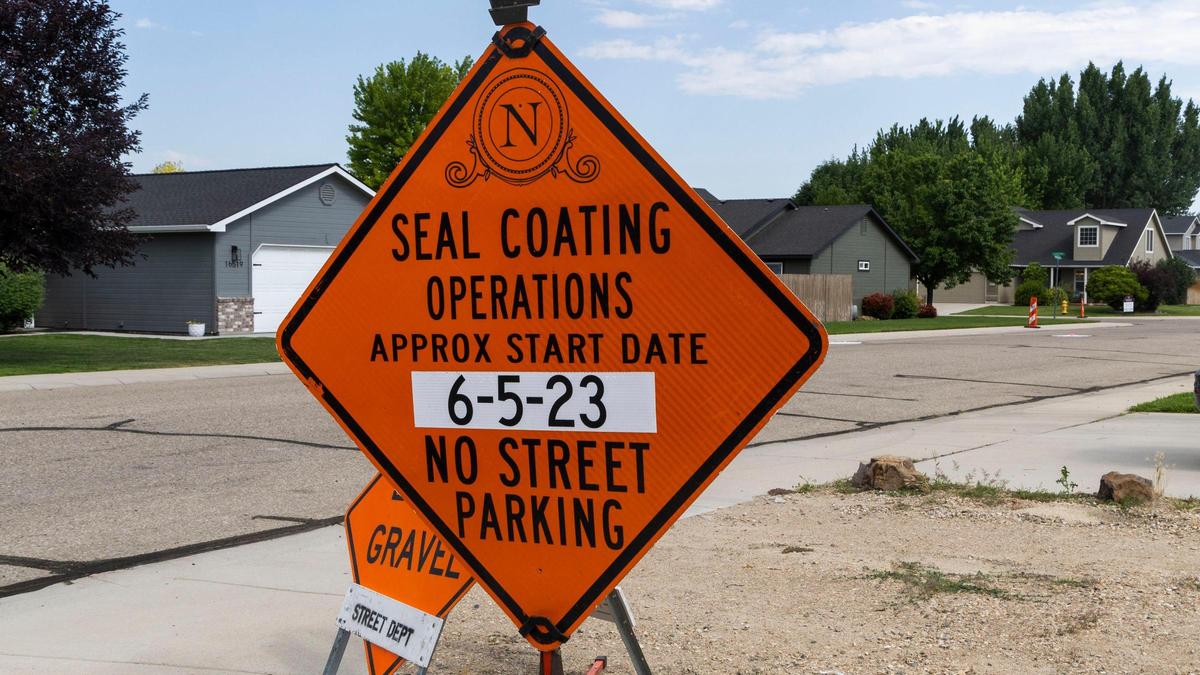
Before seal coating a street, the city of Nampa posts signs to notify residents. The city distributed door hangers with information about the 2023 chipsealing project to subdivisions in May. Darin Oswald doswald@idahostatesman.com
Which streets will be chipsealed this summer
Nampa plans to complete 30 lane miles of chipsealing this summer, in subdivisions between Cherry Lane and Birch Lane and along larger roads like North Franklin Boulevard, Madison Road and Linden Road.
The city is divided into seven zones for chip sealing and tackles one each summer, Barr said. Inside that zone, workers inspect the condition of the pavement and prioritize the roads in best condition before trickling down to others in worse condition.
If a road is already covered in cracks, Barr said, a chipseal coat can’t fill it, so moisture will get into it anyway. It makes more sense to save those roads for repairs that will be effective, like reconstruction, he said.
“It’s easier to take care of keeping a newer home nice than it is one that’s 100 years old,” he said.
Chipsealing costs roughly $35,000 per lane mile, Barr said, while rebuilding the same distance of road costs about $270,000. That puts the cost of Nampa’s operations around $1 million for chipsealing this summer, as opposed to $8.1 million for a hypothetical rebuild.
The Ada County Highway District is planning 309 lane miles of chipsealing this summer, for a total cost of $5.8 million. The district will chipseal roads in south and southeast Boise, and a tracker of the locations and progress is available online. The zone extends south from Myrtle Street and I-184 past the Boise Airport and east from Cole Road to Warm Springs Avenue.
Some residential roads aren’t included in that plan, Berenger said, because they’re used less and deteriorate more slowly over time. The plan also doesn’t include roads too damaged for chipseal, which are designated for more expensive construction.
With no maintenance, a road will generally last 12 years, Berenger said. Adding chipseal coats every seven years starting when the road is 7 years old can more than double its life, she said, extending it to 25 years.
How chipsealing works
The chipseal operation is a well-oiled machine. At a demonstration Monday in Nampa, a crew of more than 20 workers marshaled an oil tanker, chipper, dump truck and rollers to lay down new layers of asphalt in minutes, speeding through lanes in the Sherwood Meadows subdivision, near the intersection of Cherry Lane and 11th Avenue North.
In front of the operation was the tanker, filled with more than 3,000 gallons of sticky oil heated to 170 degrees. It sprayed the dark brown mixture evenly onto each road lane through an array of nozzles at the back of the tank.
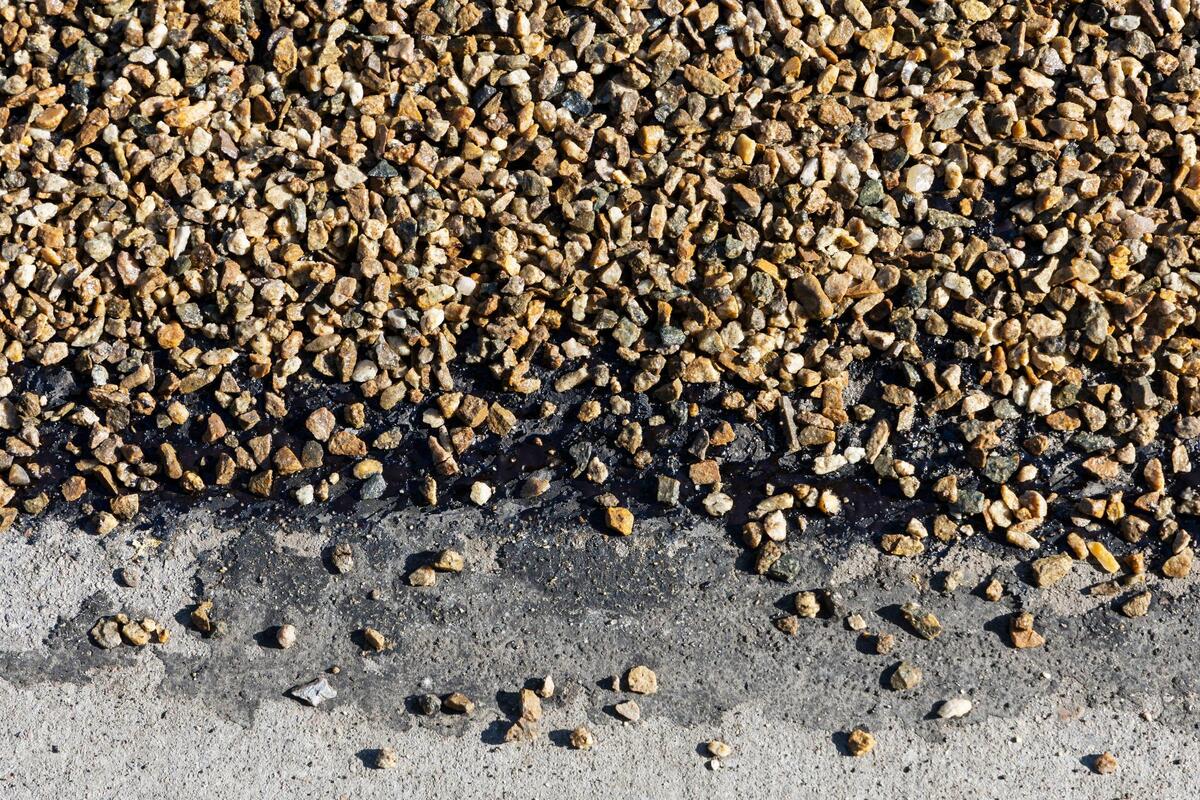
A fresh coat of oil precedes a chipper that quickly drops a layer of chipped rock to resurface a residential street. The chipper must pour the layer of chips onto the road before the oil hardens, which takes only one minute. Darin Oswald doswald@idahostatesman.com
Once the oil hit the road, the clock was ticking. Crews only had one minute to lay the fresh bed of rock into the asphalt before it began hardening.
That was the role of the chipper, a massive truck with conveyor belts running through its center. The belts carried quarter-inch rock chips from a rear storage bay to hoppers at the front of the vehicle. A smooth layer of rock poured from the hoppers onto the liquid oil surface as the chipper driver, Jose Guardian, followed closely behind the oil tanker.
It was a nonstop process.
Rock chips flowed continually into the chipper’s storage bay even as the conveyor belts depleted the pile stored there. This supply came from a dump truck latched by its rear end to the back of the chipper. The truck was shifted into neutral, allowing the chipper to tug it along while gravity pulled chips from its bed, tilted up and down by the truck driver.
When the truck ran out of chips, the crew simply reloaded on the fly. The oil tanker continued spraying, but the coupled chipper and truck stopped. The truck unlatched from the chipper with the press of a button and was instantly replaced by another. Guardian started the chipper again, catching up to the oil tanker before the asphalt hardened.
Three rollers followed the chipper and dump truck down the lane in a staggered row, pressing the rocks into the new layer. A cadre of crew members on foot was last in line, sweeping stray chips from surrounding pavement back onto the oil surface. Once one lane was complete, the vehicles paused briefly to turn around and start the adjacent lane.
Other crew members directed traffic around the roving operation, dispatching updates by walkie talkie when cars were nearby.
Steve Overweg, a Nampa street maintenance lead, was one of the conductors. He took measurements of humidity, road temperature and wind every hour, determining what volume of rocks should be poured from the chipper to create the strongest layer. Increasing heat thins the new oil surface, meaning the chipper needs to pour more rocks onto the road to fill it. Too much wind means the oil spraying from the tanker can end up coating cars instead of the road, meaning work must stop.
He also signaled to the dump truck driver when to tilt the bed to tip more rocks into the chipper so that the supply wouldn’t run out. Tilt too fast, and rocks pour out of the chipper, making crews shovel them up.
“It’s a balancing act,” he said.
The chipsealing process is nonstop in the Ada County Highway District too, said Berenger, the ACHD maintenance official. A chipsealing crew uses two tankers and eight to 10 dump trucks.
“We’re in and out within a matter of 30 minutes on a particular street,” she said.
After the layer of oil and rocks has hardened, sweepers get rid of the excess chips and another layer of thinner oil, called fog seal, is sprayed on the road. The fog seal locks down leftover rock and dust and makes the road look black again, readying it for fresh striping paint.
A layer of fresh oil followed up with chipped rock, or seal coating, gives new life to roads. Darin Oswald doswald@idahostatesman.com
Adjustments decrease damage claims
Nampa has fine-tuned this process over the years, reducing the number of claims filed for car damage, said Barr, the streets superintendent. In the last two years, the number of claims has been minimal or nonexistent, he said. Before that, the city had up to 15 claims in a summer, but none have been paid out in the last 16 years, he said.
That decrease can be attributed to a few changes in the materials and process, Barr said. Crews used to wait until they were completely done chipsealing for a summer to sweep roads. Now, they sweep the morning after the road is complete, getting rid of debris that can be kicked up.
The oil that crews use has also improved over the years to include a polymer that grabs the rock and holds it more tightly. The rock they use is cleaned with a screen and water nozzle to wash dirt and sand off, helping oil stick to the chips better.
Rachel Bjornestad, ACHD’s public information officer, said roughly 40% of the 50 claims reviewed annually by the district’s third-party claims administrator are about chipped windshields from chipsealing operations. They’re often denied in the review process, because ACHD is found not negligent in its operations, she said. ACHD has not paid out a claim for a chipped windshield since at least 2015.
“We’ve put the chips on the road for a purpose, and it’s safety critical, and anything that goes airborne is due to other cars,” Berenger said.
Gabe Barnard is a news reporting intern at the Idaho Statesman. He was previously the editor-in-chief of Montana State University’s student newspaper, the Exponent, and has reported for the St. Louis Post-Dispatch and Montana Free Press. If you like stories like this, please consider supporting our work with a digital subscription.