The West is struggling to grow enough seedlings to reforest after fires. Idaho can help
The greenhouses at Lucky Peak Nursery are packed, filled with row upon row of tiny tree seedlings sprouting from orderly containers. In a year, they’ll be scattered across the West, part of the U.S. Forest Service’s efforts to heal massive burn scars and restore a healthy forest ecosystem.
Forests across the country — but particularly in the West — are in a bad spot. Though overgrown brush and vegetation can contribute to massive wildfires, a lack of new plants to replenish burned areas means the landscape is less habitable for wildlife, less able to absorb carbon from the atmosphere and potentially susceptible to burning again.
In spite of that, efforts to replant U.S. forests have hit numerous snags — from seedling shortages to staffing issues — as the need for seedlings has ratcheted up in recent years.
Idaho, home to one-third of the Forest Service’s nurseries and the University of Idaho’s Franklin H. Pitkin Forest Nursery, is uniquely positioned to respond to a problem that will shape the West’s forests, including those in our own backyard.
Reseeding needs have shifted dramatically thanks to wildfires
Forty years ago, most of the Forest Service’s seedlings went to replenishing forests thinned by timber harvesting. These days, that’s not the case.
Austin Rempel, forest restoration manager for conservation nonprofit American Forests, said the U.S. used to produce about 3 billion seedlings each year at its peak in the 1980s. Today, the country produces about 1.3 billion seedlings.
A big part of that dramatic decrease was scaling back logging, according to David Lytle, director of Forest and Rangeland Management and Vegetation Ecology for the Forest Service
“We have seen on national forests a really dramatic shift in what is driving reforestation,” said Lytle. “Now over 80% of reforestation needs are being driven by wildfire.”
Megafires — blazes that burn at least 100,000 acres — have increased exponentially in the West over the last few decades, charring wide swaths of land. Lytle said there are currently plans to reseed 1.3 million acres of Forest Service land. About 10% of that — 145,000 acres — is in Idaho.
There are even more Forest Service lands that need to be reseeded that the agency hasn’t yet assessed or created plans for. As many as 4 million additional acres are still in need of reseeding plans. One million of those acres were burned just last year during 2020’s historic fire season.
Lytle said the Forest Service needs more employees to do field research on which areas have burned and what types of seedlings they need.
“Right now we’re only able to meet about 6% of post-wildfire restoration needs,” he said. “We need to really ramp up our efforts if we’re going to meet that need. It’s not just growing the seedlings. It’s everything.”
That’s difficult to do without a major shift in how reseeding efforts are funded. In the past, timber revenues helped fund reseeding efforts. Now the Forest Service relies almost exclusively on its Reforestation Trust Fund, which for decades has had a $30 million per year cap.
“(We) haven’t seen that grow commensurate with the needs that are out there,” Lytle said.
.jpg "Idaho_FieldVisit_10-12 040 (1).jpg")
Idaho nurseries are stuck in a catch-22
Not only are fires quickly burning large landscapes, they also affect how the agency plans its seedlings. When timber harvest was the main driver of reforestation, the Forest Service knew how many trees would be cut down, where they would be cut down and what varieties of trees would be involved. With fires, each season is a roll of the dice.
“The way the Forest Service runs our nurseries is we don’t grow anything until we have a firm order,” said Aram Eramian, nursery superintendent at the Couer d’Alene Nursery.
That means seedlings are only ordered when a burned area has been assessed and a reseeding plan put in place. Then, the plants need one to three years to grow before they can be planted.
In the meantime, officials at Idaho’s Forest Service nurseries say they have room to ramp up production. While Lucky Peak’s greenhouses are full to the brim, that’s not all it can grow. Both the Lucky Peak Nursery, about 18 miles from downtown Boise, and the Coeur d’Alene Nursery in North Idaho grow container seedlings in greenhouses and what’s known as bare-root seedlings outdoors.
Container seedlings are preferred for reforestation because they can be grown more quickly — in one year as opposed to the two or three years it takes to grow bare-root stock. Bare-root plants are grown in the ground, then the plant and roots are removed from the soil before being transplanted at their new location. Lytle said many of the nurseries’ container stock are trees, whereas bare-root plants tend to be shrubs and bushes.
Lucky Peak is at its 1.9 million container seedling capacity in its greenhouses, but grows less than half of its 7 million bare-root seedling capacity. Eramian said the Coeur d’Alene Nursery is growing only around one-quarter of its capacity: It can handle 4 million seedlings in its greenhouses and 15 million bare-root seedlings outdoors.
“We grew 20 million (seedlings) in the 1980s,” Eramian said. “The emphasis was on reforesting backlog — the same thing we’re facing today. Once we set aside all the backlog, then we went back down to maybe 8 million or 9 million a year for a while. Then it started dropping off.”
Eramian said 2015 was the nursery’s lowest production year — it grew just 3 million seedlings. Production is back on the upswing, and he said the Coeur d’Alene Nursery could easily rise to the occasion if the Forest Service ramps up its reseeding efforts.
“For us, if they said, ‘We need these tomorrow,’ we could do this,” he said.
Research that Rempel co-authored earlier this year estimated the U.S. needs about 30 billion trees to complete its reforestation.
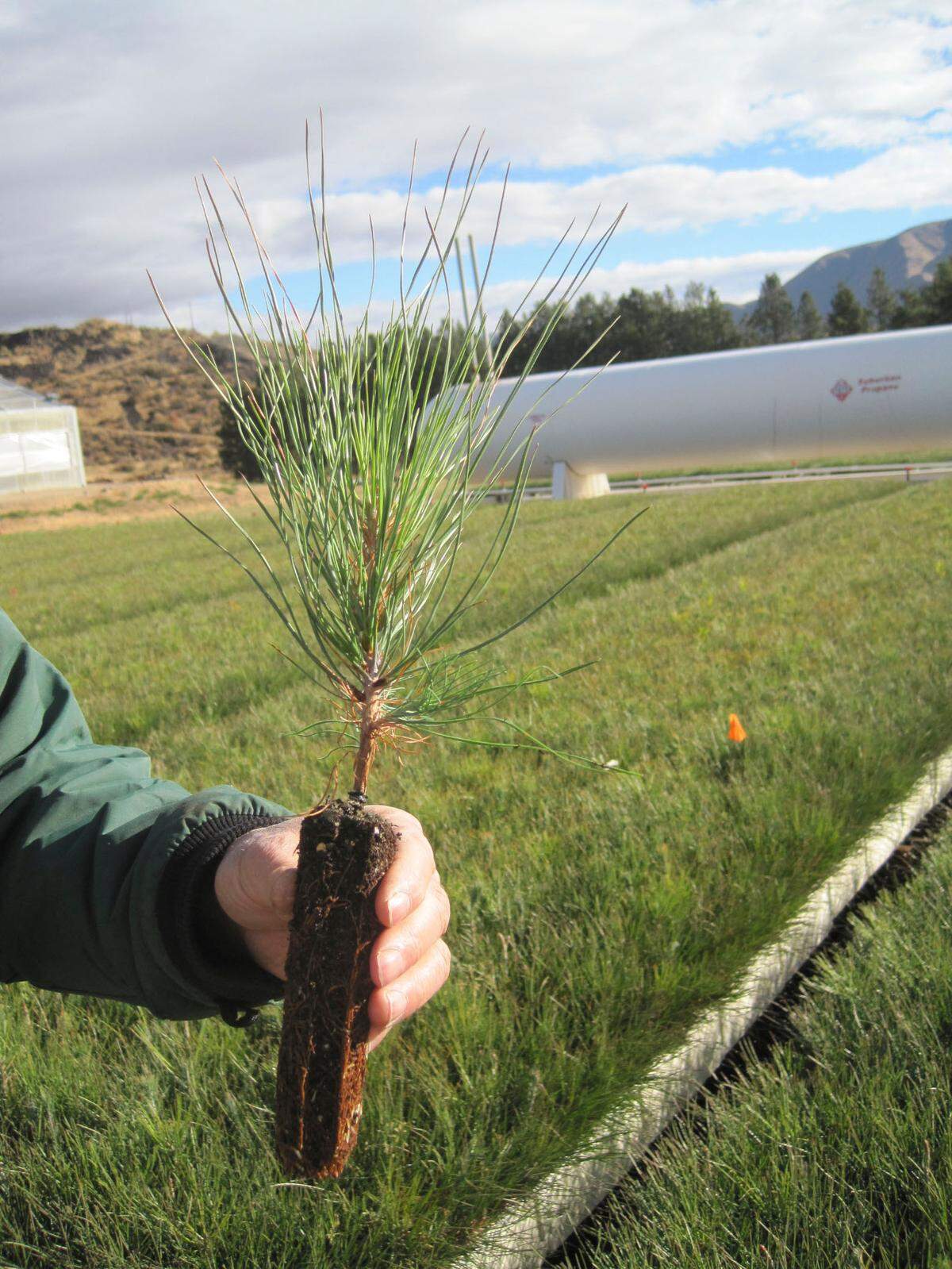
Multiple issues contributing to shortage in reseeding effort
In addition to Forest Service lands, seedlings are needed on state and private land. The University of Idaho’s Franklin H. Pitkin Forest Nursery provides seedlings for Idaho endowment lands, industrial landowners and private community members.
Dennis Becker, dean of the College of Natural Resources at the university, said the Pitkin nursery is one of just two commercial-scale research nurseries in the country. There, employees can learn essential skills like seed collecting and propagation and train to become nursery managers and growers.
Becker said there’s a shortage of that kind of knowledge, and it’s growing worse as more private nurseries close or nursery managers retire.
Without people to run nurseries, fewer seedlings will be grown despite growing demand, Becker said. What’s more, the Pitkin nursery’s work researching and propagating disease- and drought-resistant seeds could slow. Seeds from the Moscow nursery are especially useful in reforesting wildfire burn areas and diseased forests, as they’re adapted to charred soil, low water conditions and other challenges.
Like the federal agency, the school’s nursery could use an infusion of funding, Becker said.
“We are the state nursery but our facilities haven’t seen any significant infusion of technology in probably over two decades,” he said.
This spring, the Idaho Legislature approved $700,000 to go toward new greenhouses at the Pitkin nursery.
Private nurseries are also struggling. Without predictable seedling orders from the timber industry, nurseries aren’t able to grow seedling stock ahead of time. The orders they do get are unpredictable and don’t always match up with available stock.
“I think what’s going to be required (for private nurseries to succeed) is … some surety that when they have a contract it’s going to be for multiple years,” Becker said. “They need some assurance on their investments. You can’t do that on one-year contracts.”
.jpg "Idaho_FieldVisit_10-12 072 (1).jpg")
Idaho poised to help in reseeding effort
With some of the most crucial nursery facilities in the country, Idaho is in a unique position to supply many of the seedlings needed for the reforesting effort ahead. The Coeur d’Alene Nursery is home to a regional seed bank with 10 years worth of seed stock. Plus, it has seed orchards to replenish the bank.
“Idaho has led the way in really (drought- and disease-) resistant trees,” said Rempel, the nonprofit forest restoration manager. “This experience with breeding trees, growing trees, all of that kind of speaks to success. It’s the perfect place to kind of go big in reforestation.”
Already, trees from the Idaho facilities are sent all across the West, repairing burnt landscapes from New Mexico to Washington. The new vegetation helps remove carbon from the atmosphere, improve soil and snowpack retention, delay spring meltoff and protect against future wildfires.
“Reforestation is incredibly important when we’re looking at carbon sequestration, wildlife habitat, recreation, aesthetic beauty,” Lytle said. “All of that is in danger if we do not reforest.”
Help appears to be on the way. More than a dozen members of Congress — including Idaho Rep. Mike Simpson — have co-sponsored the REPLANT Act. The legislation, which stands for Repairing Existing Public Land by Adding Necessary Trees, would remove the $30 million cap on the Reforestation Trust Fund and direct money from wood product tariffs to the fund, potentially quadrupling it.
The legislators estimate the REPLANT Act would create thousands of jobs and add about 1.3 billion trees to more than 4 million acres in the next decade. The bill was introduced in March and referred to the Senate’s Committee on Agriculture, Nutrition, and Forestry.
For Forest Service nursery superintendent Eramian, it’s something to hope for.
“Next year and the year after are really going to be telling for us. It looks good,” he said.