
Stay or go? Court-ordered federal draft report weighs in on Snake River dams
A call to breach eastern Washington’s Snake River dams was rejected in the initial draft of a court-ordered environmental study released Friday by the federal government.
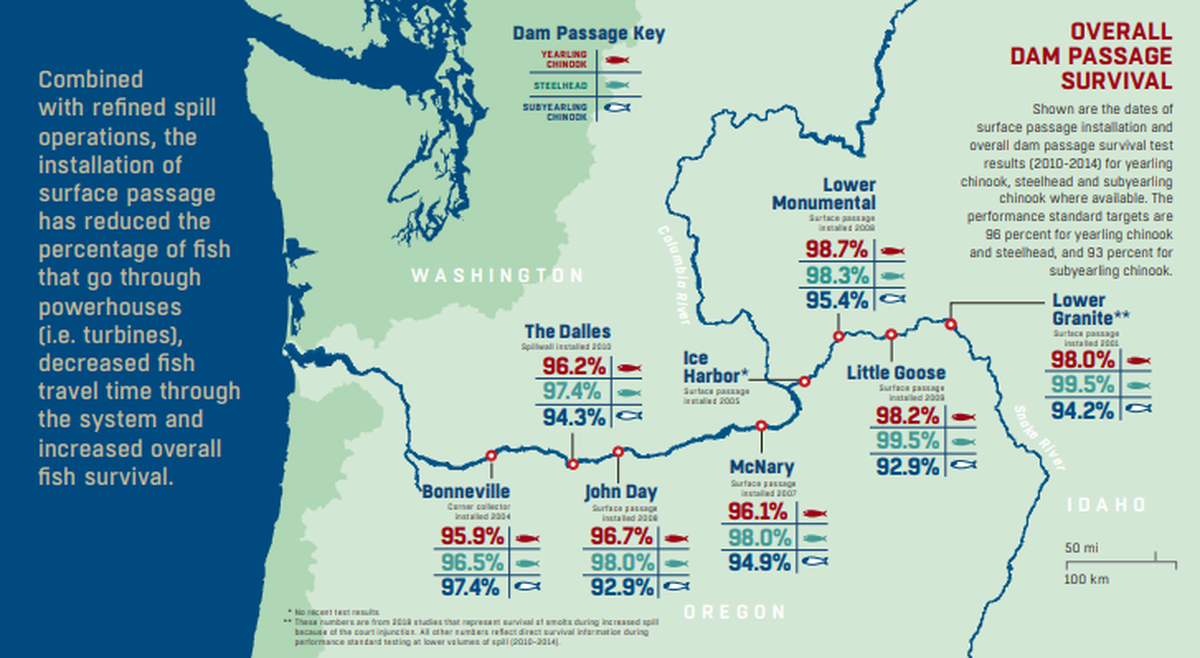
The study was ordered by U.S. Judge Michael Simon in Portland over concerns that not enough was being done to protect endangered or threatened fish species in the 14-dam Columbia River hydrosystem. The system includes the four lower Snake River dams from Ice Harbor Dam near Pasco to Lower Granite Dam north of Pomeroy.
The several-thousand-page draft study, underway for three years, concluded that the best option is to spill more water at the dam for fish passage when power generation is less valuable and spill less when power generation is more valuable. Improvements to dams to benefit fish would continue.
Environmental groups were quick to criticize the study, saying it did not go far enough to protect chinook and other endangered fish, including those that make their way into Idaho.
The draft study was done by the Army Corps of Engineers, the Bureau of Reclamation and the Bonneville Power Administration.
“Rather than seizing this opportunity to heed the public’s call for working together for a solution that revives salmon populations, the draft plan is built on the same failed approach the courts have rejected time and again,” said Todd True, an attorney for Earthjustice who has represented environmentalists and fishing groups in ongoing litigation over the dams.
Breaching the Snake River dams has been discussed for decades, but the decline of the southern resident killer whales in the Puget Sound to only 72 orca has renewed calls for removing them.
Orca feed primarily on chinook.
The construction and operation of the dams have contributed to fish declines, the draft study said.
But while the draft study looked at changes to the hydrosystem to benefit fish, it also considered the social and environmental effects of changes, such as taking out the four dams. It considered flood control, water supply, hydropower generation, fish and wildlife, navigation, cultural resources and recreation.
Spill vs. breaching Snake dams
The change in spill operations could increase power rates charged by Bonneville Power Administration, which supplies most of the electricity for the Tri-Cities area, by 2.7 percent, the draft study said.
However, breaching the lower Snake River dams could raise power costs significantly more and destabilize the power grid, it said.
The draft study estimated that adult salmon survival could see minor to major increases under the option it picked as best.
How much increasing spill could impact chinook and steelhead varied by the study models considered by the federal agencies that released the draft report.
Models that predict endangered fish survival disagree on how much various factors contribute to their decline, including deteriorating ocean conditions, the long-term affects of dam passage on fish and delays in juvenile fish reaching the ocean.
The spill changes would be evaluated to determine whether they increase adult fish.
The draft study found that the option of breaching the dams, and also increasing spill on other dams, would provide the most benefit to endangered and threatened juvenile and adult salmon, and also would provide some new recreation opportunities on the free-flowing river.
But it rejected the breaching proposal because of its impacts on shipping on the Snake River, hydropower production and irrigation, all uses authorized by Congress, it pointed out.
Breaching the dams would harm fish populations in the short term as the reservoirs are drawn down and sediment would be moved, the draft study said.
The cost of replacing the electricity production of the dams with environmentally protective, carbon-free sources could cause BPA electric rates to rise up to 50 percent, the draft study said.
Because the lower Snake River dams play an important role in maintaining a reliable power supply for the Northwest, particularly on the coldest days of the winter, removing them would double the risk of power shortage, it said.
As shipping now done on the river shifts to trucks and trains, the cost of transporting goods could increase by 10 percent to 33 percent, the study said.
Study results debated
“Salmon-dependent communities across the Pacific Northwest feel like Bill Murray in ‘Groundhog Day,’ reliving the same day over and over again,” said Wendy McDermott, director of Rivers of Puget Sound and Columbia Basin, American Rivers.
“With salmon facing extinction, isn’t it time for a new approach? We need to think bigger and more holistically. The only way forward is to focus on what connects us and commit to meeting the region’s energy, agricultural and conservation challenges together,” she said in a statement.
Quinn Read, Northwest program director for Defenders of Wildlife, said the draft impact statement “falls short.”
“The Northwest doesn’t have to choose between orcas and clean energy or between coastal fishing and inland farming; we can ensure a future for wildlife and communities by working with all stakeholders on a plan that meets everyone’s needs,” Read said. “We need members of Congress and our governors to build on the collaborative conversations ... that restore the Snake River before we lose our orcas forever.”
But the Washington Policy Center said the draft study made the right call.
“Every time the question is asked about destroying the dams, the science and economics provide the same answer,” said Todd Myers, the center’s environmental director.
The draft study showed that destroying the lower Snake River dams would have high economic costs, he said.
“Rather than spending billions to destroy the dams, and adding billions more in electricity costs for families, we should focus our resources on Puget Sound recovery, where they can make the biggest difference for salmon and orca,” he said.
Today the annual runs of salmon and steelhead average just over 2 million fish in the Columbia River system, of which 40 percent are naturally produced and the rest come from hatchery programs, the draft study said.
“Tremendous effort and billions of dollars have been invested in infrastructure, hatcheries and other project to improve passage and habitat for fish in the basin over the last 50 years,” the draft study said.
Public comment on draft study
In addition to a flexible spill operation, the preferred solution in the draft study includes measures to address blocked tributaries for bull trout due to operations at Libby Dam in Montana. It also calls for continued structural changes at dams to improve lamprey passage.
Planned improvements, such as additional fish-friendly turbines at McNary Dam on the Columbia River, would continue.
The latest look at how the Columbia River hydrosystem should be managed came after decades-long litigation regarding the effect federal dams have on salmon runs by providing physical barriers to adult salmon returning to the river to spawn and juvenile salmon migrating to the ocean.
Meetings for public comment on the report will be held in the coming weeks in several places, including Lewiston. Comments may be submitted until April 13. They may be left online at comments.crso.info or mailed to U.S. Army Corps of Engineers, Attn: CRSO EIS, P.O. Box 2870, Portland, OR 97208-2870.
A final report is expected in the summer, with the federal government making a decision on adoption of its final recommended actions in September.
This story was originally published February 28, 2020 at 2:55 PM with the headline "Stay or go? Court-ordered federal draft report weighs in on Snake River dams."