
Valley air quality has been good all spring. It can worsen because of fireworks.
As the Fourth of July sky lights up with red, blue and yellow fireworks, the Treasure Valley will be under a yellow air quality advisory.
The Idaho Department of Environmental Quality issued a yellow, or moderate, air quality advisory for Thursday and Friday because of anticipated increased smoke and particulate matter in the air from the celebrations.
The DEQ alerted local news media to the yellow air quality Wednesday afternoon — the first time in 2019 DEQ has done that. It then issued a yellow alert for Friday on Thursday afternoon. The advisory is a harbinger of summer’s pollution season that in recent years has included the Valley’s increasing episodes of wildfire smoke.
“Fireworks are explosive, and release smoke and particulates,” said Michael Toole, the Valley’s airshed coordinator for the DEQ, in a telephone interview. “The sheer amount of explosives set off during the Fourth can result in a short and sudden increase or a spike that can carry through to the next morning until the winds come through to clear it out.”
Yellow air quality days occur when the Air Quality Index surpasses 50 because of particulates in the air, ozone, carbon monoxide, sulfur dioxide or nitrogen dioxide. The Valley’s traditional primary summer smog problem has long been ground-level ozone caused by chemicals “cooking” in the sun. Index numbers below 50 are green. As smog worsens, the index colors change in 50-point increments from yellow to orange, then red, then purple, and finally maroon.
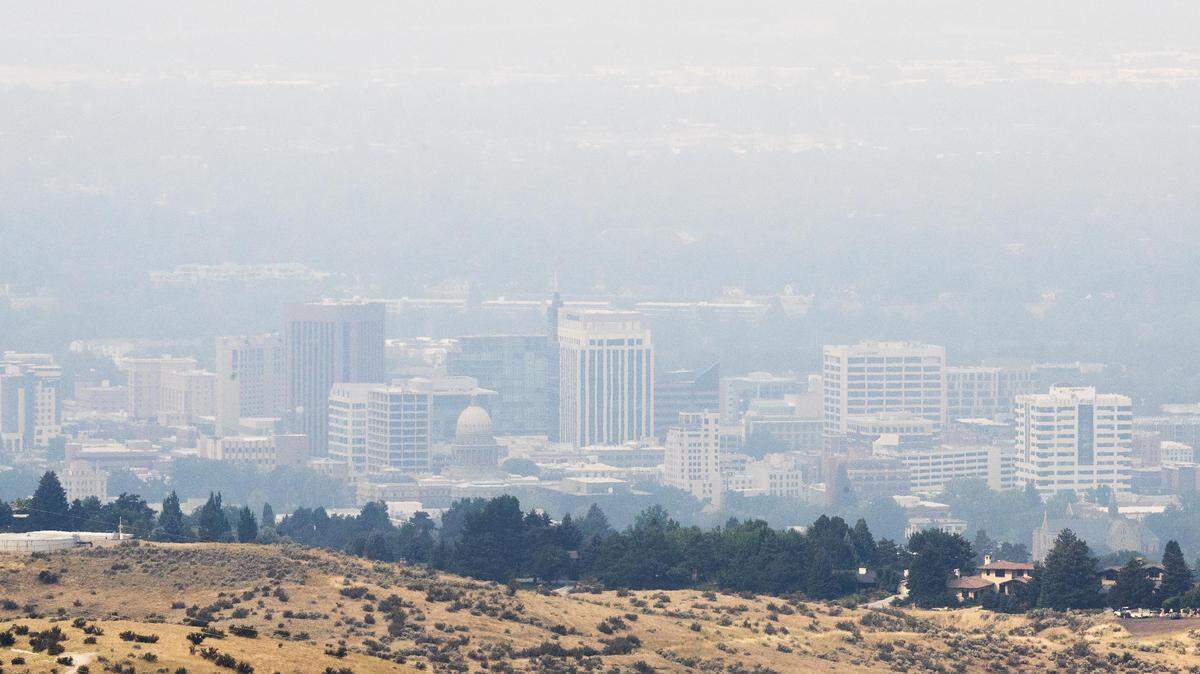
Toole said 70% of all Treasure Valley days are green and 20-25% are yellow. Five to 10% annually are orange or red. Orange days are 101-150 AQI, when the air is deemed unhealthy for sensitive groups. Red days are 151-200 AQI, deemed unhealthy for everyone. The Valley rarely gets purple days, deemed “very unhealthy,” and only when wildfire smoke is intense. (The worst category is maroon, deemed “hazardous.”)
“Air quality has been generally very green this early summer, but we usually see an increase in pollution this time of year with the Fourth and the wildfire season,” Toole said. “Green into late June and early July this year is a blessing in disguise, because we don’t know when or how the fire season will ramp up.”
Wildfires contribute to most of the bad (orange and above) air quality days in Idaho. Increasing wildfires in the Western United States have increased the number of bad air quality days in the Valley.
But there’s good news, too: Thanks in part to vehicle emission controls and inspections, all the growth we’ve experienced, and all the additional vehicles and businesses growth brings to the Valley, have not made the air worse. According to Toole, the baseline air quality excluding wildfires has remained constant for Treasure Valley over the past five or six years.
The DEQ recommends anyone that who is sensitive, including children, the elderly, and those with pre-existing conditions, take caution and check the air quality before going outdoors. Readers can check the local air quality through the Idaho Department or Air Quality or the EPA’s AirNow website or mobile app. As you celebrate the Fourth of July, consider limiting your driving, carpooling, and reducing outdoor burning.
Rachel Hager is writing for the Idaho Statesman this summer on a fellowship through the American Association for the Advancement of Science. She is a master’s student in ecology at Utah State University and earned a bachelor’s degree in biology at Bryn Mawr College.
This story was originally published July 3, 2019 at 6:20 PM.
.png)