Boise State tested Idaho’s new hiring process for presidents. It got mixed reviews
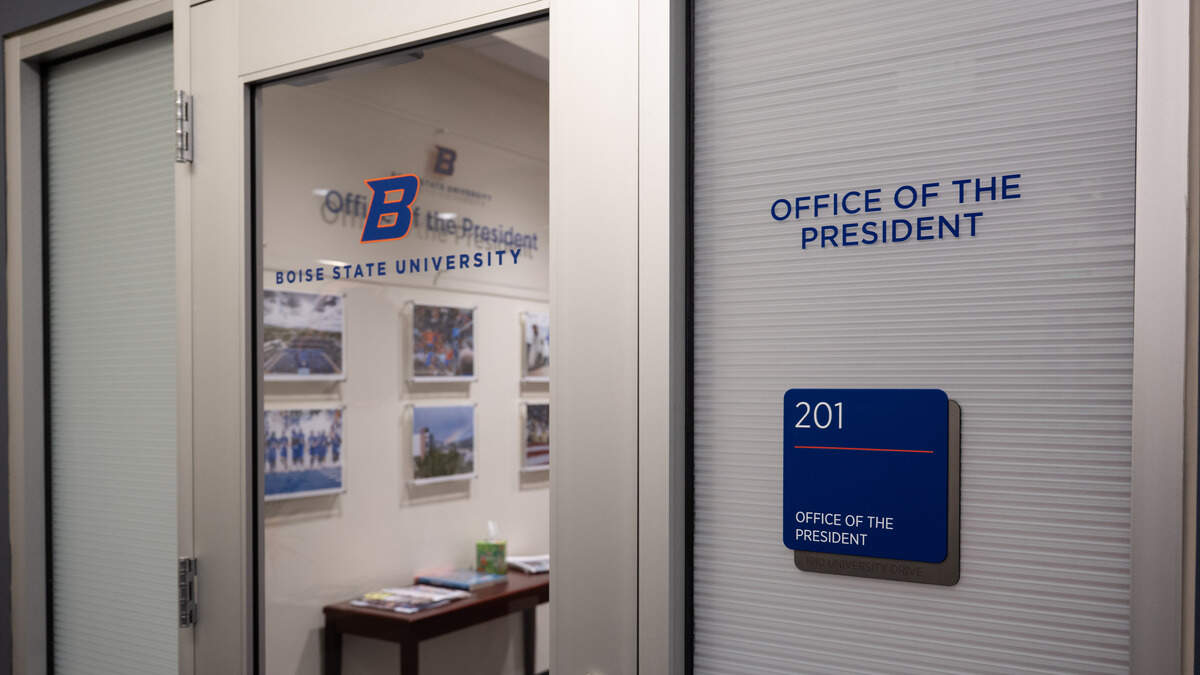
Seven years ago, the Idaho State Board of Education announced Marlene Tromp would serve as Boise State University’s new president. That day, the Idaho Statesman reported, the cheering was "akin to what one might hear when there is a game happening on the blue turf below.”
Hundreds packed into the Stueckle Sky Center cheered the board’s unanimous decision to hire Tromp, who became the university’s first female president and represented the campus through the COVID-19 pandemic, accusations of indoctrination and budget cuts.
On July 1, more than a year after Tromp accepted a job out of state, Board of Education members logged onto their laptops and appeared on Zoom to take a vote on the candidate who would come to replace Tromp. During the meeting, a handful of people looked at their laptops, with those attending in person sitting around a nearly empty oval table in the board’s conference room. After nearly 40 minutes discussing the hire behind closed doors, a board member made a motion to offer David Hahn the job.
The meeting reflected the stark difference since the Legislature passed a law in February that changed the parameters of presidential searches in Idaho, requiring the board to only disclose the name of the sole finalist instead of the top five, and to then wait 10 days before making its final decision.
Some faculty members and state officials said the change was necessary to draw high-caliber candidates and applauded the board for involving faculty and students to a greater degree than the law requires, but others in the Boise State community expressed disappointment with the overall process and what they saw as a lack of transparency and accountability to the student body.
“I think the university could have created more opportunities for the finalist to engage with a broader range of student organizations, campus departments and affinity groups,” said Marliegh Nabonne, a political science student and chair of the MLK Living Legacy Committee. “With thousands of students, faculty, and staff, the selection of a university president affects every member of the campus community.”
Hahn previously was dean of the College of Engineering at the University of Arizona. He has a doctorate in mechanical engineering from Louisiana State University and began his career as a researcher with the U.S. Food and Drug Administration Center for Devices and Radiological Health, according to his bio on the University of Arizona’s website. Before joining Arizona, Hahn worked at the University of Florida, ending his time there as the chair of mechanical and aerospace engineering.
‘The best solution for our campus community’
In the spring of 2025, Erik Hadley, the former faculty Senate president, joined the faculty subcommittee to find Boise State’s new president. The group was one of five subcommittees formed after Tromp announced she had accepted a job at the University of Vermont after nearly six years at Boise State.
The subcommittee gathered feedback from faculty, conducted forums and listening sessions and sent surveys to professors to learn about the qualities they were looking for in a new leader. They sent the feedback to the Board of Education in May of last year, expecting the board would then follow the traditional process: pick the finalists and bring them each to campus for a visit, Hadley said. But when the time came last fall, the board didn’t have five finalists willing to have their names announced publicly, Hadley told the Idaho Statesman.
The process came to a standstill.
When the presidential search resumed in March, the subcommittee started back up with similar membership, including one faculty member from each of the colleges and the vice president, president and past president of the faculty Senate.
“Where I think the greatest amount of trepidation was, is just the timing,” Hadley said, acknowledging the extended timeline was difficult. “We all knew by April, when the search recommenced, that there was no way we would get a candidate on campus before June, and that posed some concern that faculty and students would not be well represented in an on-campus interview process.”
To participate in interviews with the other top contenders, committee members were required to sign non-disclosure agreements, he said.
“I believe that through that subcommittee process we were given greater participation in the search process than the law technically required, and that’s a good thing from my perspective,” he said. The law requires only one member of the search committee to be a faculty member, but that doesn’t limit the board from engaging more faculty members in the process to get a wider array of feedback.
Faced with the choice to either resume the search and announce a finalist during the summer, while doing their best to get engagement from faculty and students, or wait until fall, Hadley said the board made the best decision. If they waited until the fall, he said: “Then you’re out another year, and that poses a lot of significant challenges as well.”
“As much as I would have liked to have done a search process when everyone was on contract,” he said, referring to faculty who typically have contracts that last through the school year and are off during the summer, “in this particular situation, I think it was probably the best solution for our campus community to move forward as we did.”
But not everyone was happy with the language of the bill.
Isaac Celedon, who served as the university’s student body president from 2024 to 2026, was selected by the board to co-chair the student subcommittee around the same time Hadley took on his position. At the time, the board also selected two other students to chair the subcommittee, a non-traditional student representative and a student-athlete, after consulting with him, he told the Statesman.
The student subcommittee operated similarly to the faculty group, gathering feedback from students — but unlike faculty, students did not have a designated seat on the main search committee.
According to the new law, the primary search committee must consist of, at minimum, two members of the Board of Education; two individuals employed by the university, one of whom is a faculty member; two alumni of the institution conducting the search; one member of the foundation; and one at-large community member.
When Celedon asked for a student representative to be included as a member of the primary search committee within the bill’s language, board members responded that “they felt students did not have the experience to fit on that committee,” he said. He added that the board communicated the stipulations should be viewed as a “floor,” meaning the primary search committee must be composed of the listed populations, but is not limited to including just them.
“I said: ‘OK, great. If it’s a floor, then we should (add the inclusion of) at least one student attending the university the search committee is being warranted from (to the bill’s language),’” he said. “I was told people had felt adding that language was unnecessary.”
During the legislative session, Celedon lobbied against the bill alongside other Idaho student governments, but decided to take a step back with concern of it becoming an “optics issue.” Instead, he elected to express his opposition “behind closed doors,” talking with legislators, members of the board and university administration.
“Being student body president of Boise State and advocating for that is tricky, because we all know Boise State is not seen in a positive light by many legislators,” he said.
While the language of the bill was not changed, students were eventually included in the interview process. Celedon’s successor and two other students represented the student voice in the closed-door interviews, he said. Celedon elected to not participate in the interview process as he had graduated and “felt (he) had done (his) job,” he said.
‘Ten days is not a lot of time to even study for a test’
Hahn was announced as the sole finalist the morning of June 16 in the Trueblood Conference Room at Boise State. In the 10 days that followed, he had meetings with faculty, donors and administrators, and held a public forum on campus where community members asked him questions on topics ranging from diversity, equity and inclusion to student engagement and the university’s future. Hundreds attended both in person and virtually.
The board solicited feedback during those 10 days via email, but it declined to provide that feedback to the Statesman. Search committee chair David Turnbull, a member of the Board of Education, said during a meeting the feedback had been overwhelmingly positive.
“When Tromp left, I was worried we were losing an advocate,” Ian X Peña, an engineering major, told the Statesman in the final days of Hahn’s 10-day review period.
Peña, who founded the Student Needs Advocacy Coalition, a student group centered on creating a platform for students to voice campus-wide concerns, sees the way the presidential search process developed as a representation of what he calls the ongoing political disconnect between the university and state Legislature.
When the search was put on pause in October after the search committee said they did not have five finalists to present to the board as previously expected, Peña said, he felt the search committee was saying the “quiet part out loud.”
“On one hand, I’m glad that they weren’t taking just anyone. On the other hand, of course they haven’t,” he said. “It’s Idaho, it’s Boise State University. No one wants to come and run this university. No one wants to be the next Marlene Tromp who has to go in front of the state Legislature every year and get chewed out.”
Desiree Brunette, a sociology instructor at Boise State, said having a sole finalist made it seem like feedback didn’t really matter. From the moment Hahn was announced, it felt like a done deal, she told the Statesman.
“The philosophy was that they could only do one finalist, because of the fact that people put their jobs in jeopardy for going public,” she said. “And so the fact that there was just one finalist in some ways, it makes sense, but in other ways it’s highly problematic.”
When Brunette first heard about the bill changing the requirements surrounding university presidential searches, she was surprised. Although she understood some of the concerns, she said it also made it feel less like a democratic process. The announcement felt “anticlimactic,” given that no one knew who else was in the running, and she said it felt like there was some general apathy around the announcement compared with 2019.
The timing made it even more challenging for the campus community to engage with the process. During the summer, students are typically off campus, and most faculty members are off contract.
“It just felt like, do faculty voices not matter? Like, who’s making the decision for us,” she said. She added: “It just feels like there’s a veil of secrecy.”
Charlotte McNeely, a political science major, told the Statesman she had mixed feelings about the decision to name only one finalist. While she understands a need for confidentiality, she said the 10-day review period did not give students enough time to meaningfully engage with the finalist.
“Ten days is not a lot of time to even study for a test,” she said.
During the 2025-26 academic year, McNeely served as senator for the School of Public Service and Senate Lead in student government. She said many students were already focused on concerns over tuition increases and the merger of the College of Education and School of Public Service, leaving the presidential search less prominent in campus conversations — especially as the process moved into summer.
“I don’t think that the majority of students are even checking their emails,” McNeely said. “People aren’t going to be looking into it or reading about the presidential search as much as they would during the school year.”
Nabonne shared a similar sentiment, saying that while she understands the need to protect candidates’ privacy during a search, “greater transparency about the process itself would have gone a long way toward building trust with the campus community.”
Students, faculty look forward to permanent leader
Still, students and faculty look forward to getting to know Boise State’s eighth president.
“I am curious and excited to see the interactions between Boise State, a new president and the legislative body of Idaho to advocate further for education in Idaho, especially for Boise State,” McNeely said. “I’m very optimistic that things could get better, especially since (Hahn) comes in with an engineering background.”
Being at a university without a president — and several other key leaders — in place has made the institution feel unstable, Brunette said. In a state where lawmakers have frequently taken aim at higher education, she said it’s important to have a leader who supports the community and can advocate for the university’s needs. The president also plays an important role in fostering a relationship with the Legislature, educating lawmakers about what universities do and protecting higher education as a place for free speech and different ideas, she said.
Hadley added that in a survey with faculty members in the spring, asking whether they had additional concerns or interests in a president since a year ago, one of the No. 1 concerns was faculty members wanting to get out of “interim status.” Faculty members said they wanted a permanent, strong leader to advocate for the university, provide a vision for Boise State and start to fill the other open positions.
Despite the twists and turns of the search, Celedon said the hard work “paid off.” The most consistent piece of feedback he heard from students in listening sessions was that they hoped for a student-centered president. The board delivered on that ask, he said.
“Overall, I’m extremely satisfied with the process, because at least I believe the board kept the promise they made to me and to the students that they would ensure this president would be student-centered. Dr. Hahn, from what I’ve seen, is,” Celedon said. “He knows what he needs to do when he comes in. There’s interim leadership, budget cuts, revenue shortfalls in the state that affect everyone, all the changes in athletics and everything in between, but I think he has the right mentality. I appreciated how much he emphasizes community above all else.”
Brunette said that she hopes Hahn is a leader who will fight for his community.
“I hope he’s a great communicator. I hope that he is engaged with faculty. I hope that he is present on campus, you know, that we feel his presence. I think that’s super important,” she said.
“And I hope that it feels like he’s a super strong advocate for the work that we do.”