Before the ‘Everyone is welcome’ sign, West Ada got complaints over ‘sexual rainbows’
Controversy over a sign in a Meridian teacher’s classroom made national news after school district administrators told her it violated the district’s policy on content-neutral classrooms. The sign displays an array of hands with different skin tones, below the words, “Everyone is welcome here.”
In an effort to explain the district’s position, Marcus Myers, chief academic officer for the West Ada School District, told host Matt Todd of the Treasure Valley’s The Ranch Podcast that the district affirmed the sign’s welcoming message but took issue with its imagery — which a district spokesperson later told the Idaho Statesman could be associated with “DEI initiatives.” DEI stands for diversity, equity and inclusion.
The sign, which has hung on Lewis and Clark Middle School teacher Sarah Inama’s classroom wall for four years, caught the eye of administrators after West Ada instructed principals across the district last month to “go out into classrooms, go out into hallways ... and just open your eyes to what’s hanging on the walls,” Myers said on the podcast.
And why the need for this “proactive” and district-wide approach? Because of previous complaints over another display altogether, Myers said. Namely, a bulletin board at Seven Oaks Elementary School in Eagle.
On Jan. 24, images of the bulletin board circulated on Instagram from an anonymous account that has since been deleted called WestAdaParents, with criticisms over the display of so-called “sexual rainbows” and hands with different skin tones.
.jpg "bulletinboard (1).jpg")
The images show the bulletin board with six posters and four flags, including three international flags alongside an American flag. One poster states “Everyone is welcome here” below a rainbow and above hands with different skin tones. Another says “Be kind,” surrounded by hands with different skins tones forming a heart. A third tells students, “In this room you belong here, you matter, you are worth it, you are important, you are loved, you have a voice, you are valued, you are respected,” with each phrase shown in a different color of the rainbow.
Two posters are of rainbows without any words — one with traditional rainbow colors and one with different shades of black, brown, and tan.
The bulletin-board materials were part of the district’s multilingual learners program, and the three international flags represented student participants’ countries of origin, according to Danae Castellaw, a Seven Oaks Elementary School parent. The flags represent Mexico, Colombia, and Tanzania. Castellaw said she saw the bulletin with one of her friends sometime around Jan. 23 and estimates that it had been up for only a day or two before the social media posts started coming in.
“We happened to see it, and we were both surprised and gladly surprised,” Castellaw told the Statesman by phone. “We were like, ‘Wow, that’s really nice to see’ ... And what do you know? Like, it was either the next day or the day after that, is when that Instagram account posted about it.”
Social media posts criticize ‘sexual rainbows’
Images circulated on Instagram labeled the rainbows as “sexual” and criticized the display for making kids feel “excluded” and for exposing them to “LGBTQ propaganda at elementary school.”
“These are clearly sexual rainbows, since they don’t have the right amount of colors as an actual rainbow,” one of the posts said. According to the Human Rights Campaign, a rainbow flag using six colors of the rainbow — red, orange, yellow, green, blue and purple — is one of the most common flags representing LGBTQ+ pride. Rainbows displayed on the bulletin at Seven Oaks have different numbers and shades of colors.
The representation of different skin tones would actually make students “question ‘Why wouldn’t I be welcome?’” one of the posts said.
“It sounded very aggressive,” said Christina Patterson, a Seven Oaks parent and volunteer.
Patterson told the Statesman that the tone of the posts — which called on parents to “speak up” to the school district and implored those responsible for the display to “leave our kids alone” — made her and other members of the Seven Oaks community feel frightened.
Fear turned to confusion when the school district began to respond online to the posts on a Friday afternoon, the parent said.
“The board will be removed tomorrow as it is a violation of policy 401.20,” the district responded to the account, according to one screenshot. “Thank you for the information.”
The district’s official account also commented on one of the posts stating, “Policy 401.20 is not about exclusion but rather about ensuring that no group or individual is left out.”
The district policy determines what items teachers can and cannot display in their classrooms. In 2022, the school board adopted changes that added language requiring displays to be “content neutral and conducive to a positive learning environment,” the Statesman previously reported.
Patterson said she’s been a part of West Ada for 25 years, and she’s “never seen West Ada engage in social media like that.”
On Monday morning, Patterson said, she went to drop her child off at school and saw that the entire bulletin board had been taken down and replaced with other posters.
By Tuesday, Patterson observed that a “handful” of other rainbow posters had been taken down from different spots in the school hallways. They included a several-feet-long sign advertising a student walking club, with no particular message of inclusivity.
“It’s an elementary school,” Patterson said. “Everything is rainbow.”
Castellaw told the Statesman that teachers in the school were instructed to remove rainbow signs from their classrooms as well, according to a teacher who she said was “afraid” to provide her name.
Decision to remove board made over weekend
Patterson said she was concerned by what felt like a “lack of transparency” about how the decision to remove the posters was made over the weekend and in response to a post from an account with no identifying information.
“The fact that there was just this knee-jerk reaction and not some sort of dialogue is super-concerning,” Patterson said.
Patterson reached out to Seven Oaks Principal Allie Jacobs and Dave Binetti, the school board trustee representing the area where Seven Oaks is located, to learn more.
Binetti told her the sign violated district policy on neutral classrooms — the same policy that Inama’s “Everyone is welcome here” poster was found to violate.
%20(1).jpg "IMG_6875 (1) (1).jpg")
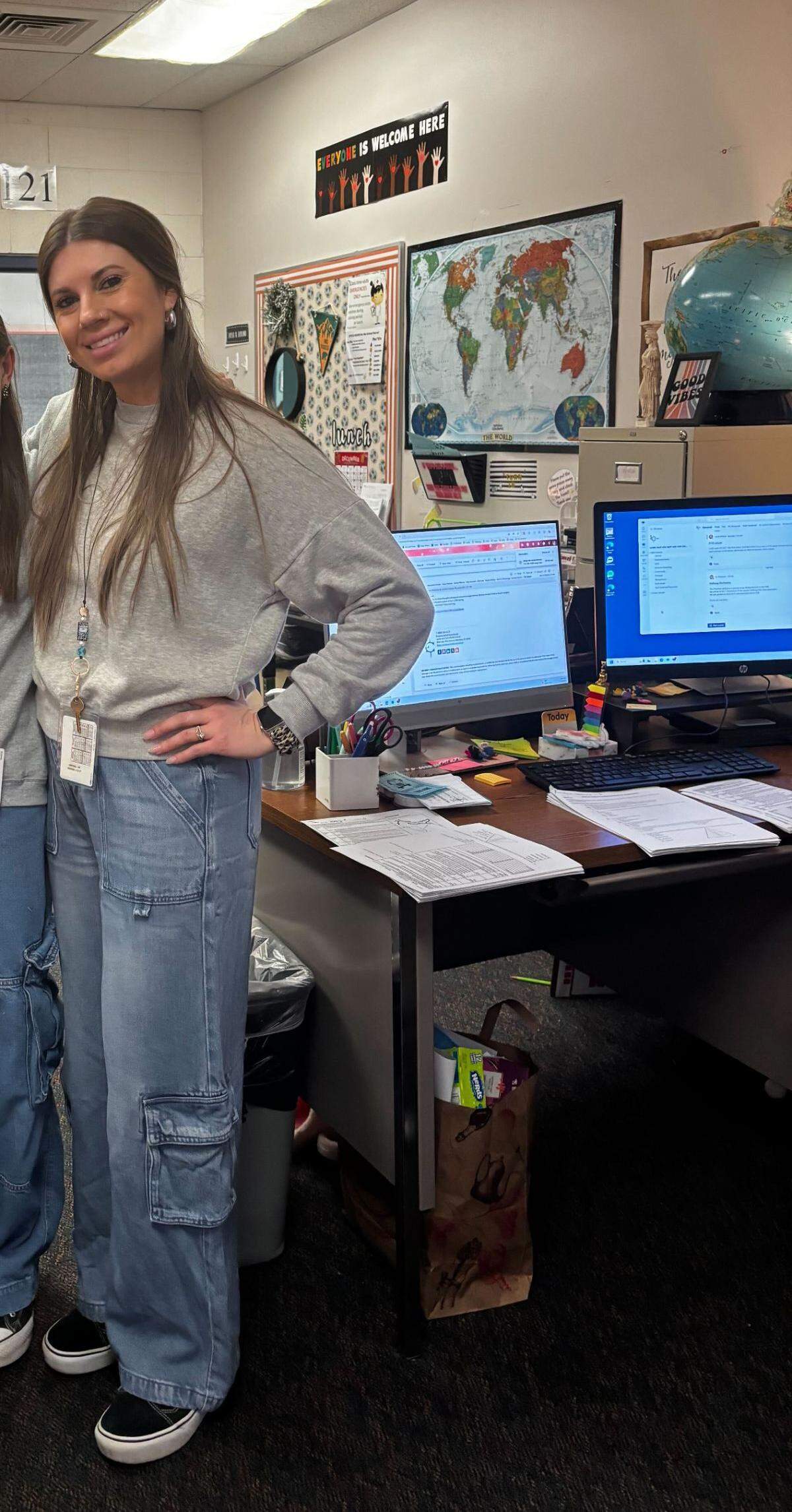
The policy “is designed to promote a distraction-free environment so that we can focus on education,” Binetti said in an email. “This was a distraction. And I know it was a distraction because we were all being distracted by it.”
“The environment is now free from that distraction,” Binetti said. The policy, he said, “worked as designed.”
Patterson pushed back, saying that the district’s actions caused the distraction, rather than the bulletin board itself. She was instructed to file a patron grievance, as Binetti said the individual upset about the bulletin board had.
But a district response to another parent’s public-records request that Patterson shared with the Statesman revealed that no such formal complaint had been filed.
“The building and the Board of Trustees never received a formal written grievance from a patron,” wrote Niki Scheppers, chief of staff and communications for the school district.
“My understanding is that a patron voiced a concern to Trustee Binetti regarding the bulletin board,” Scheppers wrote in an email to the parent. “In response, he directed them back to the building administrator to discuss the issue.”
Scheppers went on to say that the decision to remove the bulletin board was in response to a parent’s complaint to the building administration on Friday, Jan. 24, not to the social media post. “The principal communicated to the District that she was addressed by a Seven Oaks parent on Friday after school,” Scheppers wrote.
District policy on patron grievances
West Ada’s patron grievance policy specifies how patrons can make complaints over curriculum, instruction, disciplinary issues or district policy, and lays out the process by which the district can respond.
“The Board believes complaints and grievances are best settled as close to their origin as possible, and staff should be given every opportunity to consider the issues and attempt to resolve the problem prior to the involvement of the Board,” the policy states.
In the policy’s tiered approach, complaints should first be brought to a specific teacher or staff member. Complaints at this “Level 1” are considered “informal,” the policy states. If the issue is not resolved, the complaint can move on to “Level 2,” through a written grievance to a principal or supervisor.
According to emails between Patterson and Binetti, the individual concerned about the bulletin board was instructed to go through the “Level 2” channel — namely, to reach out to the building administrator, in this case, Principal Allie Jacobs.
“Upon receipt of the written complaint, the Principal/Supervisor shall first determine that the complaint meets the criteria of the grievance definition in this policy and that such has been filed in a timely manner,” the policy states. “If the Principal/Supervisor determines the complaint meets the criteria and is timely, the process shall move forward.”
The policy states that a written complaint submitted at “Level 2” must include specific information about what law or district policy has allegedly been violated, efforts made to resolve the matter at “Level 1,” and requested action.
While no written grievance was filed, Scheppers told the Statesman in an email that concerns over the bulletin board had been “formally communicated to school administration” on a Friday afternoon — before any social media post, she said.
“In response, the school’s administrator made the decision to remove the bulletin board over the weekend,” Scheppers said.
Scheppers clarified that “the district takes all concerns seriously, regardless of the format in which they are received.”
“Whether a complaint is verbal, written, or submitted through other means, administrators are committed to addressing them promptly and appropriately,” Scheppers said.
Scheppers did not respond to follow-up questions from the Statesman asking if the decision was made solely by the Seven Oaks principal or if district officials were involved. She also did not respond to a follow-up question asking why was action taken at a “Level 2” without any written grievance being filed.
The principal’s account of events was slightly different. Rather than referencing any formal communication from a patron, Jacobs told the Statesman, “It was brought to my attention that there were posts on social media regarding the bulletin board.
“I then contacted West Ada district administration for guidance,” Jacobs said in an email to the Statesman. The district’s “direction was that this display was in violation of policy 401.20, and as a result, the bulletin board was taken down,” she said.
Seven Oaks parents ‘heartbroken’
Five Seven Oaks parents reached out to the Statesman to express disappointment with the removal of the bulletin board.
“It’s just unacceptable that we’re erasing these symbols of love and acceptance because of pressure from this small, loud minority,” Castellow told the Statesman by phone. “I’m just heartbroken, and I’m outraged and disgusted.”
“I think people assume that this was just an isolated incident,” said Myesha Tegen, another Seven Oaks parent. “That this was just one teacher who happened to have one poster in one school, and it really didn’t start that way.”
“What began as a single act of intimidation has turned into a district-wide silencing of LGBTQ+ and non-white representation,” Tegen said in an email to the Statesman.
Tegen, who is a person of color and mother of biracial children, said she believes the district’s immediate compliance with complaints like the anonymous social media post sends a “chilling” message to her and others in West Ada, especially those who are not straight or white.
She said that taking down the bulletin board — and other rainbows throughout the school — signals to the individual or individuals who posted “that their tactics work ... That their intolerance should be accommodated.”
“I’ve spent the last month feeling fearful and heartbroken. I’ve questioned whether my children are truly safe. Whether I am,” she said.
Tegen said she wants to see the district “make clear that inclusion is not a threat, and representation is not a controversy.”
Shortly after the bulletin board was taken down, West Ada administrators instructed principals across the district to look for signs that might also be considered “controversial.” That’s when they identified another sign they took issue with: Inama’s “Everyone is welcome here” poster. Despite an outcry of support for Inama, the district has stood firm that that sign violates West Ada policy.
This story was originally published March 25, 2025 at 10:17 AM.