Idaho’s sand dunes are a lot like Mars. Here’s how scientists simulated a space mission
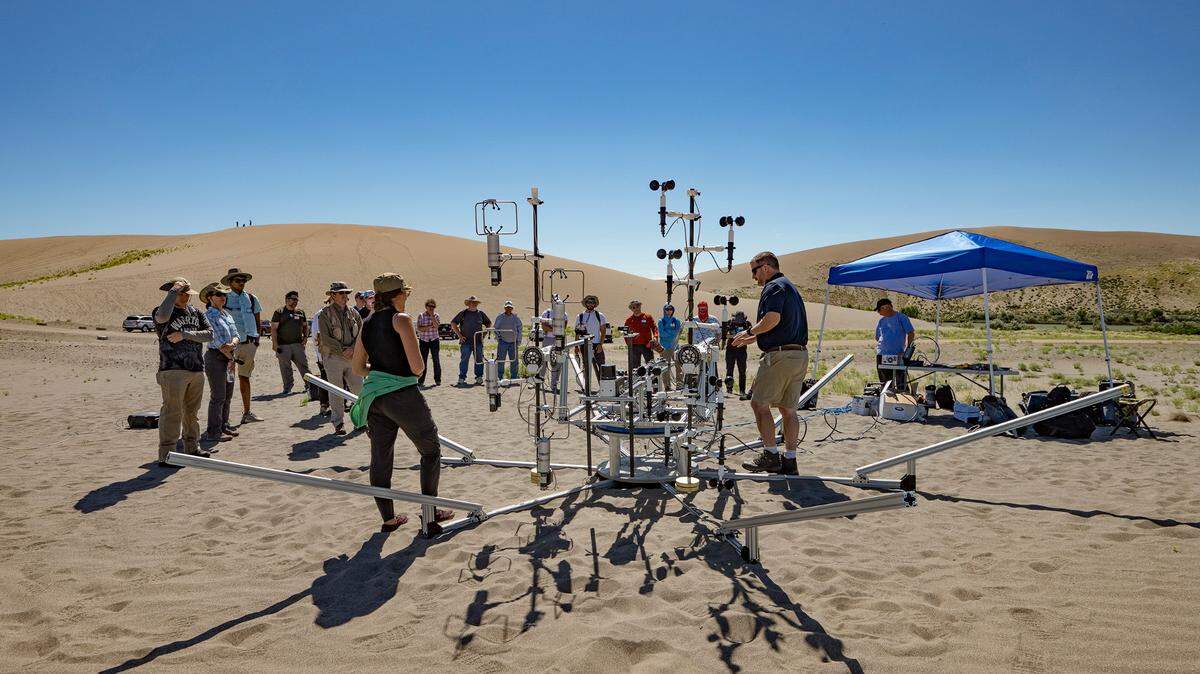
For space scientists, Idaho’s majestic sand dunes are a window to Mars.
Planetary researchers from across the country traveled to Idaho’s Bruneau Sand Dunes State Park last month to plan future outer space missions. The goal was to use the park as a replicate of other parts of the solar system and design a cost-efficient Mars lander — a spacecraft that rests on a celestial body and sends data to Earth.
The workshop brought together researchers from Boise State University and organizations such as the Jet Propulsion Laboratory, Southwest Research Institute, U.S. Geological Survey, and U.S. Naval Laboratory.
Bruneau is an analogue field site, Alejandro Soto, a planetary scientist at the Southwest Research Institute in Texas, told the Idaho Statesman. It’s not the same as standing on Mars or Saturn’s moon Titan — where we can’t breathe — but it’s similar to those places in the solar system.
“Although I wish I had actual teleporting capabilities, it’s the closest I get to — at least within the constraints of technologies that exist — to sort of teleporting somewhere else,” Soto said.
Sand dunes exist on Mars, Titan, and potentially even Pluto and Venus, Soto said.
Bruneau’s sand is unconsolidated, which means the wind can blow it around readily and form dunes, Christy Swann, a researcher at the U.S. Naval Research Laboratory in Washington D.C., told the Statesman. This makes Bruneau similar to Mars, where there’s no vegetation to keep sediment in place.
Making Martian measurements on Earth
Swann, who has extensive experience developing instruments and conducting fieldwork on Earth, led the trip.
“Sending something to Mars is like the most difficult, most expensive, hardest field experiment ever,” Swann said.
Out in the dunes, Swann set up a mock-up of a Mars lander with instruments on it, leading a discussion on how to use these tools to best measure interactions between the surface and atmosphere on planetary bodies.
These interactions — like blowing winds, moving sand and dust, and changing water vapor — have been the dominant forces on planetary surfaces for millions and billions of years, Serina Diniega, a planetary scientist at the Jet Propulsion Laboratory in California, told the Statesman. Understanding them is the key to interpreting present-day information about celestial bodies.
The attendees mulled over considerations that included the size and structure of instruments on spacecraft, as well as desired landing areas.
“When it comes to Mars, the No. 1 question is life,” Swann said.
Scientists often aim to send landers to locations that may reveal organic material or any kinds of life, which is usually in old lake beds — where the Perseverance rover currently is, Swann said. These locations can indicate things like flowing water, which can lead to life.
But for this workshop, scientists were particularly interested in dusty landing spots. A spot with unconsolidated sand and without big rocks is more conducive to a dust storm. Researchers want to study those storms, Swann said. That makes Bruneau an ideal testing ground.
Hope for a space mission in the next decade
Opportunities for spacecraft travel are costly and limited, Diniega said. But advancements in planetary technology have made small, focused missions more economically feasible. Small missions can address valuable scientific questions, and missions to the moon or Mars have lots of commercial interest, Diniega added.
And with new propulsion systems that reduce launch costs, small spacecraft could venture even further into space — beyond the low-Earth orbit, to the moon or Mars.
The next step forward is to propose a space mission to NASA, hopefully within the next decade, Soto said.
Once researchers send out a spacecraft, they can no longer fix it — making the scientists’ planning all the more important. “There’s no repair truck that can go out and get it,” Diniega said.
The National Academy of Sciences released new guidance on priorities for space exploration in the next decade, Soto said. The guidance proposes that larger missions, called New Frontiers, would go next, followed by smaller-scale Discovery missions, like the ones the researchers hope to do, he added.
It will likely take a year or two to see how NASA plans things out, Soto said, and he hopes that there will be two or three opportunities to propose missions in the next decade.
“But this is the part of the exploration that we don’t control. This comes down to NASA priorities, Congress’ budgeting priorities, and the wills of the American people,” Soto said.
This story was originally published July 19, 2022 at 4:00 AM.